

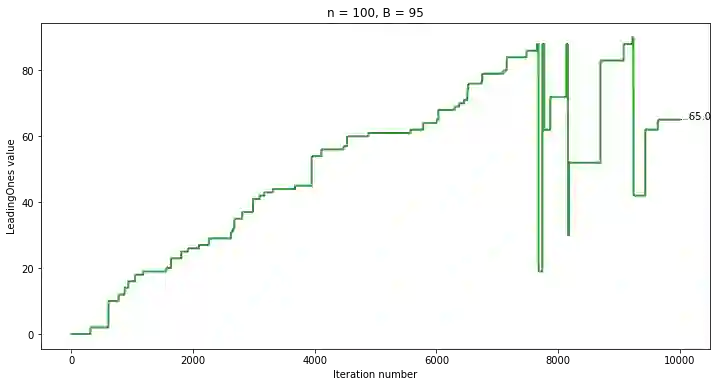
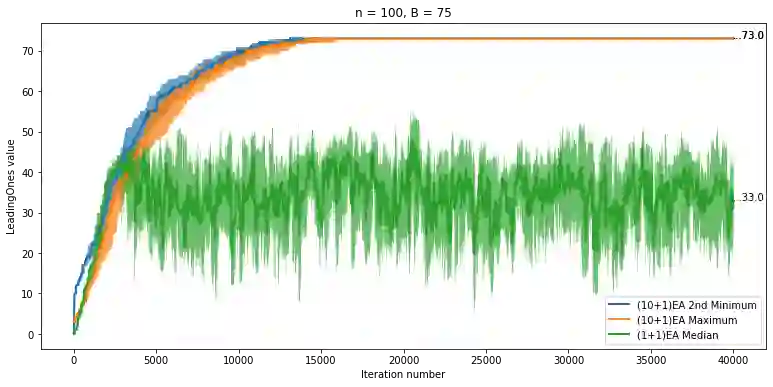
Understanding how evolutionary algorithms perform on constrained problems has gained increasing attention in recent years. In this paper, we study how evolutionary algorithms optimize constrained versions of the classical LeadingOnes problem. We first provide a run time analysis for the classical (1+1) EA on the LeadingOnes problem with a deterministic cardinality constraint, giving $\Theta(n (n-B)\log(B) + n^2)$ as the tight bound. Our results show that the behaviour of the algorithm is highly dependent on the constraint bound of the uniform constraint. Afterwards, we consider the problem in the context of stochastic constraints and provide insights using experimental studies on how the ($\mu$+1) EA is able to deal with these constraints in a sampling-based setting.
翻译:近年来,理解进化算法在约束问题上的表现日益受到关注。本文研究了进化算法如何优化经典LeadingOnes问题的约束版本。我们首先对带有确定性基数约束的LeadingOnes问题进行(1+1)进化算法的运行时间分析,给出了紧界$\Theta(n (n-B)\log(B) + n^2)$。结果表明,算法行为高度依赖于均匀约束的约束边界。随后,我们考虑随机约束下的问题,并通过实验研究分析($\mu$+1)进化算法如何在基于采样的设置中处理这些约束,从而获得启发性见解。







相关内容


 微信扫码咨询专知VIP会员