

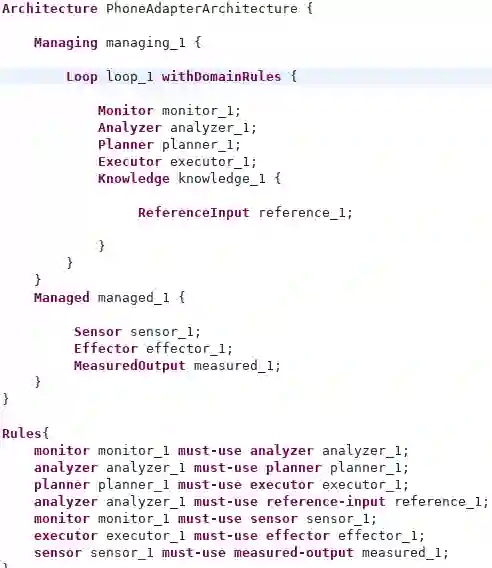
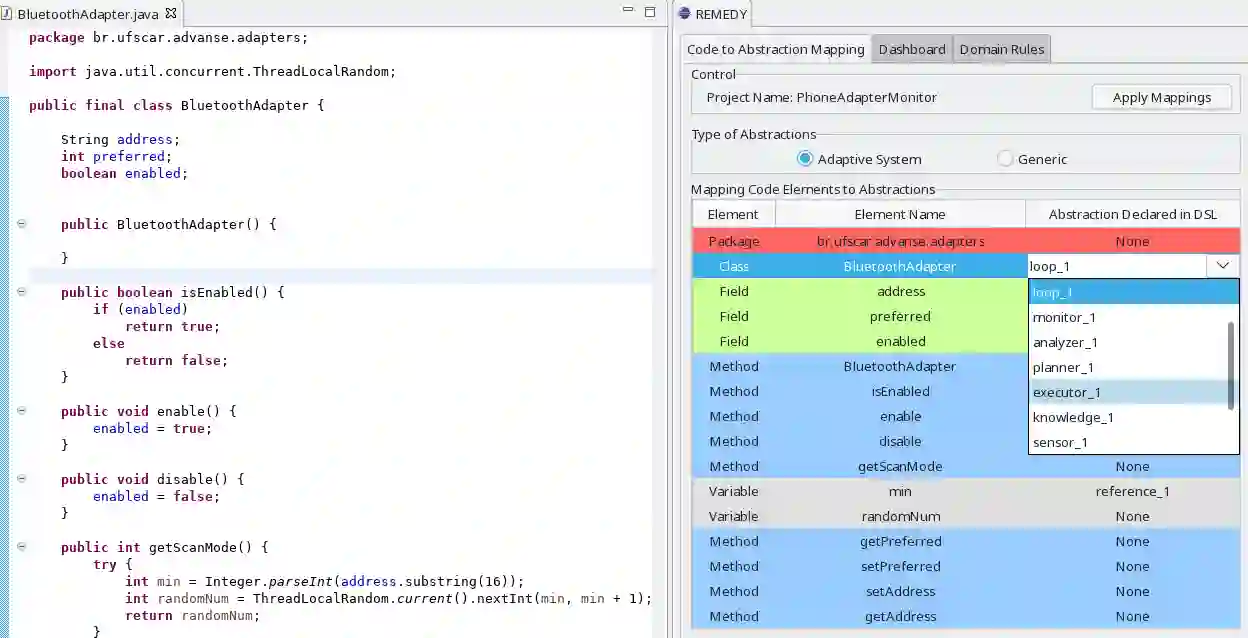
Adaptive Systems (ASs) are capable to monitor their behavior and make adjustments when quality goals are not achieved through the MAPE-K, a widely recognized reference model that offers abstractions for designing ASs. By making these abstractions evident in the system structure, numerous benefits emerge, particularly in terms of enhancing the architecture's maintenance and comprehensibility. However, it is observed that many existing ASs are not designed in accordance with MAPE-K, causing these abstractions to remain hidden in their architecture. To address this issue, Architectural Conformance Checking (ACC) emerges as a valuable technique for verifying whether the current architecture (CA) of a system adheres to the rules prescribed by the planned architecture (PA) or a reference model, such as MAPE-K. In this paper, we present REMEDY, a domain-specific approach that encompasses the specification of the planned adaptive architecture based on the MAPE-K reference model, the recovery of the current adaptive architecture, the conformance checking process, and architecture visualizations. Furthermore, our approach is specifically tailored for ASs, incorporating well-known rules from the MAPE-K model. The evaluation of the REMEDY DSL involves a comparison with a general-purpose DSL, and the results demonstrate improvements in productivity. REMEDY facilitates the identification and correction of architectural non-conformance issues, thereby enhancing the overall quality of adaptive systems.
翻译:自适应系统(ASs)能够监控自身行为,并在未达到质量目标时通过MAPE-K这一广泛认可的参考模型进行调整,该模型为ASs设计提供了抽象机制。通过使这些抽象在系统结构中显式化,可带来诸多优势,尤其是在提升架构的可维护性与可理解性方面。然而,现有许多ASs在设计时并未遵循MAPE-K模型,导致这些抽象仍隐藏在其架构中。为解决此问题,架构一致性检测(ACC)作为一种重要技术被提出,用于验证系统当前架构(CA)是否符合规划架构(PA)或参考模型(如MAPE-K)所规定的规则。本文提出REMEDY这一领域特定方法,涵盖基于MAPE-K参考模型的规划自适应架构规约、当前自适应架构恢复、一致性检测过程及架构可视化。此外,该方法专为ASs定制,融合了MAPE-K模型的经典规则。通过将REMEDY领域特定语言与通用领域特定语言进行对比评估,结果表明其在生产率方面具有显著提升。REMEDY有助于识别并纠正架构非一致性问题,从而全面提升自适应系统质量。




相关内容





 微信扫码咨询专知VIP会员