

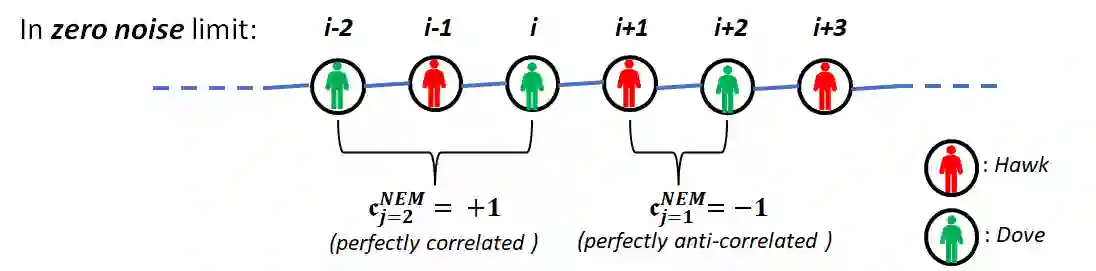
Analytically, finding the origins of cooperative behavior in infinite-player games is an exciting topic of current interest. Previously, cooperative behavior has been studied by considering game magnetization and individual player's average payoff as indicators. This paper shows that game susceptibility, correlation, and payoff capacity can aid in understanding cooperative behavior in social dilemmas in the thermodynamic limit. In this paper, we compare three analytical methods, i.e., Nash equilibrium mapping (NEM), Darwinian selection (DS), and Aggregate selection (AS), with a numerical-based method (ABM) via the game susceptibility, correlation, and payoff capacity as indicators of cooperative behavior. AS and DS fail compared to NEM and ABM by giving incorrect results for the indicators in question. The results obtained via NEM and ABM are in good agreement for all three indicators in question, for both Hawk-Dove and the Public goods games. After comparing the results obtained for all five indicators, we see that individual players' average payoff and payoff capacity are the best indicators to study cooperative behavior among players in the thermodynamic limit. This paper finds that NEM and ABM, along with the selected indicators, offer valuable insights into cooperative behavior in infinite-player games, contributing to understanding social dilemmas in the thermodynamic limit.
翻译:从解析角度研究无限玩家博弈中合作行为的起源是当前备受关注的课题。过去的研究通常以博弈磁化强度与个体玩家平均收益作为合作行为的指标。本文证明,博弈敏感性、相关性及收益能力能够帮助理解热力学极限下社会困境中的合作行为。我们通过这三种指标,比较了纳什均衡映射(NEM)、达尔文选择(DS)与聚合选择(AS)三种解析方法,以及基于数值的个体基模型(ABM)方法。结果表明,DS与AS方法在相关指标上给出错误结果,表现不及NEM与ABM;而NEM与ABM在鹰鸽博弈与公共物品博弈中,针对所有三种指标均获得高度一致的结果。综合五种指标的比较发现,个体玩家平均收益与收益能力是研究热力学极限下玩家间合作行为的最佳指标。本文证实,NEM与ABM方法结合所选指标,为无限玩家博弈中的合作行为提供了重要见解,有助于理解热力学极限下的社会困境。




相关内容




 微信扫码咨询专知VIP会员