

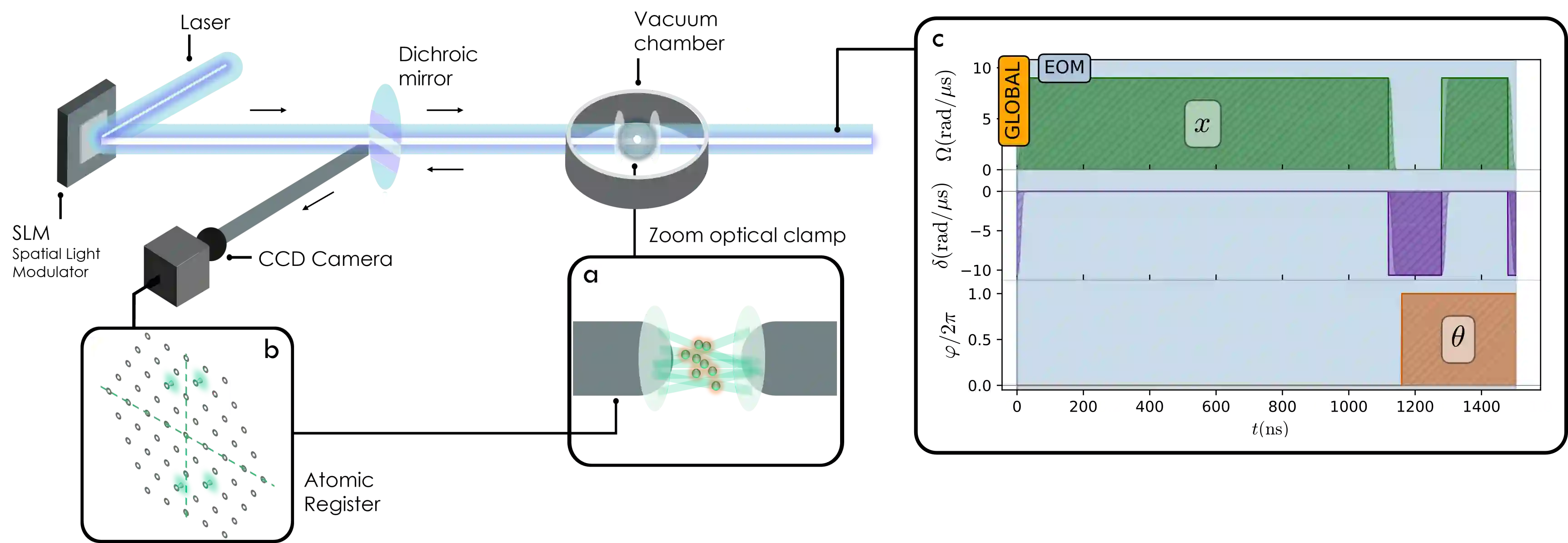
Solving and optimizing differential equations (DEs) is ubiquitous in both engineering and fundamental science. The promise of quantum architectures to accelerate scientific computing thus naturally involved interest towards how efficiently quantum algorithms can solve DEs. Differentiable quantum circuits (DQC) offer a viable route to compute DE solutions using a variational approach amenable to existing quantum computers, by producing a machine-learnable surrogate of the solution. Quantum extremal learning (QEL) complements such approach by finding extreme points in the output of learnable models of unknown (implicit) functions, offering a powerful tool to bypass a full DE solution, in cases where the crux consists in retrieving solution extrema. In this work, we provide the results from the first experimental demonstration of both DQC and QEL, displaying their performance on a synthetic usecase. Whilst both DQC and QEL are expected to require digital quantum hardware, we successfully challenge this assumption by running a closed-loop instance on a commercial analog quantum computer, based upon neutral atom technology.
翻译:微分方程(DEs)的求解与优化在工程学和基础科学中无处不在。量子架构有望加速科学计算,这自然引发了人们对量子算法求解微分方程效率的关注。可微量子电路(DQC)通过生成一个可机器学习的解替代模型,提供了一种利用适用于现有量子计算机的变分方法来计算微分方程解的可行途径。量子极值学习(QEL)则通过寻找未知(隐式)函数可学习模型输出中的极值点,对此方法进行了补充,在问题的核心在于获取解极值的情况下,它提供了一种强大的工具来绕过完整的微分方程求解。在本工作中,我们首次提供了DQC和QEL的实验演示结果,并展示了它们在一个合成用例上的性能。尽管DQC和QEL通常被认为需要数字量子硬件,但我们通过在基于中性原子技术的商用模拟量子计算机上运行一个闭环实例,成功挑战了这一假设。




相关内容




 微信扫码咨询专知VIP会员