

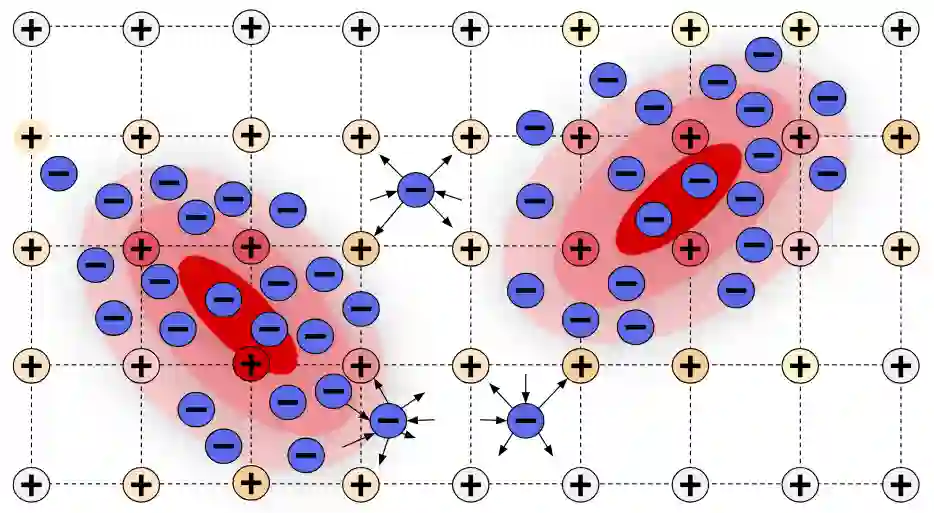
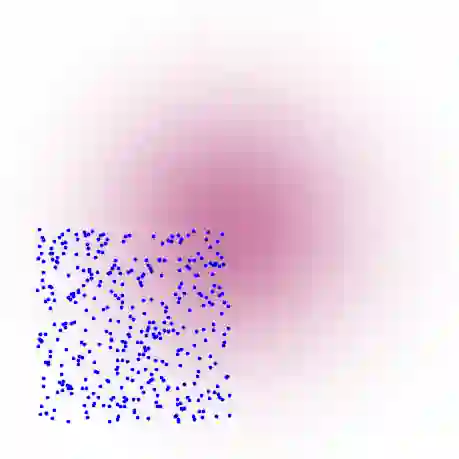
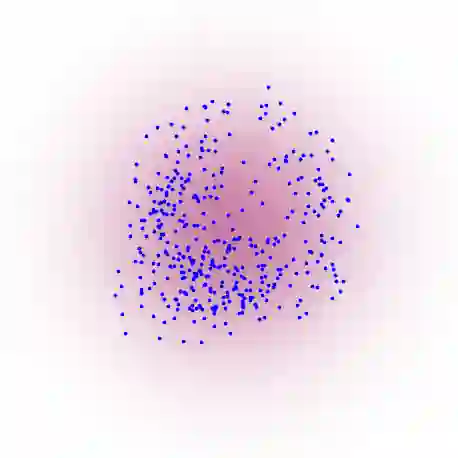
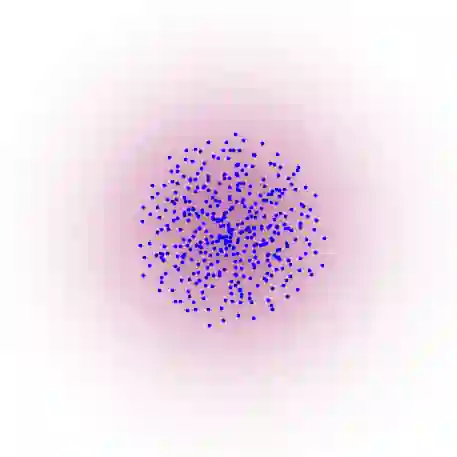
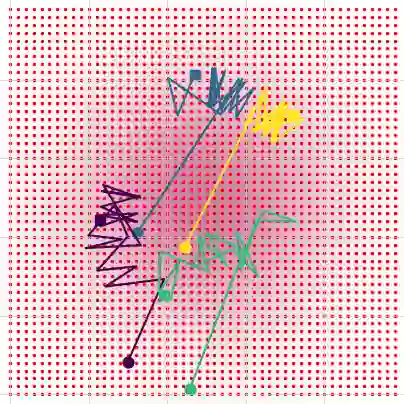
A new particle-based sampling and approximate inference method, based on electrostatics and Newton mechanics principles, is introduced with theoretical ground, algorithm design and experimental validation. This method simulates an interacting particle system (IPS) where particles, i.e. the freely-moving negative charges and spatially-fixed positive charges with magnitudes proportional to the target distribution, interact with each other via attraction and repulsion induced by the resulting electric fields described by Poisson's equation. The IPS evolves towards a steady-state where the distribution of negative charges conforms to the target distribution. This physics-inspired method offers deterministic, gradient-free sampling and inference, achieving comparable performance as other particle-based and MCMC methods in benchmark tasks of inferring complex densities, Bayesian logistic regression and dynamical system identification. A discrete-time, discrete-space algorithmic design, readily extendable to continuous time and space, is provided for usage in more general inference problems occurring in probabilistic machine learning scenarios such as Bayesian inference, generative modelling, and beyond.
翻译:本文提出了一种基于静电学与牛顿力学原理的新型粒子采样与近似推断方法,并提供了理论依据、算法设计与实验验证。该方法模拟了一个相互作用的粒子系统,其中粒子(即可自由移动的负电荷与空间位置固定的正电荷,其电荷量大小与目标分布成正比)通过泊松方程描述的电场产生的吸引与排斥作用相互影响。该粒子系统将演化至稳态,此时负电荷的分布与目标分布一致。这种受物理学启发的方 法提供了确定性的、无梯度的采样与推断能力,在推断复杂密度函数、贝叶斯逻辑回归以及动态系统辨识等基准任务中,取得了与其他基于粒子的方法及MCMC方法相当的性能。本文还提出了一种离散时间、离散空间的算法设计(可轻松扩展至连续时间与连续空间),适用于概率机器学习场景中出现的更一般推断问题,如贝叶斯推断、生成建模及其他相关领域。




相关内容




 微信扫码咨询专知VIP会员