

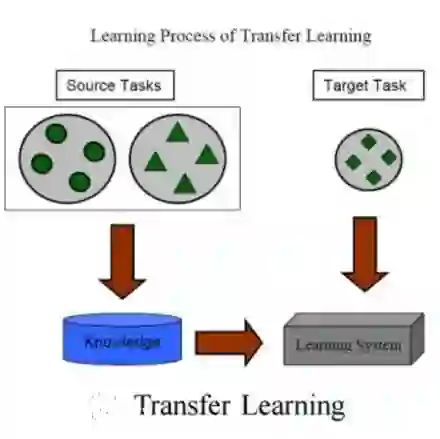
In the smart grid of the future, accurate load forecasts on the level of individual clients can help to balance supply and demand locally and to prevent grid outages. While the number of monitored clients will increase with the ongoing smart meter rollout, the amount of data per client will always be limited. We evaluate whether a Transformer load forecasting model benefits from a transfer learning strategy, where a global univariate model is trained on the load time series from multiple clients. In experiments with two datasets containing load time series from several hundred clients, we find that the global training strategy is superior to the multivariate and local training strategies used in related work. On average, the global training strategy results in 21.8% and 12.8% lower forecasting errors than the two other strategies, measured across forecasting horizons from one day to one month into the future. A comparison to linear models, multi-layer perceptrons and LSTMs shows that Transformers are effective for load forecasting when they are trained with the global training strategy.
翻译:在未来的智能电网中,针对单个客户级别的准确负荷预测有助于实现本地供需平衡并防止电网中断。随着智能电表的持续推广,受监测客户数量将增加,但每个客户的数据量始终有限。我们评估了Transformer负荷预测模型是否受益于迁移学习策略——该策略基于多客户负荷时间序列训练全局单变量模型。在包含数百个客户负荷时间序列的两个数据集实验中,我们发现全局训练策略优于相关工作中使用的多变量和局部训练策略。以未来一天至一个月的预测时间范围衡量,全局训练策略的平均预测误差比另外两种策略分别低21.8%和12.8%。与线性模型、多层感知机和LSTM的对比表明,采用全局训练策略时,Transformer在负荷预测中具有显著效果。




相关内容


 微信扫码咨询专知VIP会员