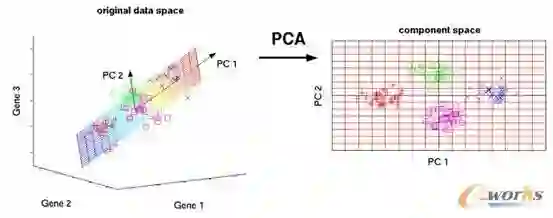
Factor models have been widely used in economics and finance. However, the heavy-tailed nature of macroeconomic and financial data is often neglected in the existing literature. To address this issue and achieve robustness, we propose an approach to estimate factor loadings and scores by minimizing the Huber loss function, which is motivated by the equivalence of conventional Principal Component Analysis (PCA) and the constrained least squares method in the factor model. We provide two algorithms that use different penalty forms. The first algorithm, which we refer to as Huber PCA, minimizes the $\ell_2$-norm-type Huber loss and performs PCA on the weighted sample covariance matrix. The second algorithm involves an element-wise type Huber loss minimization, which can be solved by an iterative Huber regression algorithm. Our study examines the theoretical minimizer of the element-wise Huber loss function and demonstrates that it has the same convergence rate as conventional PCA when the idiosyncratic errors have bounded second moments. We also derive their asymptotic distributions under mild conditions. Moreover, we suggest a consistent model selection criterion that relies on rank minimization to estimate the number of factors robustly. We showcase the benefits of Huber PCA through extensive numerical experiments and a real financial portfolio selection example. An R package named ``HDRFA" has been developed to implement the proposed robust factor analysis.


翻译:因子模型在经济学和金融学中得到了广泛应用。然而,现有文献往往忽略了宏观经济与金融数据的重尾特征。为解决此问题并实现稳健性,我们提出了一种通过最小化Huber损失函数来估计因子载荷与得分的方法,这一方法源于传统主成分分析(PCA)与因子模型中约束最小二乘法的等价性。我们提供了两种采用不同惩罚形式的算法。第一种算法称为Huber PCA,通过最小化ℓ₂范数型Huber损失并对加权样本协方差矩阵执行PCA实现;第二种算法涉及逐元素型Huber损失最小化,可通过迭代Huber回归算法求解。我们研究了逐元素型Huber损失函数的理论最小化器,证明当特质误差具有有界二阶矩时,其收敛速率与传统PCA相同,并在温和条件下推导了其渐近分布。此外,我们提出了一种基于秩最小化的一致模型选择准则,以稳健地估计因子数量。通过大量数值实验及一个真实的金融投资组合选择实例,我们展示了Huber PCA的优势。本研究开发了R包"HDRFA"用于实现所提出的稳健因子分析。


0
下载
关闭预览

相关内容

【干货书】凸随机优化,320页pdf
专知会员服务
93+阅读 · 2022年9月16日
不可错过!《机器学习100讲》课程,UBC Mark Schmidt讲授
专知会员服务
76+阅读 · 2022年6月28日
专知会员服务
52+阅读 · 2020年12月14日
专知会员服务
162+阅读 · 2020年1月16日
【康奈尔大学】度量数据粒度,Measuring Dataset Granularity
专知会员服务
13+阅读 · 2019年12月27日
【哈佛大学商学院课程Fall 2019】机器学习可解释性
专知会员服务
105+阅读 · 2019年10月9日
VCIP 2022 Call for Demos
CCF多媒体专委会
1+阅读 · 2022年6月6日
Hierarchically Structured Meta-learning
CreateAMind
27+阅读 · 2019年5月22日
论文浅尝 | TuckER:基于张量分解的知识图谱补全
开放知识图谱
35+阅读 · 2019年3月17日
A Technical Overview of AI & ML in 2018 & Trends for 2019
待字闺中
18+阅读 · 2018年12月24日
笔记 | Sentiment Analysis
黑龙江大学自然语言处理实验室
10+阅读 · 2018年5月6日
【推荐】免费书(草稿):数据科学的数学基础
机器学习研究会
20+阅读 · 2017年10月1日
国家自然科学基金
0+阅读 · 2013年12月31日
国家自然科学基金
2+阅读 · 2013年12月31日
国家自然科学基金
0+阅读 · 2012年12月31日
国家自然科学基金
0+阅读 · 2012年12月31日
国家自然科学基金
3+阅读 · 2012年12月31日
国家自然科学基金
0+阅读 · 2012年12月31日
国家自然科学基金
1+阅读 · 2012年12月31日
国家自然科学基金
2+阅读 · 2012年12月31日
国家自然科学基金
0+阅读 · 2009年12月31日
国家自然科学基金
1+阅读 · 2009年12月31日
Arxiv
0+阅读 · 2023年5月19日
Arxiv
0+阅读 · 2023年5月17日
VIP会员
最新内容
《基于深度强化学习的反无人机技术研究》178页
专知会员服务
1+阅读 · 今天16:06
“史诗怒火”行动与“AI中心战”模式的浮现
专知会员服务
1+阅读 · 今天15:31
【CVPR2026教程】扩散模型的解析理解
专知会员服务
0+阅读 · 今天14:49
马赛克战:俄乌战场透析
专知会员服务
13+阅读 · 今天4:12
《利用人工智能增强军事决策》
专知会员服务
4+阅读 · 今天4:09
《自动机器学习在军事数据耕耘法中的应用》
专知会员服务
6+阅读 · 今天4:02
为何指挥所生存能力要求范式转变
专知会员服务
5+阅读 · 今天3:54
打造“新蛛网”模式与高科技动员
专知会员服务
4+阅读 · 今天3:33
“蛛网”行动一周年:远程无人机战争
专知会员服务
3+阅读 · 今天3:23
【剑桥博士论文】智能体-环境协同优化
专知会员服务
7+阅读 · 6月9日
相关资讯
VCIP 2022 Call for Demos
CCF多媒体专委会
1+阅读 · 2022年6月6日
Hierarchically Structured Meta-learning
CreateAMind
27+阅读 · 2019年5月22日
论文浅尝 | TuckER:基于张量分解的知识图谱补全
开放知识图谱
35+阅读 · 2019年3月17日
A Technical Overview of AI & ML in 2018 & Trends for 2019
待字闺中
18+阅读 · 2018年12月24日
笔记 | Sentiment Analysis
黑龙江大学自然语言处理实验室
10+阅读 · 2018年5月6日
【推荐】免费书(草稿):数据科学的数学基础
机器学习研究会
20+阅读 · 2017年10月1日
相关基金
国家自然科学基金
0+阅读 · 2013年12月31日
国家自然科学基金
2+阅读 · 2013年12月31日
国家自然科学基金
0+阅读 · 2012年12月31日
国家自然科学基金
0+阅读 · 2012年12月31日
国家自然科学基金
3+阅读 · 2012年12月31日
国家自然科学基金
0+阅读 · 2012年12月31日
国家自然科学基金
1+阅读 · 2012年12月31日
国家自然科学基金
2+阅读 · 2012年12月31日
国家自然科学基金
0+阅读 · 2009年12月31日
国家自然科学基金
1+阅读 · 2009年12月31日
Top
微信扫码咨询专知VIP会员