

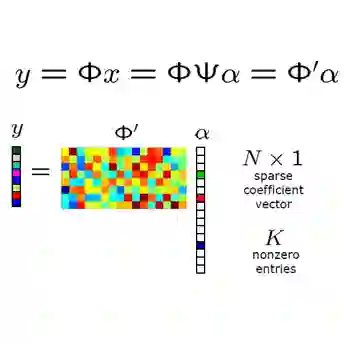
Image reconstruction based on indirect, noisy, or incomplete data remains an important yet challenging task. While methods such as compressive sensing have demonstrated high-resolution image recovery in various settings, there remain issues of robustness due to parameter tuning. Moreover, since the recovery is limited to a point estimate, it is impossible to quantify the uncertainty, which is often desirable. Due to these inherent limitations, a sparse Bayesian learning approach is sometimes adopted to recover a posterior distribution of the unknown. Sparse Bayesian learning assumes that some linear transformation of the unknown is sparse. However, most of the methods developed are tailored to specific problems, with particular forward models and priors. Here, we present a generalized approach to sparse Bayesian learning. It has the advantage that it can be used for various types of data acquisitions and prior information. Some preliminary results on image reconstruction/recovery indicate its potential use for denoising, deblurring, and magnetic resonance imaging.
翻译:基于间接、含噪或不完整数据的图像重建仍是一项重要且具有挑战性的任务。尽管压缩感知等方法已在多种场景下展现出高分辨率图像恢复的能力,但由于参数调优问题,其鲁棒性仍存在局限。此外,由于恢复结果局限于点估计,无法量化不确定性——而这通常是人们期望具有的特性。受限于这些固有缺陷,稀疏贝叶斯学习方法有时被用于恢复未知量的后验分布。稀疏贝叶斯学习假设未知量的某种线性变换具有稀疏性。然而,现有的大多数方法都是针对特定问题定制的,采用特定的正向模型和先验信息。本文提出了一种广义的稀疏贝叶斯学习方法,其优势在于能够适应多种数据采集方式和先验信息类型。针对图像重建/恢复的初步结果表明,该方法在去噪、去模糊及磁共振成像领域具有潜在应用价值。




相关内容



 微信扫码咨询专知VIP会员