

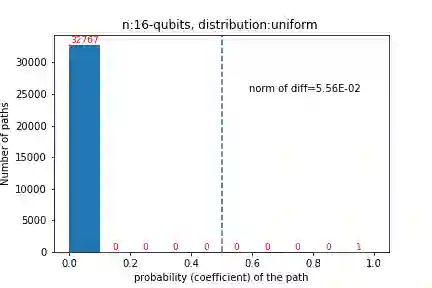
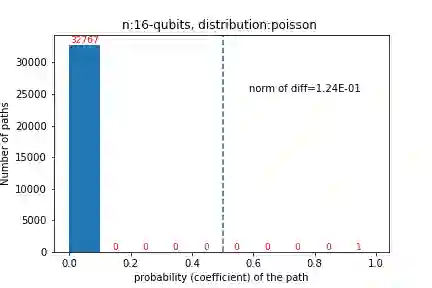
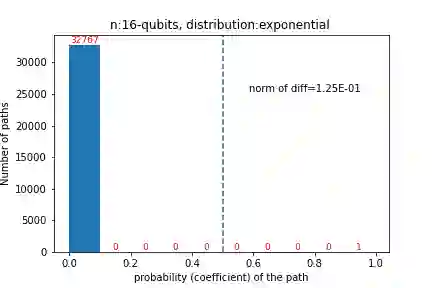
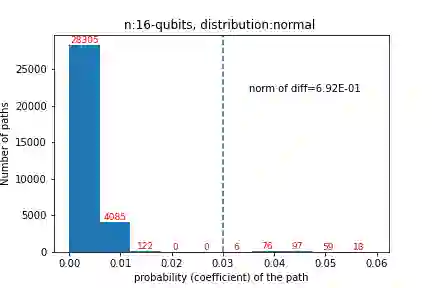
Quantum computers are believed to have the ability to process huge data sizes which can be seen in machine learning applications. In these applications, the data in general is classical. Therefore, to process them on a quantum computer, there is a need for efficient methods which can be used to map classical data on quantum states in a concise manner. On the other hand, to verify the results of quantum computers and study quantum algorithms, we need to be able to approximate quantum operations into forms that are easier to simulate on classical computers with some errors. Motivated by these needs, in this paper we study the approximation of matrices and vectors by using their tensor products obtained through successive Schmidt decompositions. We show that data with distributions such as uniform, Poisson, exponential, or similar to these distributions can be approximated by using only a few terms which can be easily mapped onto quantum circuits. The examples include random data with different distributions, the Gram matrices of iris flower, handwritten digits, 20newsgroup, and labeled faces in the wild. And similarly, some quantum operations such as quantum Fourier transform and variational quantum circuits with a small depth also may be approximated with a few terms that are easier to simulate on classical computers. Furthermore, we show how the method can be used to simplify quantum Hamiltonians: In particular, we show the application to randomly generated transverse field Ising model Hamiltonians. The reduced Hamiltonians can be mapped into quantum circuits easily and therefore can be simulated more efficiently.
翻译:量子计算机被认为具备处理海量数据的能力,这在机器学习应用中有所体现。这些应用中的数据通常为经典数据。因此,要在量子计算机上处理它们,需要高效方法将经典数据简洁地映射到量子态上。另一方面,为了验证量子计算机的结果并研究量子算法,我们需要能够将量子操作近似为更易在经典计算机上模拟的形式(允许一定误差)。基于这些需求,本文研究了通过连续施密特分解获得的张量积来近似矩阵与向量的方法。我们证明,具有均匀分布、泊松分布、指数分布或类似分布的数据,仅需少量易于映射到量子电路的项即可近似。示例包括不同分布的随机数据,以及鸢尾花、手写数字、20Newsgroup和野外标记人脸数据的Gram矩阵。类似地,某些量子操作(如量子傅里叶变换和小深度变分量子电路)也可通过少量更易在经典计算机上模拟的项进行近似。此外,我们展示了该方法如何用于简化量子哈密顿量:特别地,我们将其应用于随机生成的横场伊辛模型哈密顿量。简化后的哈密顿量可轻松映射到量子电路,从而更高效地模拟。




相关内容




 微信扫码咨询专知VIP会员