

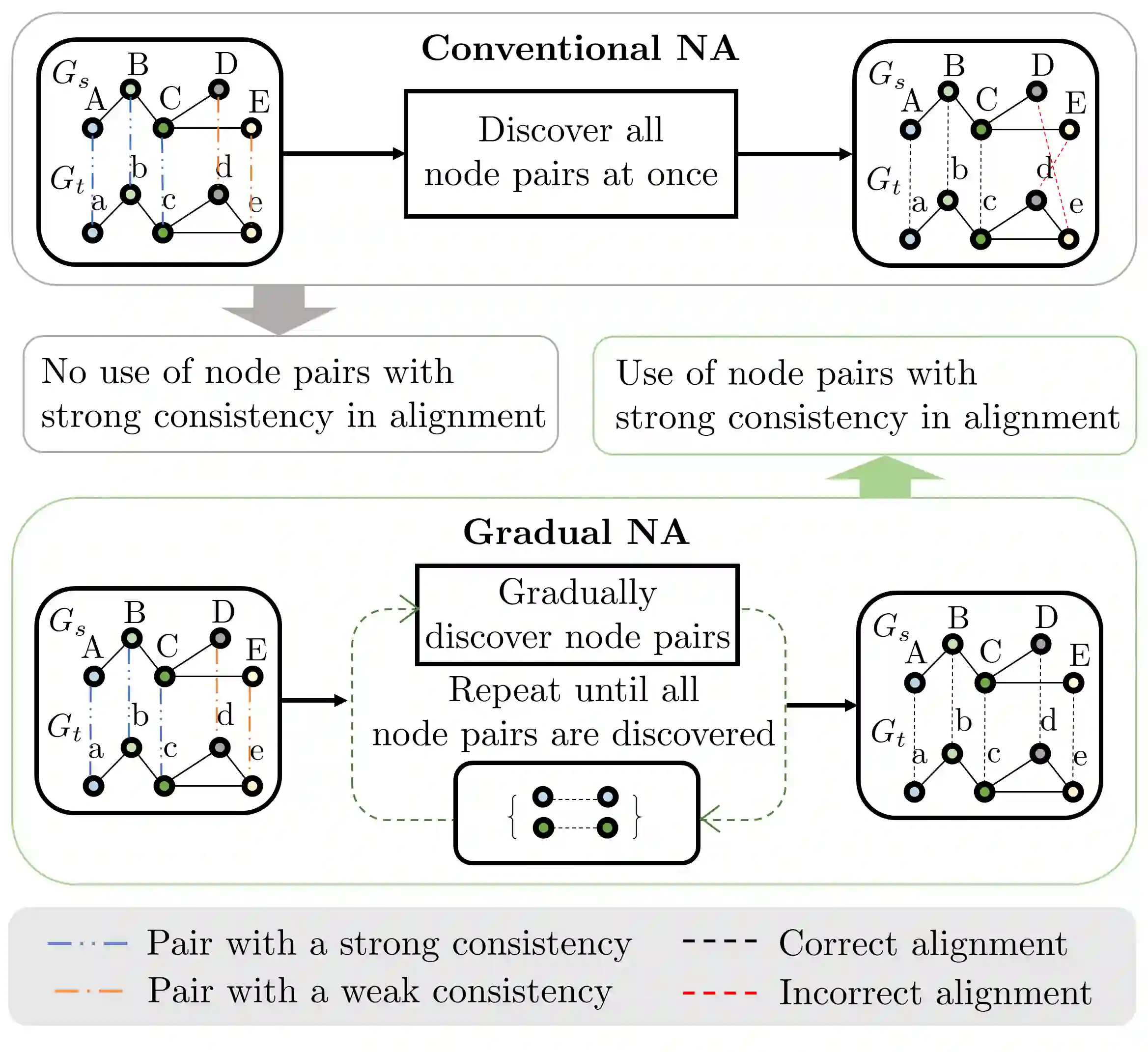
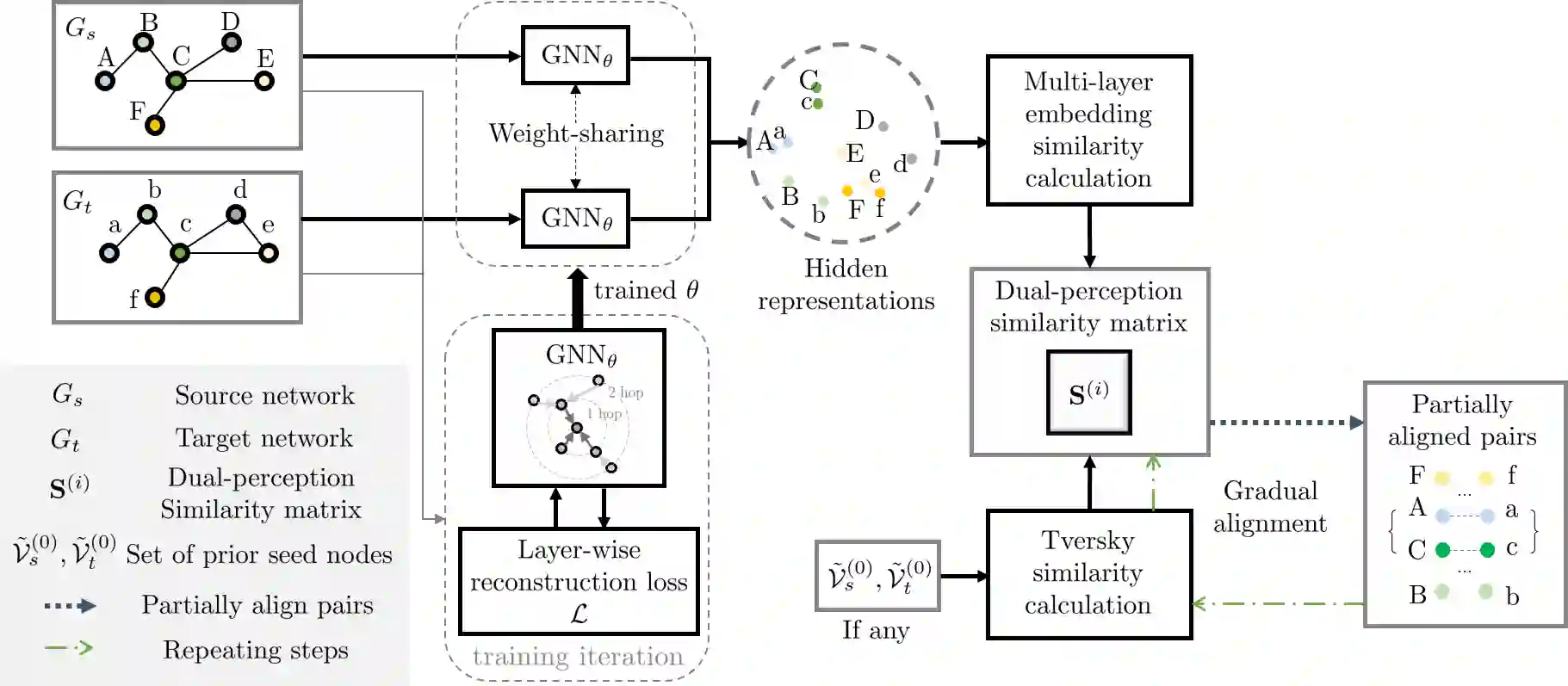
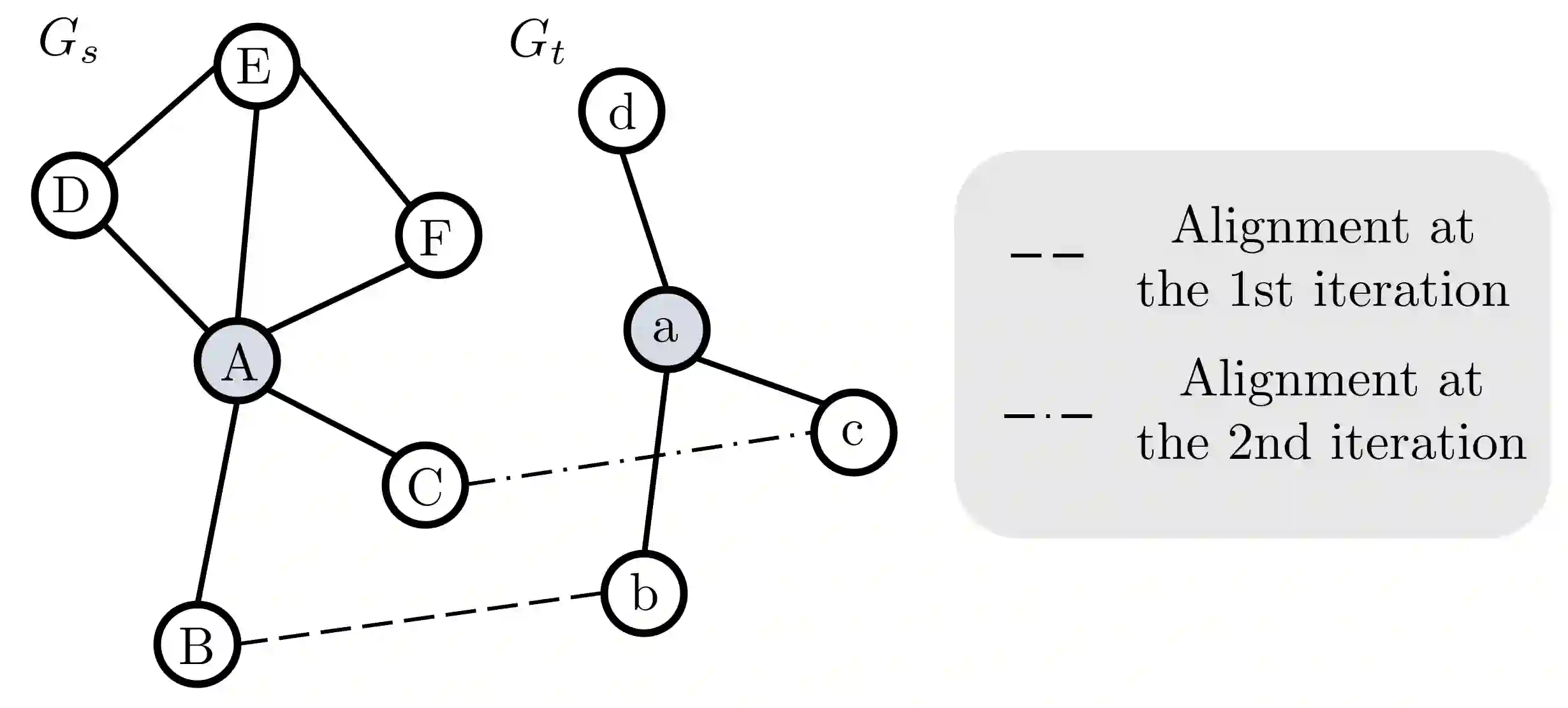
Network alignment (NA) is the task of finding the correspondence of nodes between two networks based on the network structure and node attributes. Our study is motivated by the fact that, since most of existing NA methods have attempted to discover all node pairs at once, they do not harness information enriched through interim discovery of node correspondences to more accurately find the next correspondences during the node matching. To tackle this challenge, we propose Grad-Align, a new NA method that gradually discovers node pairs by making full use of node pairs exhibiting strong consistency, which are easy to be discovered in the early stage of gradual matching. Specifically, Grad-Align first generates node embeddings of the two networks based on graph neural networks along with our layer-wise reconstruction loss, a loss built upon capturing the first-order and higher-order neighborhood structures. Then, nodes are gradually aligned by computing dual-perception similarity measures including the multi-layer embedding similarity as well as the Tversky similarity, an asymmetric set similarity using the Tversky index applicable to networks with different scales. Additionally, we incorporate an edge augmentation module into Grad-Align to reinforce the structural consistency. Through comprehensive experiments using real-world and synthetic datasets, we empirically demonstrate that Grad-Align consistently outperforms state-of-the-art NA methods.
翻译:摘要:网络对齐(NA)旨在基于网络结构和节点属性,寻找两个网络间的节点对应关系。本研究的动机在于,现有大多数NA方法试图一次性发现所有节点对,未能充分利用中间发现的节点对应关系所蕴含的信息,从而在节点匹配过程中更精准地寻找后续对应关系。为解决该挑战,我们提出Grad-Align,一种渐进式网络对齐新方法,通过充分利用在渐进匹配早期阶段易于发现且具有强一致性的节点对,逐步发现节点对应关系。具体而言,Grad-Align首先生成基于图神经网络的两个网络节点嵌入,并结合我们提出的逐层重建损失(一种基于捕获一阶和高阶邻域结构构建的损失)。随后,通过计算双重感知相似性度量(包括多层嵌入相似性和Tversky相似性(一种基于Tversky指数且适用于不同规模网络的不对称集合相似性)),逐步对齐节点。此外,我们在Grad-Align中引入边增强模块以强化结构一致性。通过使用真实数据集和合成数据集的综合实验,我们实证表明Grad-Align始终优于最先进的NA方法。




相关内容


 微信扫码咨询专知VIP会员