

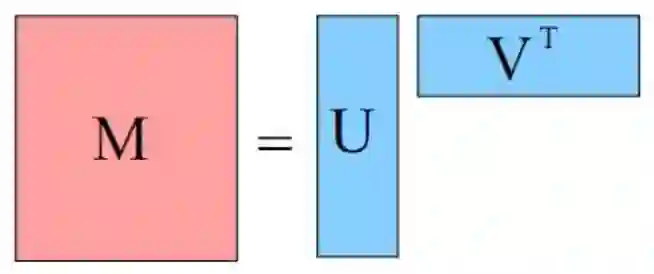
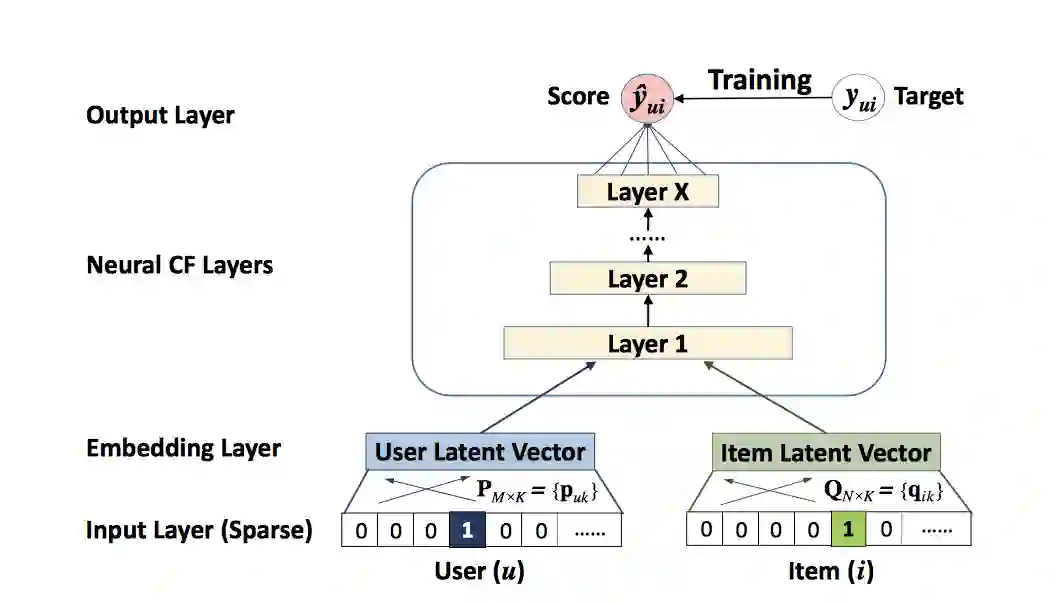
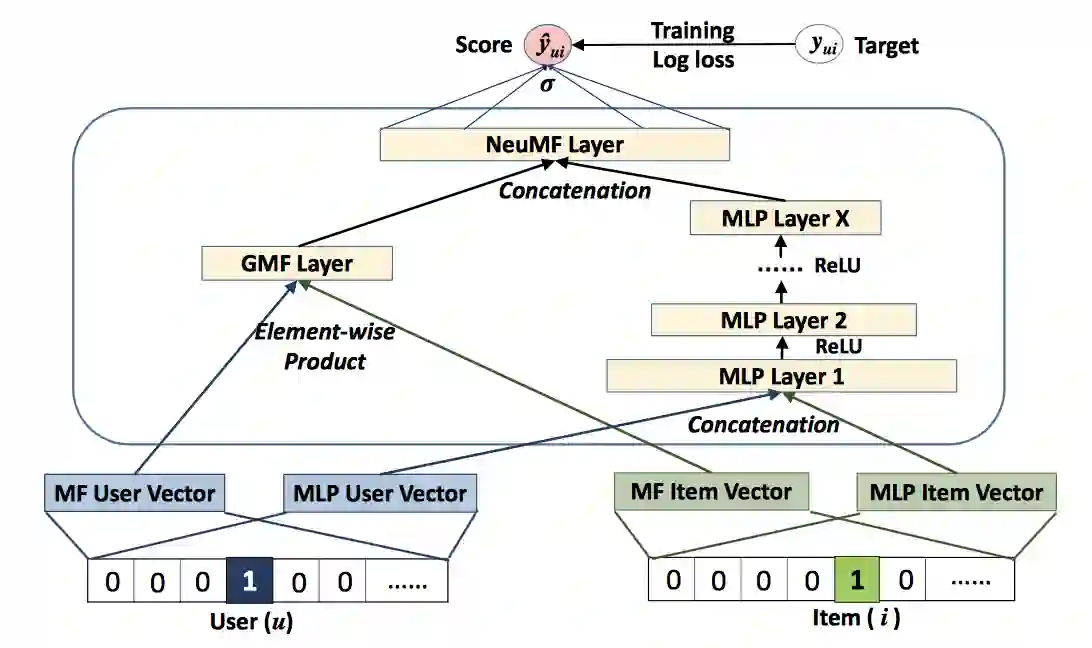
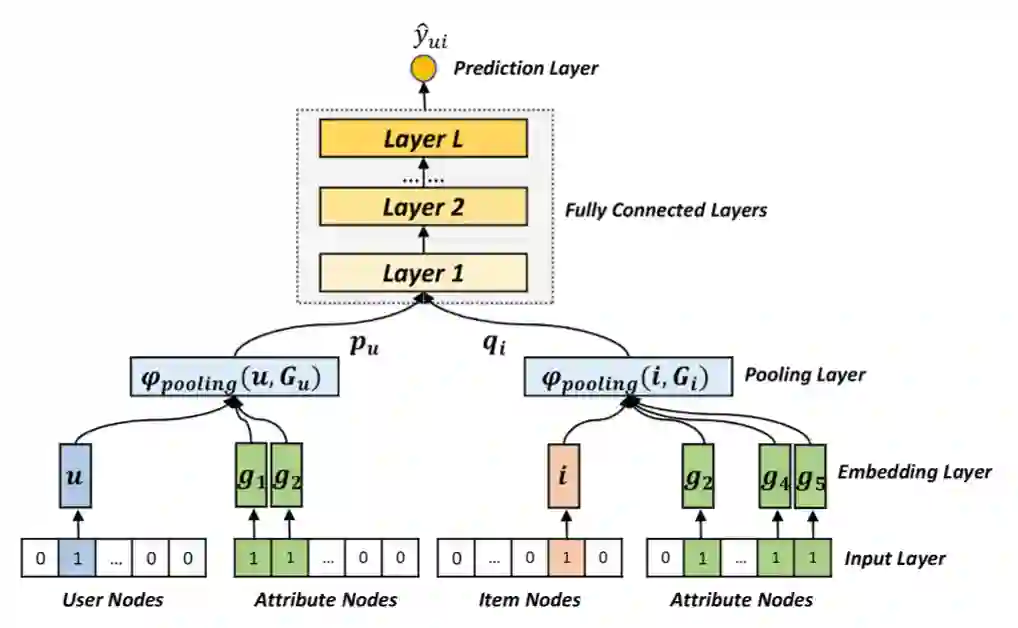
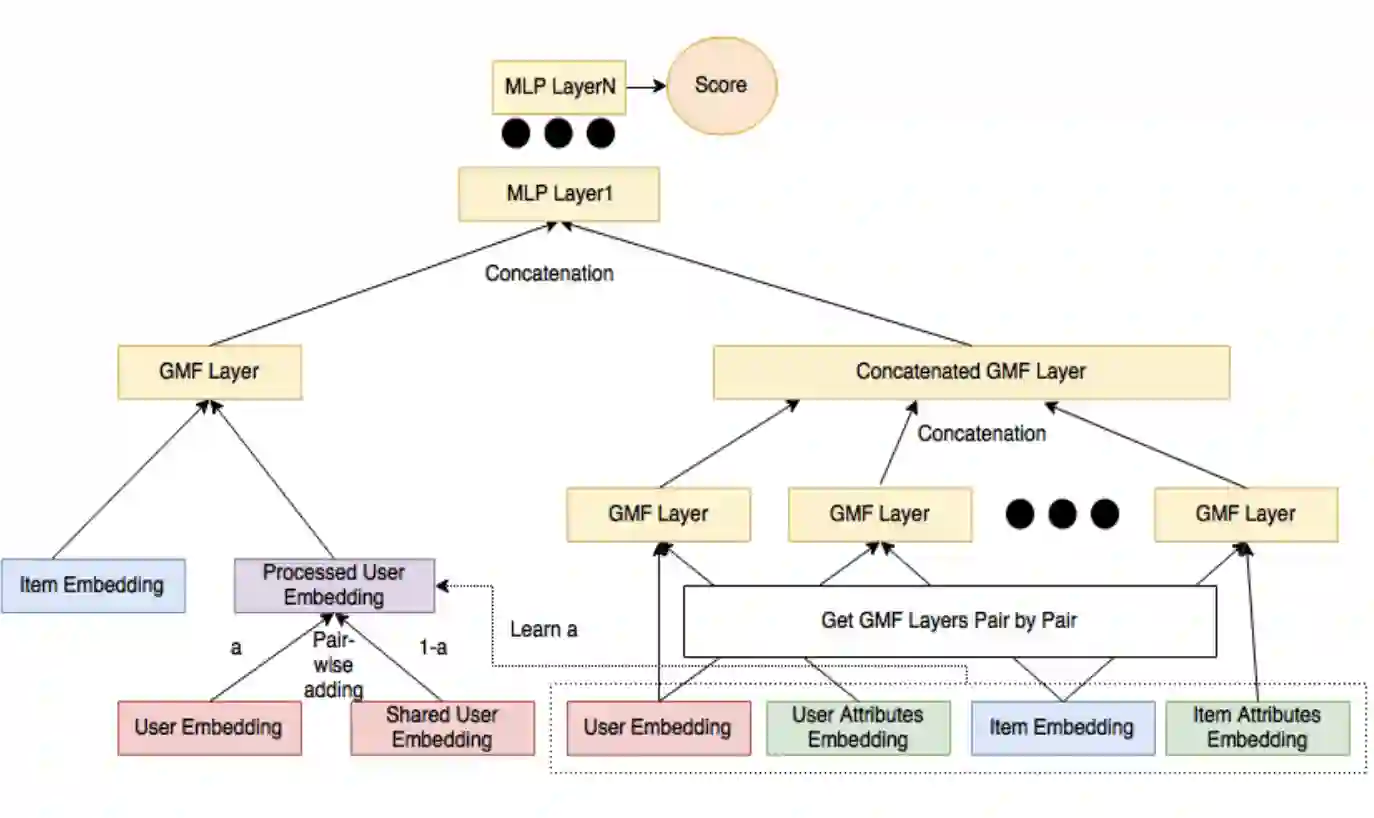
Over the past few years, deep learning has firmly established its prowess across various domains, including computer vision, speech recognition, and natural language processing. Motivated by its outstanding success, researchers have been directing their efforts towards applying deep learning techniques to recommender systems. Neural collaborative filtering (NCF) and Neural Matrix Factorization (NeuMF) refreshes the traditional inner product in matrix factorization with a neural architecture capable of learning complex and data-driven functions. While these models effectively capture user-item interactions, they overlook the specific attributes of both users and items. This can lead to robustness issues, especially for items and users that belong to the "long tail". Such challenges are commonly recognized in recommender systems as a part of the cold-start problem. A direct and intuitive approach to address this issue is by leveraging the features and attributes of the items and users themselves. In this paper, we introduce a refined NeuMF model that considers not only the interaction between users and items, but also acrossing associated attributes. Moreover, our proposed architecture features a shared user embedding, seamlessly integrating with user embeddings to imporve the robustness and effectively address the cold-start problem. Rigorous experiments on both the Movielens and Pinterest datasets demonstrate the superiority of our Cross-Attribute Matrix Factorization model, particularly in scenarios characterized by higher dataset sparsity.
翻译:近年来,深度学习在计算机视觉、语音识别和自然语言处理等众多领域展现了其强大能力。受其卓越成功的启发,研究者们正致力于将深度学习技术应用于推荐系统。神经协同过滤(NCF)和神经矩阵分解(NeuMF)通过能够学习复杂数据驱动函数的神经架构,革新了矩阵分解中传统的内积运算。尽管这些模型有效捕捉了用户-项目交互,却忽略了用户和项目的具体属性。这可能导致鲁棒性问题,尤其对于属于"长尾"的冷门项目和用户而言。此类挑战在推荐系统中常被视为冷启动问题的一部分。一个直接直观的解决方法是利用项目与用户自身的特征属性。本文提出一种改进的NeuMF模型,不仅考虑用户与项目之间的交互,还关注其关联属性之间的交互。此外,我们提出的架构采用共享用户嵌入,通过无缝集成用户嵌入来提升鲁棒性并有效解决冷启动问题。在Movielens和Pinterest数据集上的严格实验表明,我们的跨属性矩阵分解模型具有优越性,尤其在数据集稀疏度较高的场景中表现突出。




相关内容




 微信扫码咨询专知VIP会员