

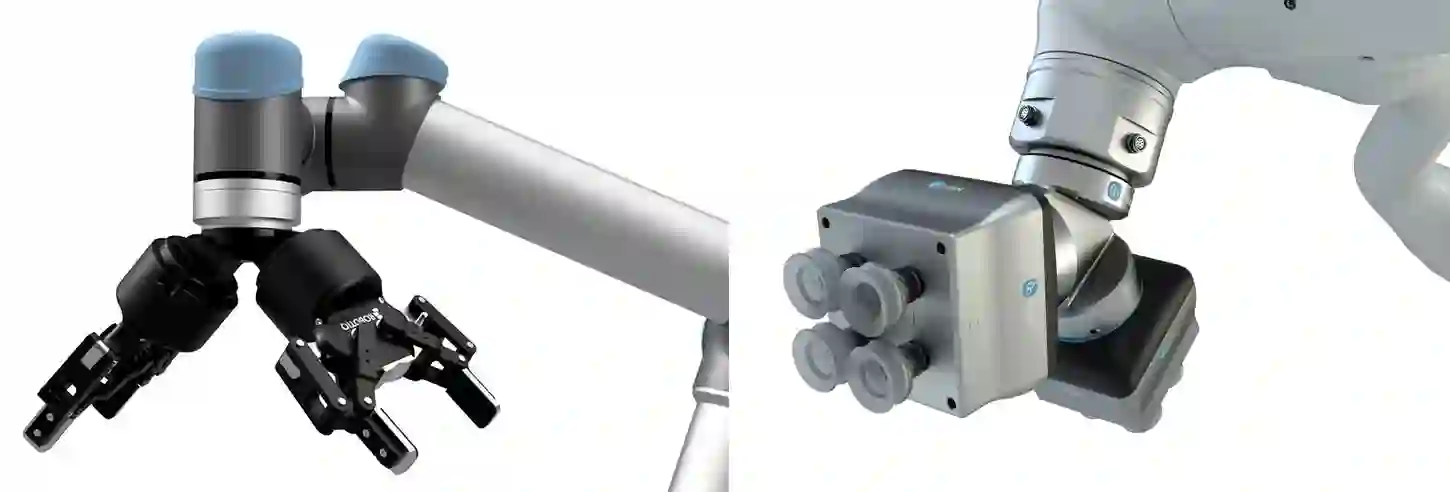
We investigate the utility of employing multiple buffers in solving a class of rearrangement problems with pick-n-swap manipulation primitives. In this problem, objects stored randomly in a lattice are to be sorted using a robot arm with k>=1 swap spaces or buffers, capable of holding up to k objects on its end-effector simultaneously. On the structural side, we show that the addition of each new buffer brings diminishing returns in saving the end-effector travel distance while holding the total number of pick-n-swap operations at the minimum. This is due to an interesting recursive cycle structure in random m-permutation, where the largest cycle covers over 60% of objects. On the algorithmic side, we propose fast algorithms for 1D and 2D lattice rearrangement problems that can effectively use multiple buffers to boost solution optimality. Numerical experiments demonstrate the efficiency and scalability of our methods, as well as confirm the diminishing return structure as more buffers are employed.
翻译:本文研究了在运用拾取-交换操作基元求解一类重排问题时,采用多个缓冲区的效用。在该问题中,随机存储在晶格中的物体需借助配备k≥1个交换空间或缓冲区的机器人手臂进行排序,该机械臂末端执行器最多可同时容纳k个物体。在结构层面,我们表明:在保持拾取-交换操作总数最小化的前提下,每新增一个缓冲区对减少末端执行器行程距离带来的收益呈递减趋势。这一现象源于随机m-置换中存在的有趣递归循环结构,其中最大循环覆盖了超过60%的物体。在算法层面,我们提出了适用于一维和二维晶格重排问题的快速算法,该算法能有效利用多个缓冲区提升解的最优性。数值实验验证了所提方法的效率与可扩展性,同时证实了随着缓冲区数量增加而产生的收益递减结构特征。




相关内容



 微信扫码咨询专知VIP会员