

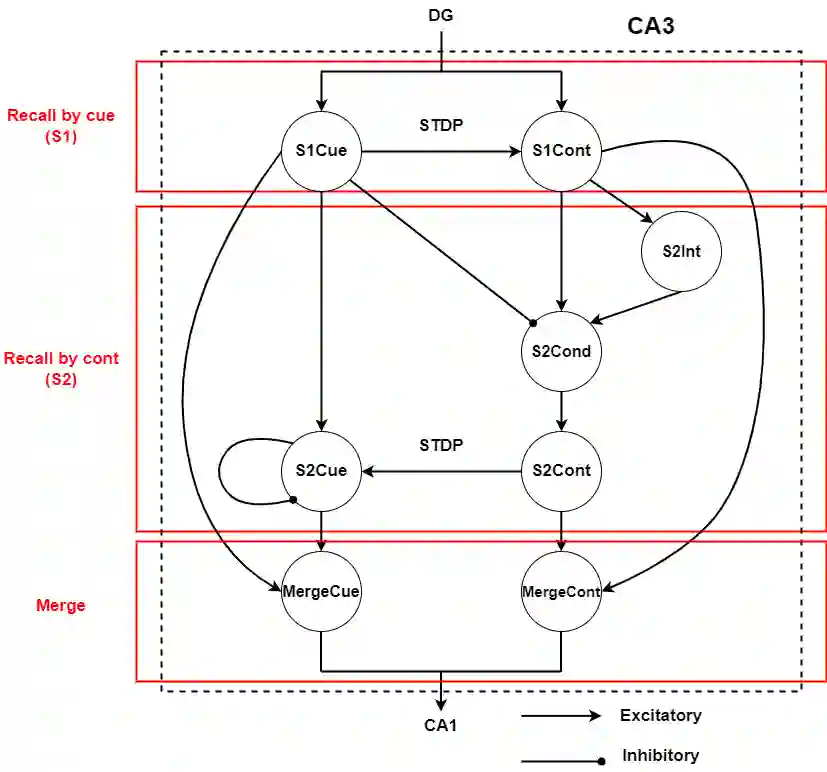
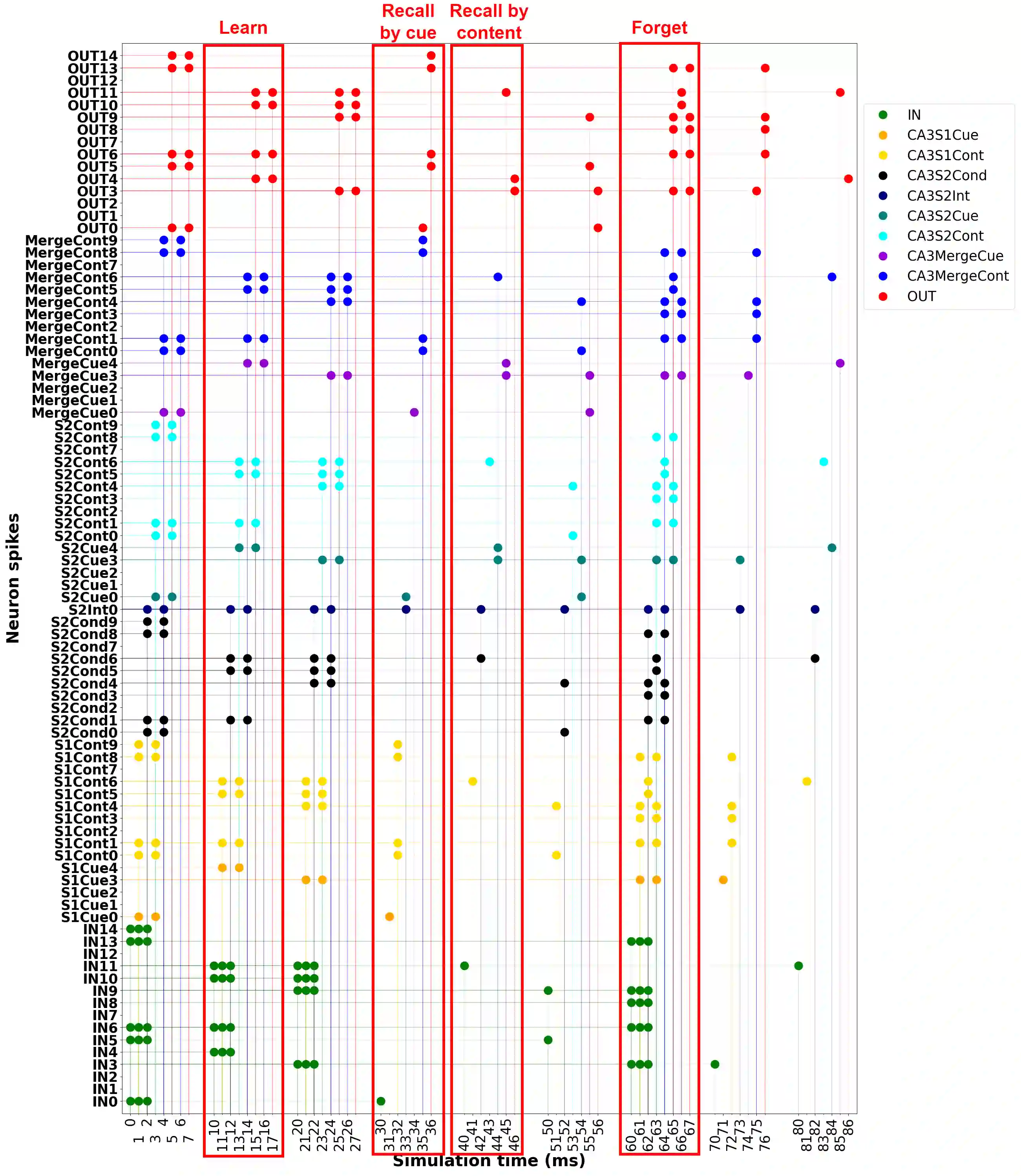
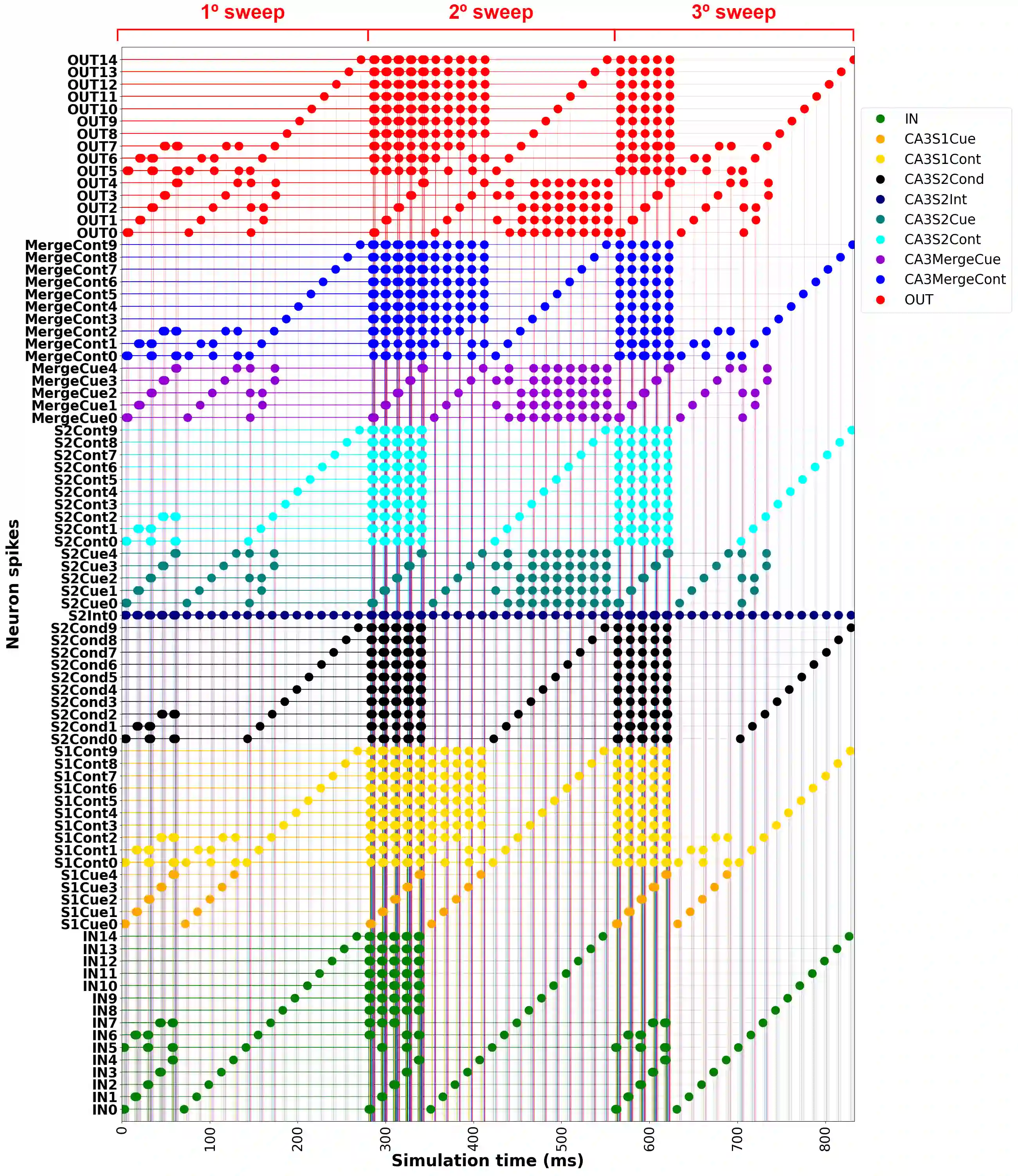
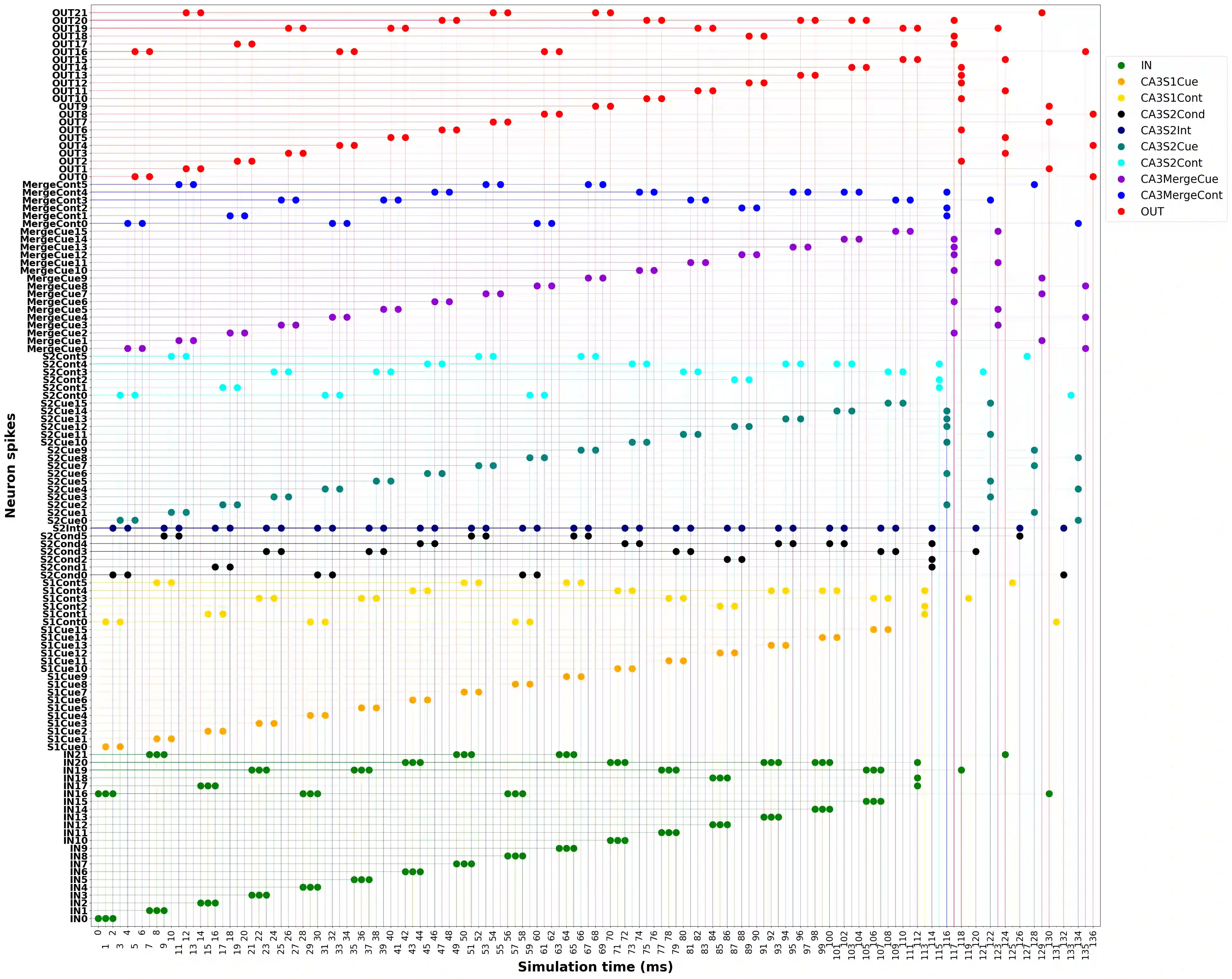
The brain has computational capabilities that surpass those of modern systems, being able to solve complex problems efficiently in a simple way. Neuromorphic engineering aims to mimic biology in order to develop new systems capable of incorporating such capabilities. Bio-inspired learning systems continue to be a challenge that must be solved, and much work needs to be done in this regard. Among all brain regions, the hippocampus stands out as an autoassociative short-term memory with the capacity to learn and recall memories from any fragment of them. These characteristics make the hippocampus an ideal candidate for developing bio-inspired learning systems that, in addition, resemble content-addressable memories. Therefore, in this work we propose a bio-inspired spiking content-addressable memory model based on the CA3 region of the hippocampus with the ability to learn, forget and recall memories, both orthogonal and non-orthogonal, from any fragment of them. The model was implemented on the SpiNNaker hardware platform using Spiking Neural Networks. A set of experiments based on functional, stress and applicability tests were performed to demonstrate its correct functioning. This work presents the first hardware implementation of a fully-functional bio-inspired spiking hippocampal content-addressable memory model, paving the way for the development of future more complex neuromorphic systems.
翻译:大脑具有超越现代系统的计算能力,能够以简单方式高效解决复杂问题。神经形态工程旨在模仿生物学特性,以开发能够整合此类能力的新型系统。受生物启发的学习系统仍是亟待解决的挑战,这一领域尚需大量研究工作。在所有脑区中,海马体作为具备联想式短期记忆特性的结构,能够从任意记忆片段中学习并回忆完整信息。该特性使其成为开发兼具内容寻址存储器特征的生物启发学习系统的理想候选对象。因此,本研究提出一种基于海马体CA3区的生物启发脉冲型内容寻址存储器模型,该模型具备从正交与非正交记忆片段中学习、遗忘及回忆记忆的能力。模型采用脉冲神经网络在SpiNNaker硬件平台上实现。通过功能测试、压力测试及适用性测试等系列实验验证其正确运行。本工作首次实现了全功能生物启发脉冲型海马体内容寻址存储器的硬件部署,为未来更复杂神经形态系统的开发奠定基础。





相关内容




 微信扫码咨询专知VIP会员