

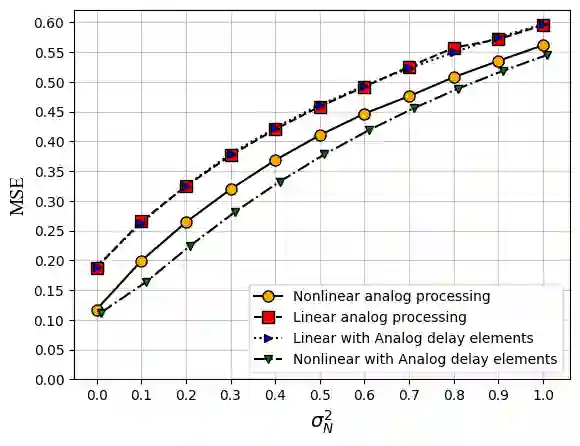
In task-based quantization, a multivariate analog signal is transformed into a digital signal using a limited number of low-resolution analog-to-digital converters (ADCs). This process aims to minimize a fidelity criterion, which is assessed against an unobserved task variable that is correlated with the analog signal. The scenario models various applications of interest such as channel estimation, medical imaging applications, and object localization. This work explores the integration of analog processing components -- such as analog delay elements, polynomial operators, and envelope detectors -- prior to ADC quantization. Specifically, four scenarios, involving different collections of analog processing operators are considered: (i) arbitrary polynomial operators with analog delay elements, (ii) limited-degree polynomial operators, excluding delay elements, (iii) sequences of envelope detectors, and (iv) a combination of analog delay elements and linear combiners. For each scenario, the minimum achievable distortion is quantified through derivation of computable expressions in various statistical settings. It is shown that analog processing can significantly reduce the distortion in task reconstruction. Numerical simulations in a Gaussian example are provided to give further insights into the aforementioned analog processing gains.
翻译:在基于任务的量化中,多变量模拟信号通过有限数量的低分辨率模数转换器(ADC)转换为数字信号。这一过程旨在最小化一个保真度准则,该准则针对与模拟信号相关但未观测的任务变量进行衡量。该场景模拟了多种重要应用,如信道估计、医学成像和物体定位。本文探索了在ADC量化之前集成模拟处理组件(如模拟延迟元件、多项式算子和包络检测器)的效果。具体而言,考虑了涉及不同模拟处理算子集合的四种场景:(i)带有模拟延迟元件的任意多项式算子;(ii)有限次多项式算子(不含延迟元件);(iii)包络检测器序列;以及(iv)模拟延迟元件与线性组合器的组合。对于每种场景,通过推导不同统计设置下的可计算表达式,量化了可实现的最小失真。研究表明,模拟处理能显著降低任务重建中的失真。通过高斯示例的数值模拟,进一步阐释了上述模拟处理增益。




相关内容



 微信扫码咨询专知VIP会员