

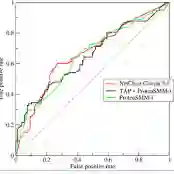
Radiomics and deep learning both offer powerful tools for quantitative medical imaging, but most existing fusion approaches only leverage global radiomic features and overlook the complementary value of spatially resolved radiomic parametric maps. We propose a unified framework that first selects discriminative radiomic features and then injects them into a radiomics-enhanced nnUNet at both the global and voxel levels for pancreatic ductal adenocarcinoma (PDAC) detection. On the PANORAMA dataset, our method achieved AUC = 0.96 and AP = 0.84 in cross-validation. On an external in-house cohort, it achieved AUC = 0.95 and AP = 0.78, outperforming the baseline nnUNet; it also ranked second in the PANORAMA Grand Challenge. This demonstrates that handcrafted radiomics, when injected at both global and voxel levels, provide complementary signals to deep learning models for PDAC detection. Our code can be found at https://github.com/briandzt/dl-pdac-radiomics-global-n-paramaps
翻译:影像组学与深度学习均为定量医学影像分析提供了强大工具,但现有的大多数融合方法仅利用全局影像组学特征,忽视了空间分辨的影像组学参数图的互补价值。我们提出一个统一框架,首先筛选具有判别性的影像组学特征,随后在全局与体素两个层面将其注入到一个影像组学增强的nnUNet中,用于胰腺导管腺癌(PDAC)检测。在PANORAMA数据集上,我们的方法在交叉验证中取得了AUC = 0.96和AP = 0.84。在一个外部内部队列中,该方法取得了AUC = 0.95和AP = 0.78,优于基线nnUNet;同时该方法在PANORAMA Grand Challenge中排名第二。这表明,手工设计的影像组学特征在全局和体素两个层面注入时,能够为深度学习模型提供用于PDAC检测的互补信号。我们的代码可在https://github.com/briandzt/dl-pdac-radiomics-global-n-paramaps找到。




相关内容


 微信扫码咨询专知VIP会员