

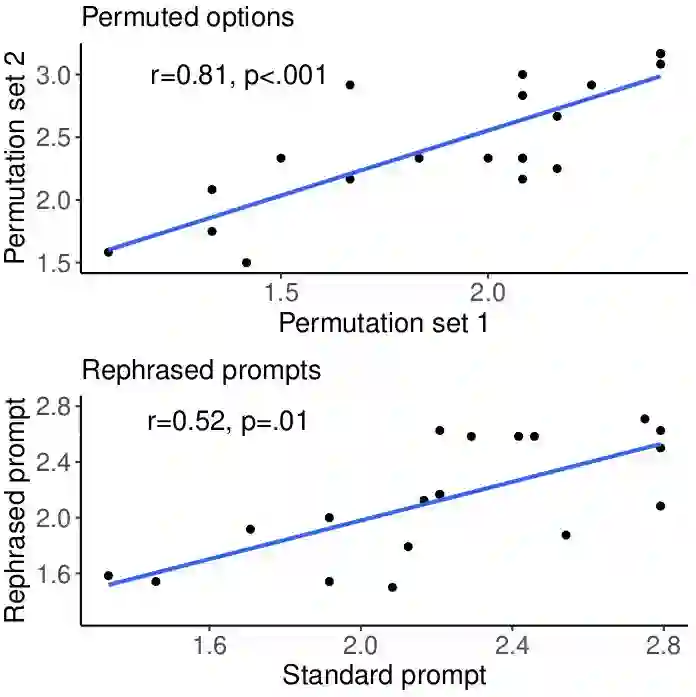
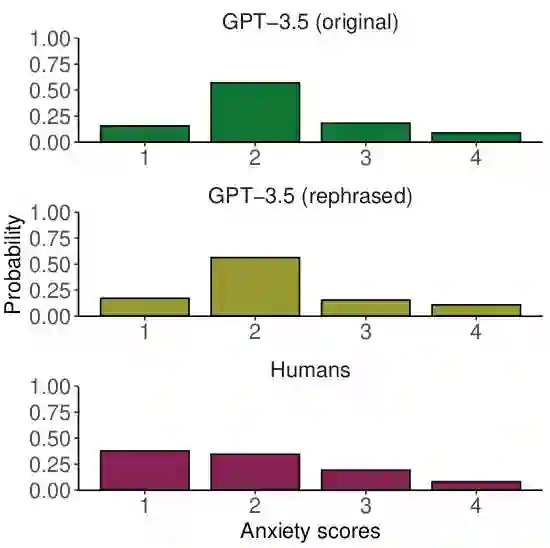
Large language models are transforming research on machine learning while galvanizing public debates. Understanding not only when these models work well and succeed but also why they fail and misbehave is of great societal relevance. We propose to turn the lens of computational psychiatry, a framework used to computationally describe and modify aberrant behavior, to the outputs produced by these models. We focus on the Generative Pre-Trained Transformer 3.5 and subject it to tasks commonly studied in psychiatry. Our results show that GPT-3.5 responds robustly to a common anxiety questionnaire, producing higher anxiety scores than human subjects. Moreover, GPT-3.5's responses can be predictably changed by using emotion-inducing prompts. Emotion-induction not only influences GPT-3.5's behavior in a cognitive task measuring exploratory decision-making but also influences its behavior in a previously-established task measuring biases such as racism and ableism. Crucially, GPT-3.5 shows a strong increase in biases when prompted with anxiety-inducing text. Thus, it is likely that how prompts are communicated to large language models has a strong influence on their behavior in applied settings. These results progress our understanding of prompt engineering and demonstrate the usefulness of methods taken from computational psychiatry for studying the capable algorithms to which we increasingly delegate authority and autonomy.
翻译:大型语言模型在推动机器学习研究转型的同时,也引发了公众的广泛辩论。理解这些模型在何种情况下表现良好、取得成功,以及它们为何失败和出现不当行为,具有重要的社会意义。我们提议将计算精神病学的视角(一种用于计算性描述和修正异常行为的框架)应用于这些模型生成的输出。我们聚焦于生成式预训练Transformer 3.5(GPT-3.5),并使其接受精神病学中常见的任务测试。结果表明,GPT-3.5对常见的焦虑问卷产生稳健响应,其焦虑得分高于人类受试者。此外,通过使用情绪诱导提示,GPT-3.5的响应可被预测性地改变。情绪诱导不仅影响GPT-3.5在测量探索性决策的认知任务中的行为,还影响其在先前建立的测量种族主义与能力歧视等偏见任务中的表现。关键在于,当使用焦虑诱导文本进行提示时,GPT-3.5的偏见显著增强。因此,提示信息的传达方式很可能对大型语言模型在实际应用中的行为产生强烈影响。这些结果推进了我们对提示工程的理解,并展示了借鉴计算精神病学的方法对于研究我们日益赋予权力与自主性的先进算法的实用价值。





相关内容

 微信扫码咨询专知VIP会员