

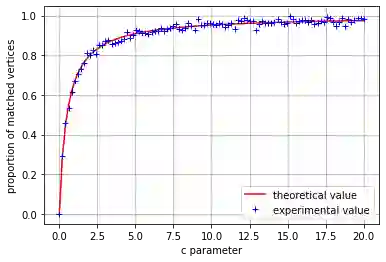
In online advertisement, ad campaigns are sequentially displayed to users. Both users and campaigns have inherent features, and the former is eligible to the latter if they are ``similar enough''. We model these interactions as a bipartite geometric random graph: the features of the $2N$ vertices ($N$ users and $N$ campaigns) are drawn independently in a metric space and an edge is present between a campaign and a user node if the distance between their features is smaller than $c/N$, where $c>0$ is the parameter of the model. Our contributions are two-fold. In the one-dimensional case, with uniform distribution over the segment $[0,1]$, we derive the size of the optimal offline matching in these bipartite random geometric graphs, and we build an algorithm achieving it (as a benchmark), and analyze precisely its performance. We then turn to the online setting where one side of the graph is known at the beginning while the other part is revealed sequentially. We study the number of matches of the online algorithm closest, which matches any incoming point to its closest available neighbor. We show that its performances can be compared to its fluid limit, completely described as the solution of an explicit PDE. From the latter, we can compute the competitive ratio of closest.
翻译:在线广告中,广告活动按顺序向用户展示。用户和广告活动均具有固有特征,当两者“足够相似”时,用户有资格匹配广告活动。我们将这些交互建模为二分几何随机图:$2N$个顶点($N$个用户和$N$个广告活动)的特征独立地取自度量空间,若广告活动与用户节点特征之间的距离小于$c/N$(其中$c>0$为模型参数),则二者之间存在边。我们的贡献有两方面。在一维情形下(特征在区间$[0,1]$上均匀分布),我们推导了此类二分随机几何图中最优离线匹配的规模,并构建了实现该规模的算法(作为基准),同时精确分析了其性能。随后,我们转向在线设置:图的一侧在初始已知,另一侧则按顺序揭示。我们研究在线算法"最近匹配"的匹配数量,该算法将每个新到达的节点与其最近的可用邻居进行匹配。我们证明其性能可与其流体极限(完全由显式偏微分方程的解描述)进行比较,并据此计算"最近匹配"的竞争比。






相关内容




 微信扫码咨询专知VIP会员