

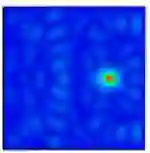
Wireless communications in the terahertz band have been recently proposed as complement to conventional wired interconnects within computing packages. Such environments are typically highly reverberant, hence showing long channel impulse responses and severely limiting the achievable rates. Fortunately, this communications scenario is static and can be pre-characterized, which opens the door to techniques such as time reversal. Time reversal acts a spatial matched filter and has a spatiotemporal focusing effect, which allows not only to increase the achievable symbol rates, but also to create multiple spatial channels. In this paper, the multi-user capability of time reversal is explored in the context of wireless communications in the terahertz band within a computing package. Full-wave simulations are carried out to validate the approach, whereas modulation streams are simulated to evaluate the error rate as a function of the transmitted power, symbol rate, and number of simultaneous transmissions.
翻译:近年来,太赫兹频段无线通信被提出作为计算封装中传统有线互连的补充方案。此类环境通常具有高度混响特性,导致信道冲激响应极长,严重制约了可达速率。幸运的是,这种通信场景是静态的且可预先表征,为时间反演等技术创造了应用条件。时间反演作为空间匹配滤波器,具有时空聚焦效应,不仅能提升可达符号率,还可生成多个空间信道。本文探讨了在计算封装内太赫兹频段无线通信场景下时间反演的多用户能力。通过全波仿真验证该方法的有效性,同时模拟调制数据流以评估误码率与发射功率、符号率及并发传输数量的关系。







相关内容



 微信扫码咨询专知VIP会员