

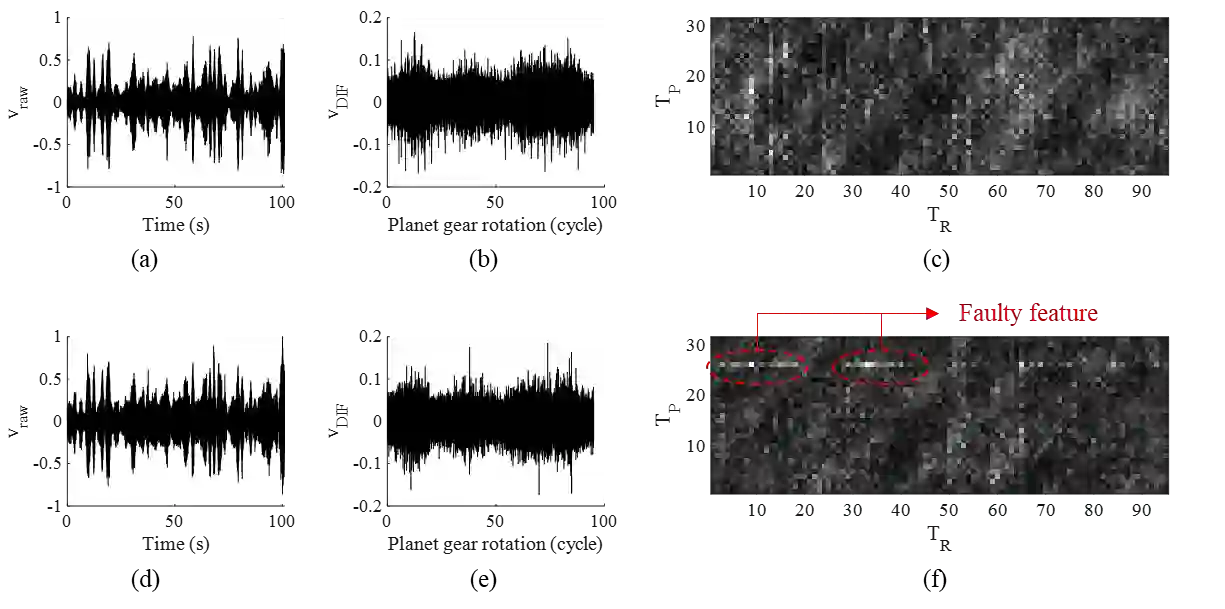
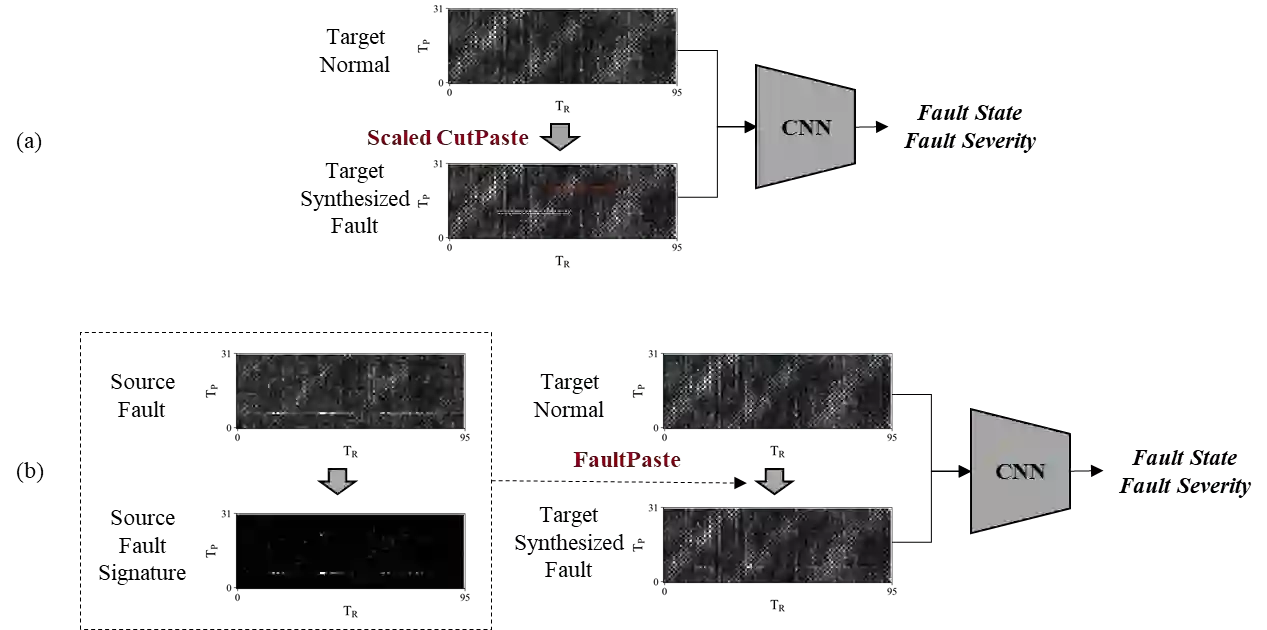
Extensive research has been conducted on fault diagnosis of planetary gearboxes using vibration signals and deep learning (DL) approaches. However, DL-based methods are susceptible to the domain shift problem caused by varying operating conditions of the gearbox. Although domain adaptation and data synthesis methods have been proposed to overcome such domain shifts, they are often not directly applicable in real-world situations where only healthy data is available in the target domain. To tackle the challenge of extreme domain shift scenarios where only healthy data is available in the target domain, this paper proposes two novel domain knowledge-informed data synthesis methods utilizing the health data map (HDMap). The two proposed approaches are referred to as scaled CutPaste and FaultPaste. The HDMap is used to physically represent the vibration signal of the planetary gearbox as an image-like matrix, allowing for visualization of fault-related features. CutPaste and FaultPaste are then applied to generate faulty samples based on the healthy data in the target domain, using domain knowledge and fault signatures extracted from the source domain, respectively. In addition to generating realistic faults, the proposed methods introduce scaling of fault signatures for controlled synthesis of faults with various severity levels. A case study is conducted on a planetary gearbox testbed to evaluate the proposed approaches. The results show that the proposed methods are capable of accurately diagnosing faults, even in cases of extreme domain shift, and can estimate the severity of faults that have not been previously observed in the target domain.
翻译:针对行星齿轮箱的振动信号与深度学习故障诊断问题,已有大量研究。然而,基于深度学习的方法易受齿轮箱运行工况变化导致的域偏移问题影响。尽管已有域自适应和数据合成方法被提出以克服此类域偏移,但在目标域仅存在健康数据的实际场景中,这些方法往往难以直接应用。为应对目标域仅有健康数据的极端域偏移挑战,本文提出两种基于健康数据图(HDMap)的领域知识驱动数据合成新方法,分别称为缩放型CutPaste和FaultPaste。HDMap通过物理方式将行星齿轮箱的振动信号表示为类图像矩阵,实现故障相关特征的可视化。进而利用CutPaste和FaultPaste方法,分别基于目标域健康数据结合领域知识及源域提取的故障特征,生成故障样本。除生成逼真故障外,所提方法还引入故障特征缩放机制,可控制合成不同严重程度的故障。通过行星齿轮箱试验台案例研究评估所提方法,结果表明:即使在极端域偏移情况下,该方法仍能实现精确故障诊断,并能估计目标域中未见过的故障严重程度。






相关内容



 微信扫码咨询专知VIP会员