

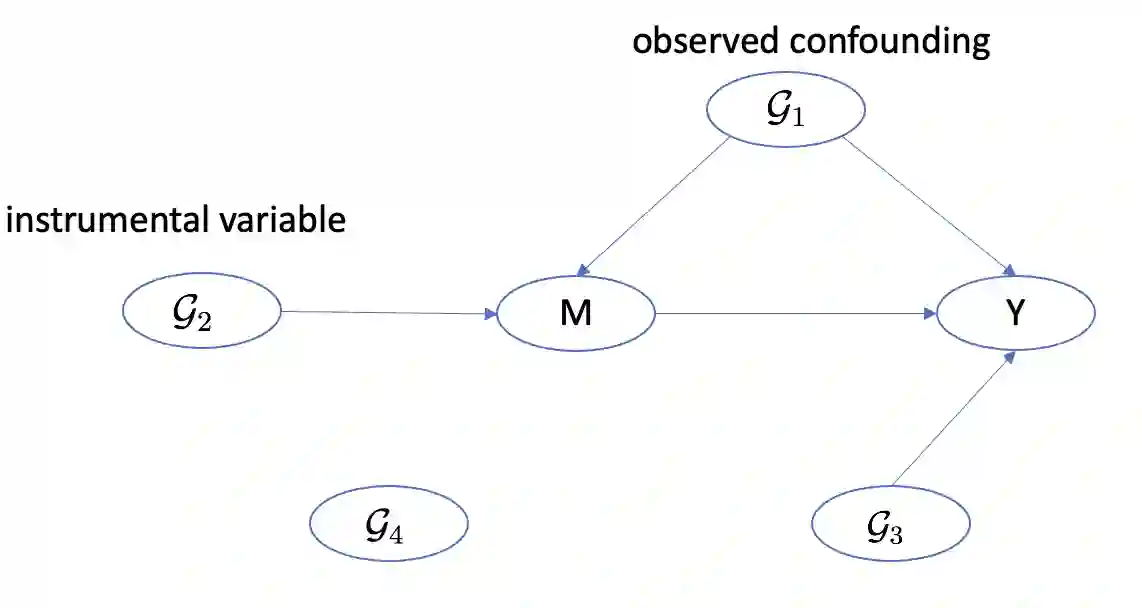
The intricate interplay between host organisms and their gut microbiota has catalyzed research into the microbiome's role in disease, shedding light on novel aspects of disease pathogenesis. However, the mechanisms through which the microbiome exerts its influence on disease remain largely unclear. In this study, we first introduce a structural equation model to delineate the pathways connecting the microbiome, metabolome, and disease processes, utilizing a target multiview microbiome data. To mitigate the challenges posed by hidden confounders, we further propose an integrative approach that incorporates data from an external microbiome cohort. This method also supports the identification of disease-specific and microbiome-associated metabolites that are missing in the target cohort. We provide theoretical underpinnings for the estimations derived from our integrative approach, demonstrating estimation consistency and asymptotic normality. The effectiveness of our methodologies is validated through comprehensive simulation studies and an empirical application to inflammatory bowel disease, highlighting their potential to unravel the complex relationships between the microbiome, metabolome, and disease.
翻译:宿主生物体与其肠道微生物组之间的复杂相互作用推动了微生物组在疾病中作用的研究,揭示了疾病发病机制的新层面。然而,微生物组影响疾病的具体机制仍不清楚。在本研究中,我们首先引入一个结构方程模型,利用目标多视图微生物组数据来描绘连接微生物组、代谢组和疾病过程的通路。为缓解隐藏混杂因素带来的挑战,我们进一步提出了一种整合方法,该方法纳入外部微生物组队列的数据。该方法还能识别目标队列中缺失的疾病特异性及微生物组相关代谢物。我们为整合方法得到的估计提供了理论基础,证明了估计的一致性和渐近正态性。我们方法的有效性通过全面的模拟研究以及对炎症性肠病的实证应用得到验证,凸显了其在揭示微生物组、代谢组与疾病之间复杂关系的潜力。




相关内容




 微信扫码咨询专知VIP会员