

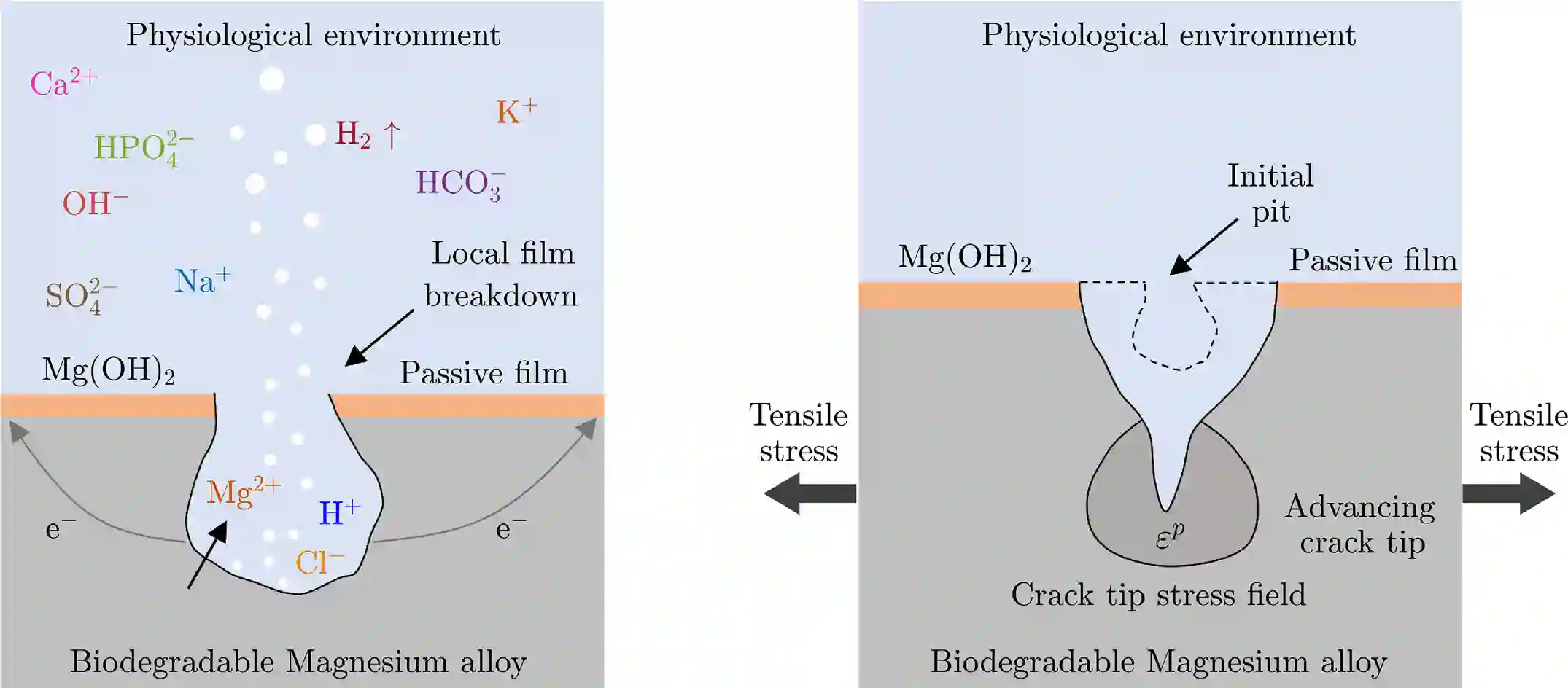
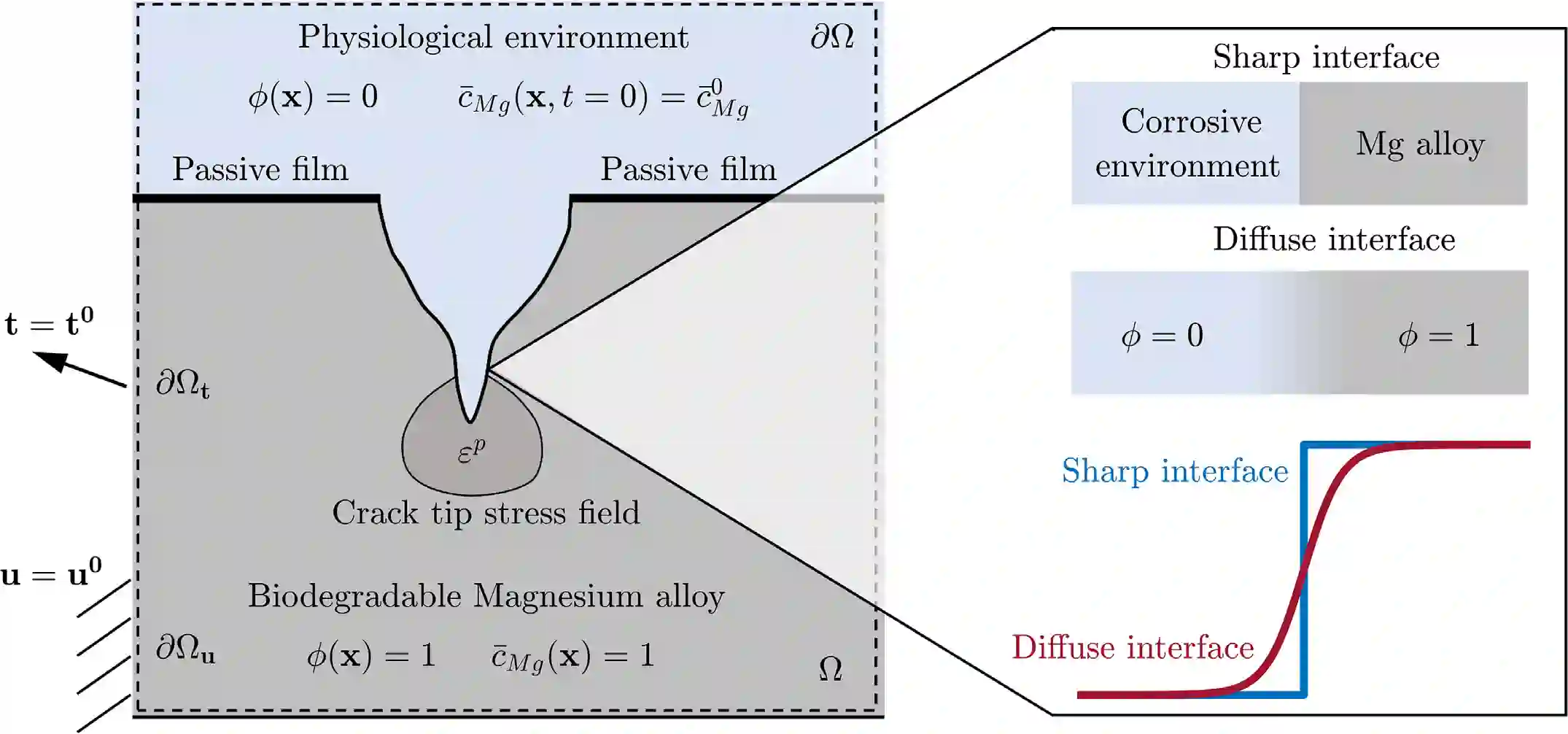
A phase-field model is developed to simulate the corrosion of Mg alloys in body fluids. The model incorporates both Mg dissolution and the transport of Mg ions in solution, naturally predicting the transition from activation-controlled to diffusion-controlled bio-corrosion. In addition to uniform corrosion, the presented framework captures pitting corrosion and accounts for the synergistic effect of aggressive environments and mechanical loading in accelerating corrosion kinetics. The model applies to arbitrary 2D and 3D geometries with no special treatment for the evolution of the corrosion front, which is described using a diffuse interface approach. Experiments are conducted to validate the model and a good agreement is attained against in vitro measurements on Mg wires. The potential of the model to capture mechano-chemical effects during corrosion is demonstrated in case studies considering Mg wires in tension and bioabsorbable coronary Mg stents subjected to mechanical loading. The proposed methodology can be used to assess the in vitro and in vivo service life of Mg-based biomedical devices and optimize the design taking into account the effect of mechanical deformation on the corrosion rate. The model has the potential to advocate further development of Mg alloys as a biodegradable implant material for biomedical applications.
翻译:建立了一种相场模型,用于模拟镁合金在体液中的腐蚀行为。该模型同时考虑了镁的溶解与镁离子在溶液中的输运,自然预测了从活化控制到扩散控制的生物腐蚀转变过程。除均匀腐蚀外,所提出的框架还能捕捉点蚀现象,并考虑侵蚀性环境与机械载荷对加速腐蚀动力学的协同效应。该模型适用于任意二维和三维几何结构,无需对腐蚀前沿的演化进行特殊处理,而是采用扩散界面方法进行描述。通过实验验证模型,与镁丝体外测量结果取得了良好的一致性。在考虑镁丝拉伸及可吸收冠状动脉镁支架承受机械载荷的案例研究中,展示了该模型捕捉腐蚀过程中机械化学效应的潜力。所提出的方法可用于评估镁基生物医学器件的体外和体内服役寿命,并考虑机械变形对腐蚀速率的影响进行优化设计。该模型有望推动镁合金作为可降解植入材料在生物医学应用中的进一步发展。






相关内容




 微信扫码咨询专知VIP会员