

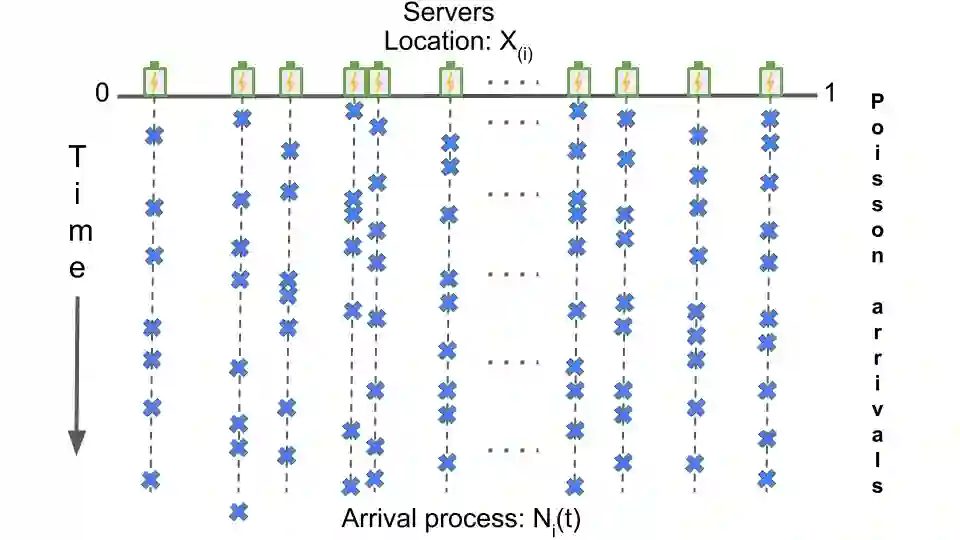
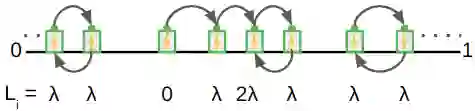
In this work we study multi-server queues on a Euclidean space. Consider $N$ servers that are distributed uniformly in $[0,1]^d$. Customers (users) arrive at the servers according to independent Poisson processes of intensity $\lambda$. However, they probabilistically decide whether to join the queue they arrived at, or move to one of the nearest neighbours. The strategy followed by the customers affects the load on the servers in the long run. In this paper, we are interested in characterizing the fraction of servers that bear a larger load as compared to when the users do not follow any strategy, i.e., they join the queue they arrive at. These are called overloaded servers. In the one-dimensional case ($d=1$), we evaluate the expected fraction of overloaded servers for any finite $N$ when the users follow probabilistic nearest neighbour shift strategies. Additionally, for servers distributed in a $d$-dimensional space we provide expressions for the fraction of overloaded servers in the system as the total number of servers $N\rightarrow \infty$. Numerical experiments are provided to support our claims. Typical applications of our results include electric vehicles queueing at charging stations, and queues in airports or supermarkets.
翻译:本文研究了欧几里得空间中的多服务器排队系统。考虑$N$个服务器均匀分布在$[0,1]^d$区域内。顾客(用户)根据强度为$\lambda$的独立泊松过程到达各服务器。然而,他们会以一定概率决定是加入当前到达的队列,还是转移到最近邻的服务器之一。顾客所采用的策略会长期影响服务器的负载。本文旨在刻画相较于用户不采用任何策略(即直接加入到达时的队列)时,承受更大负载的服务器比例,这些服务器被称为过载服务器。在一维情形($d=1$)下,我们评估了用户采用概率性最近邻转移策略时,对于任意有限$N$大小的过载服务器期望比例。此外,对于服务器分布在$d$维空间的情形,我们给出了当服务器总数$N\rightarrow \infty$时系统中过载服务器比例的表达式。通过数值实验验证了我们的结论。该结果的典型应用包括电动汽车在充电站的排队、机场或超市中的排队场景。




相关内容




 微信扫码咨询专知VIP会员