

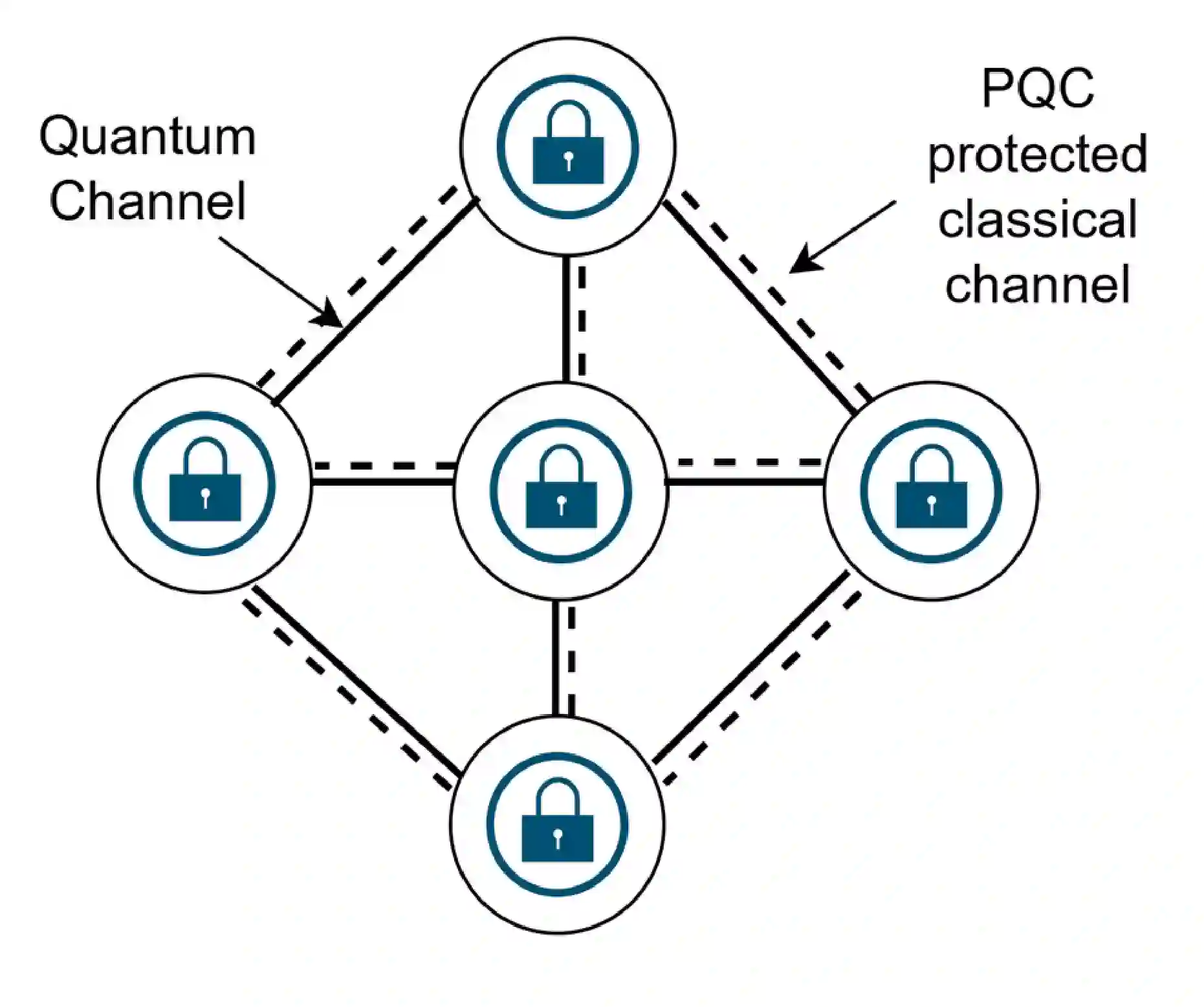
Quantum networks rely on both quantum and classical channels for coordinated operation. Current architectures employ entanglement distribution and key exchange over quantum channels but often assume that classical communication is sufficiently secure. In practice, classical channels protected by traditional cryptography remain vulnerable to quantum adversaries, since large-scale quantum computers could break widely used public-key schemes and reduce the effective security of symmetric cryptography. This perspective presents a quantum-resistant network architecture that secures classical communication with post-quantum cryptographic techniques while supporting entanglement-based communication over quantum channels. Beyond cryptographic protection, the framework incorporates continuous monitoring of both quantum and classical layers, together with orchestration across heterogeneous infrastructures, to ensure end-to-end security. Collectively, these mechanisms provide a pathway toward scalable, robust, and secure quantum networks that remain dependable against both classical and quantum-era threats.
翻译:量子网络依赖于量子信道和经典信道的协同运行。当前架构利用量子信道进行纠缠分发和密钥交换,但通常假设经典通信具有足够的安全性。实际上,受传统密码学保护的经典信道仍易受量子攻击者的威胁,因为大规模量子计算机可能破解广泛使用的公钥方案,并降低对称密码学的有效安全性。本文提出一种量子抗性网络架构,通过后量子密码技术保护经典通信,同时支持基于量子信道的纠缠通信。除密码保护外,该框架整合了对量子层和经典层的持续监控,并结合跨异构基础设施的协同编排,以确保端到端安全性。这些机制共同为构建可扩展、鲁棒且安全的量子网络提供了可行路径,使其在面对经典威胁和量子时代威胁时均保持可靠。




相关内容



 微信扫码咨询专知VIP会员