

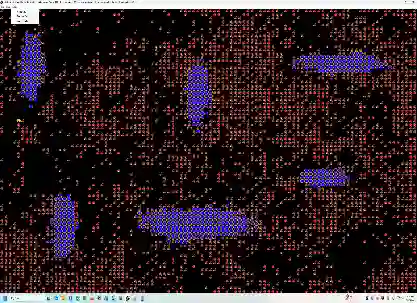
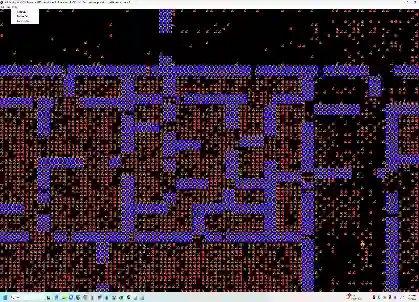
An artificial world of barriers and plains scattered with food is used to test the feasibility of using genetic algorithms to optimize hebbian neural networks to perform on problems without apriori knowledge of the problem domain. A formal L-System based genetic alphabet for neural networks, titled Lsys, and a neural network genetic modeling tool titled Wp1hgn are introduced. Lsys and Matrix neural network topology genetic encoding methods are compared across 24 experimental runs. Lsys encoding achieved a mean maximum food count of 3802 +- 197 at generation 1000 across 8 runs with varied parameters, compared to 1388 +- 610 for Matrix encoding, a 2.74x performance advantage with an 8.5-fold improvement in consistency as measured by coefficient of variation (5.2% vs 44.0%). All 8 Lsys populations successfully learned to navigate the environment, while 4 of 8 Matrix populations failed to achieve competitive performance at any point during 1000 generations. When transferred to a novel maze environment, Lsys populations demonstrated immediate robust generalization, achieving a mean maximum food count of 2455 +- 176 compared to 422 +- 212 for Matrix populations, a 5.82x advantage that exceeded the training world performance gap. A MatrixLSG control condition, in which initial populations were generated using Lsys genotypes and then evolved using Matrix operators, demonstrated that the performance advantage of Lsys encoding derives primarily from the genetic algorithm operating on the compressed symbolic Lsys alphabet throughout evolution rather than from initial population structure. Lsys encoding is shown to provide faster convergence, higher peak performance, dramatically greater reliability, and superior generalization to novel environments compared to Matrix encoding across all experimental conditions tested.
翻译:一个由障碍物和平原组成、散布着食物的人工世界被用于测试遗传算法优化赫布型神经网络的可行性,使其能在无先验领域知识的情况下解决问题。本文提出了基于形式化L系统的神经网络基因编码方案(Lsys)以及神经网络基因建模工具(Wp1hgn),并对Lsys与矩阵神经网络拓扑基因编码方法在24次实验中进行了比较。采用Lsys编码的8组不同参数实验中,第1000代平均最大食物计数为3802±197,而矩阵编码为1388±610,性能提升2.74倍,变异系数(5.2% vs 44.0%)显示一致性提升8.5倍。所有8个Lsys种群成功学会环境导航,而矩阵编码中4个种群在1000代内始终未能达到竞争性表现。当迁移至新型迷宫环境时,Lsys种群展现了即时鲁棒泛化能力,平均最大食物计数达2455±176(矩阵编码为422±212),5.82倍的优势超越了训练世界的性能差距。对照组实验(MatrixLSG)采用Lsys基因型初始化种群后以矩阵算子演化,证明Lsys编码的性能优势主要源于遗传算法在整个演化过程中对压缩符号化Lsys字母表的操作,而非初始种群结构。在所有实验条件下,Lsys编码较矩阵编码表现出更快的收敛速度、更高的峰值性能、显著提升的可靠性以及更优的泛化能力。





相关内容


 微信扫码咨询专知VIP会员