

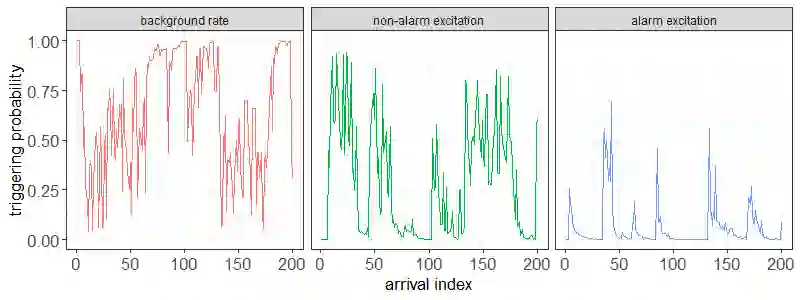
Hawkes processes are a class of self-exciting point processes that are used to model complex phenomena. While most applications of Hawkes processes assume that event data occurs in continuous-time, the less-studied discrete-time version of the process is more appropriate in some situations. In this work, we develop methodology for the efficient implementation of discrete Hawkes processes. We achieve this by developing efficient algorithms to evaluate the log-likelihood function and its gradient, whose computational complexity is linear in the number of events. We extend these methods to a particular form of a multivariate marked discrete Hawkes process which we use to model the occurrences of violent events within a forensic psychiatric hospital. A prominent feature of our problem, captured by a mark in our process, is the presence of an alarm system which can be heard throughout the hospital. An alarm is sounded when an event is particularly violent in nature and warrants a call for assistance from other members of staff. We conduct a detailed analysis showing that such a variant of the Hawkes process manages to outperform alternative models in terms of predictive power. Finally, we interpret our findings and describe their implications.
翻译:霍克斯过程是一类自激点过程,用于对复杂现象进行建模。尽管大多数霍克斯过程的应用假设事件数据在连续时间中发生,但在某些情况下,研究较少的离散时间版本的过程更为合适。本文中,我们开发了高效实现离散霍克斯过程的方法。通过设计高效算法来评估对数似然函数及其梯度,其计算复杂度与事件数量呈线性关系。我们将这些方法扩展到一种特定形式的多变量标记离散霍克斯过程,并用于建模法医精神病院内暴力事件的发生。我们问题的一个显著特征(由过程中的标记捕捉)是存在一个可在全院听到的报警系统。当事件本质上特别暴力且需要呼叫其他工作人员协助时,警报便会响起。我们进行了详细分析,表明这种霍克斯过程的变体在预测能力方面优于其他替代模型。最后,我们解释了研究结果并描述了其意义。




相关内容




 微信扫码咨询专知VIP会员