

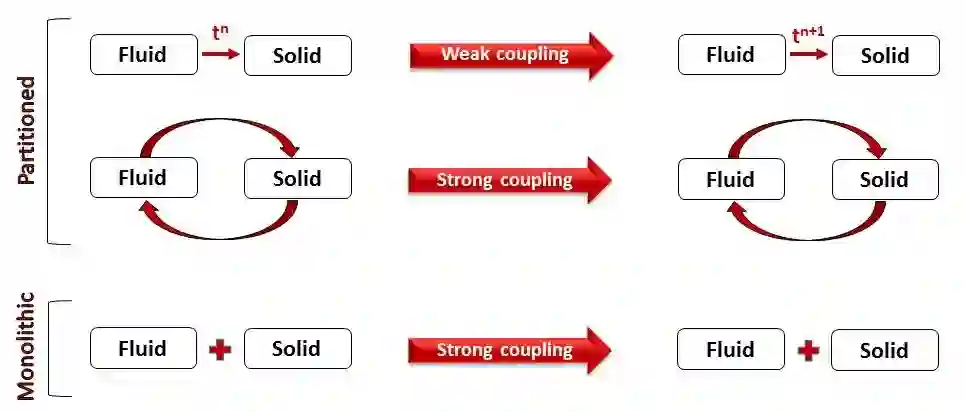
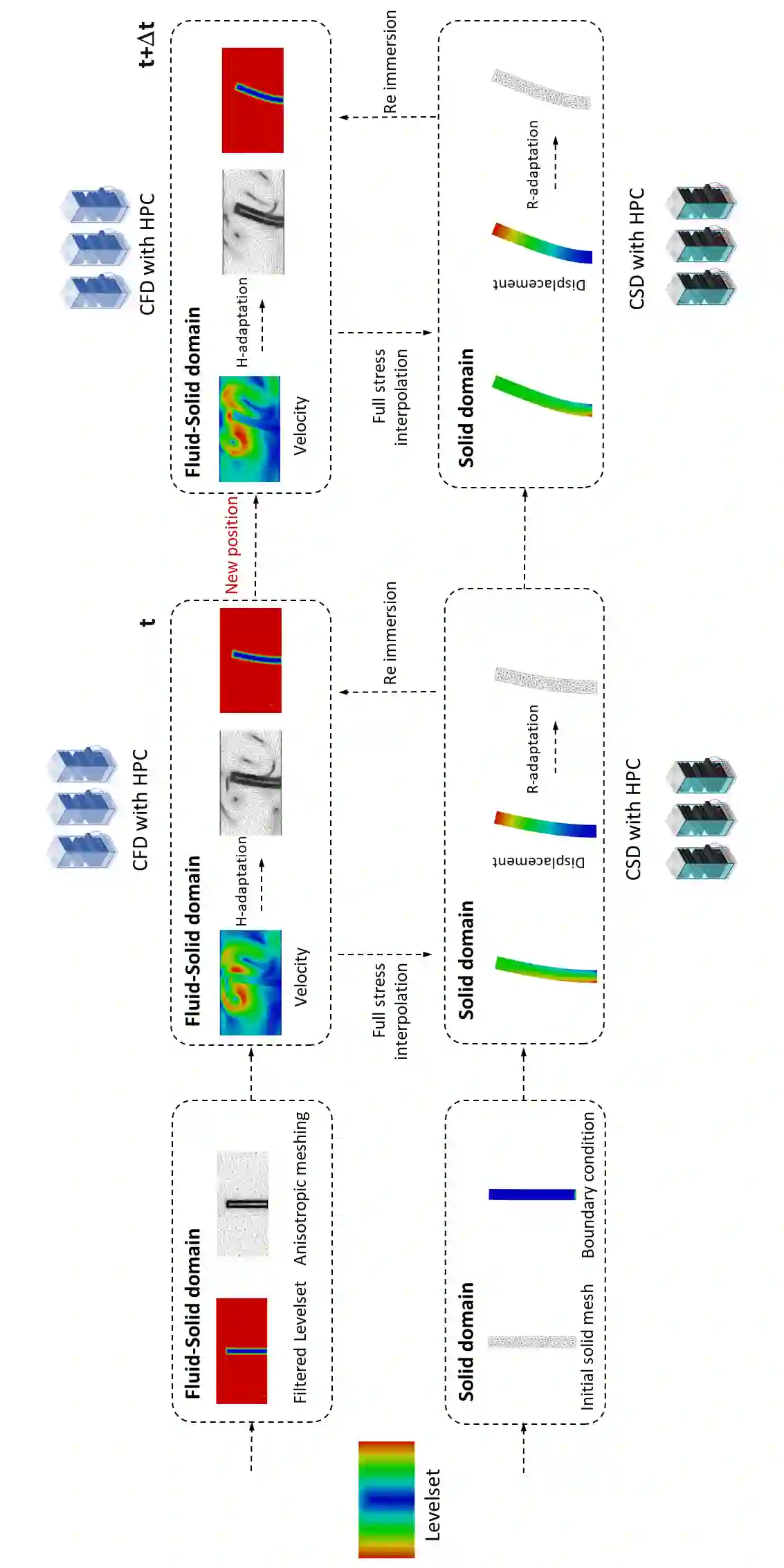
Our paper proposes an innovative approach for modeling Fluid-Structure Interaction (FSI). Our method combines both traditional monolithic and partitioned approaches, creating a hybrid solution that facilitates FSI. At each time iteration, the solid mesh is immersed within a fluid-solid mesh, all while maintaining its independent Lagrangian hyperelastic solver. The Eulerian mesh encompasses both the fluid and solid components and accommodates various physical phenomena. We enhance the interaction between solid and fluid through anisotropic mesh adaptation and the Level-Set methods. This enables a more accurate representation of their interaction. Together, these components constitute the Adaptive Immersed Mesh Method (AIMM). For both solvers, we utilize the Variational Multi-Scale (VMS) method, mitigating potential spurious oscillations common with piecewise linear tetrahedral elements. The framework operates in 3D with parallel computing capabilities. Our methods accuracy, robustness, and capabilities are assessed through a series of 2D numerical problems. Furthermore, we present various three-dimensional test cases and compare their results to experimental data.
翻译:本文提出了一种创新的流固耦合(FSI)建模方法。该方法融合了传统整体式与分区式方法,形成一种混合求解方案以促进FSI分析。在每个时间步迭代中,固体网格浸入流体-固体耦合网格中,同时保持其独立的拉格朗日超弹性求解器。欧拉网格同时覆盖流体与固体域,并适应多种物理现象。我们通过各向异性网格自适应与水平集方法增强固液相互作用,从而更精确地表征其交互行为。上述组件共同构成了自适应浸入网格方法(AIMM)。针对两个求解器,我们均采用变分多尺度(VMS)方法,以抑制分段线性四面体单元常见的潜在非物理振荡。该框架具备三维并行计算能力。通过一系列二维数值算例评估了方法的准确性、鲁棒性与功能。此外,我们呈现了多种三维测试案例,并将计算结果与实验数据进行了对比。





相关内容





 微信扫码咨询专知VIP会员