

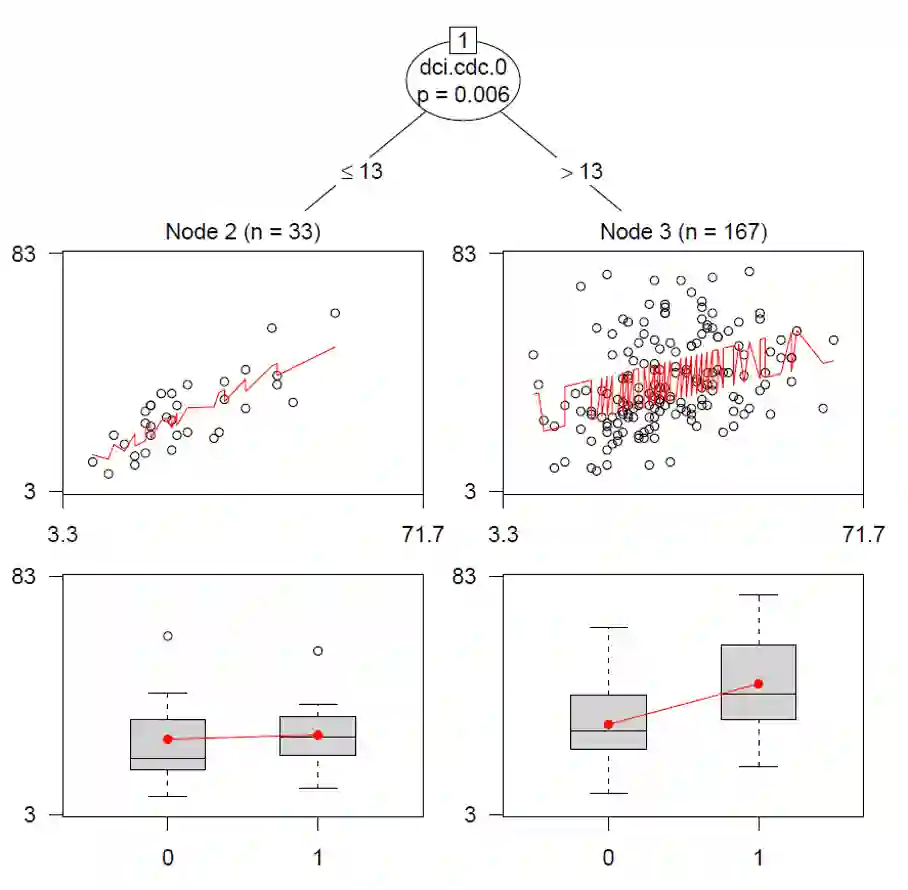
Genito-Pelvic Pain/Penetration-Disorder (GPPPD) is a common disorder but rarely treated in routine care. Previous research documents that GPPPD symptoms can be treated effectively using internet-based psychological interventions. However, non-response remains common for all state-of-the-art treatments and it is unclear which patient groups are expected to benefit most from an internet-based intervention. Multivariable prediction models are increasingly used to identify predictors of heterogeneous treatment effects, and to allocate treatments with the greatest expected benefits. In this study, we developed and internally validated a multivariable decision tree model that predicts effects of an internet-based treatment on a multidimensional composite score of GPPPD symptoms. Data of a randomized controlled trial comparing the internet-based intervention to a waitlist control group (N =200) was used to develop a decision tree model using model-based recursive partitioning. Model performance was assessed by examining the apparent and bootstrap bias-corrected performance. The final pruned decision tree consisted of one splitting variable, joint dyadic coping, based on which two response clusters emerged. No effect was found for patients with low dyadic coping ($n$=33; $d$=0.12; 95% CI: -0.57-0.80), while large effects ($d$=1.00; 95%CI: 0.68-1.32; $n$=167) are predicted for those with high dyadic coping at baseline. The bootstrap-bias-corrected performance of the model was $R^2$=27.74% (RMSE=13.22).
翻译:生殖器-盆腔疼痛/穿透障碍(GPPPD)是一种常见疾病,但在常规诊疗中很少得到治疗。既往研究证实,GPPPD症状可通过网络心理干预有效治疗。然而,对所有现有先进疗法而言,无应答现象仍很普遍,且尚不明确哪些患者群体预期能从网络干预中获益最多。多变量预测模型越来越多地被用于识别异质性治疗效果的预测因子,并分配预期获益最大的治疗方案。本研究开发并内部验证了一个多变量决策树模型,用于预测网络治疗对GPPPD症状多维复合评分的效果。利用一项将网络干预与等候名单对照组(N=200)进行比较的随机对照试验数据,采用基于模型的递归分割方法构建了决策树模型。通过评估表观性能及bootstrap偏差校正性能来检验模型表现。最终剪枝后的决策树包含一个分裂变量——联合二元应对,并据此产生两个应答亚组。低二元应对水平患者未见治疗效果(n=33;d=0.12;95% CI: -0.57-0.80),而基线高二元应对水平患者则预测有较大效果(d=1.00;95%CI: 0.68-1.32;n=167)。模型的bootstrap偏差校正性能指标为R²=27.74%(RMSE=13.22)。






相关内容




 微信扫码咨询专知VIP会员