

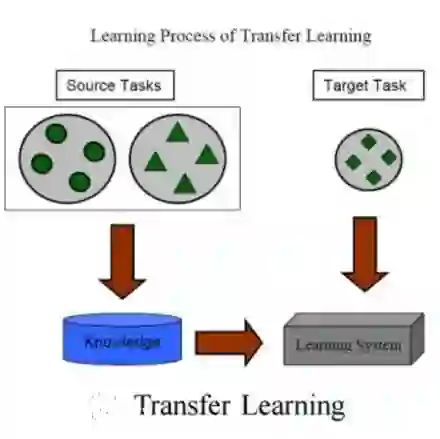
Sensor-based human activity recognition (HAR) has been an active research area, owing to its applications in smart environments, assisted living, fitness, healthcare, etc. Recently, deep learning based end-to-end training has resulted in state-of-the-art performance in domains such as computer vision and natural language, where large amounts of annotated data are available. However, large quantities of annotated data are not available for sensor-based HAR. Moreover, the real-world settings on which the HAR is performed differ in terms of sensor modalities, classification tasks, and target users. To address this problem, transfer learning has been employed extensively. In this survey, we focus on these transfer learning methods in the application domains of smart home and wearables-based HAR. In particular, we provide a problem-solution perspective by categorizing and presenting the works in terms of their contributions and the challenges they address. We also present an updated view of the state-of-the-art for both application domains. Based on our analysis of 205 papers, we highlight the gaps in the literature and provide a roadmap for addressing them. This survey provides a reference to the HAR community, by summarizing the existing works and providing a promising research agenda.
翻译:基于传感器的人类活动识别(HAR)因其在智能环境、辅助生活、健身、医疗健康等领域的应用,一直是一个活跃的研究方向。近年来,基于深度学习的端到端训练在计算机视觉和自然语言处理等领域取得了最先进的性能,这些领域通常拥有大量标注数据。然而,基于传感器的HAR领域却缺乏充足的标注数据。此外,HAR所涉及的真实场景在传感器模态、分类任务以及目标用户方面存在差异。为解决这一问题,迁移学习被广泛采用。本综述聚焦于迁移学习在智能家居和基于可穿戴设备的HAR应用领域中的方法。具体而言,我们从问题-解决方案的视角出发,根据各类研究的贡献及其所应对的挑战对其进行分类与呈现。同时,我们为这两个应用领域提供了最新的研究进展综述。基于对205篇文献的分析,我们指出了当前研究的空白,并提供了填补这些空白的路线图。本综述通过总结现有研究并提出具有前景的研究议程,为HAR领域的科研人员提供了参考依据。







相关内容

 微信扫码咨询专知VIP会员