

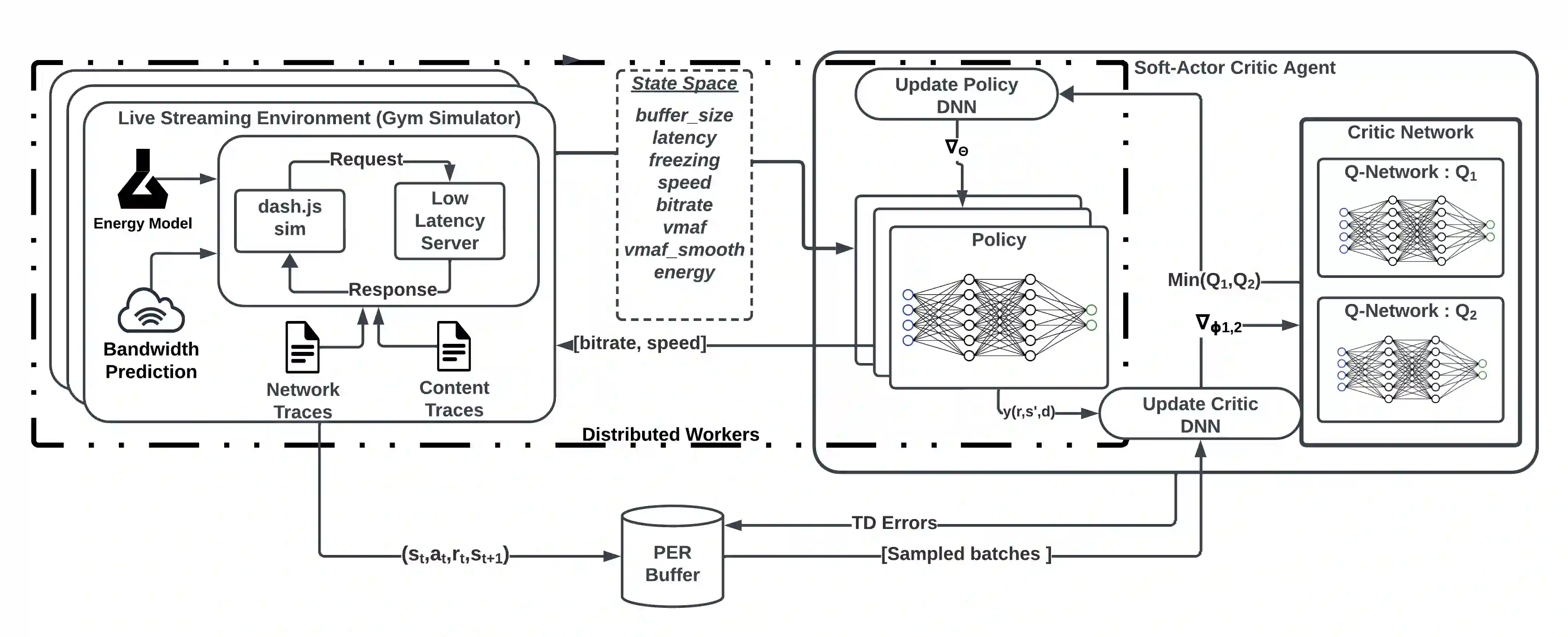
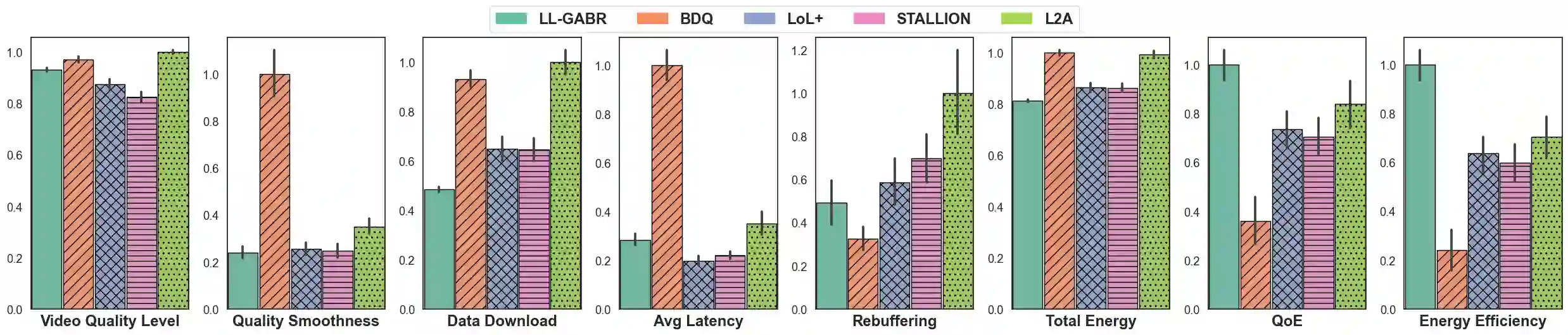
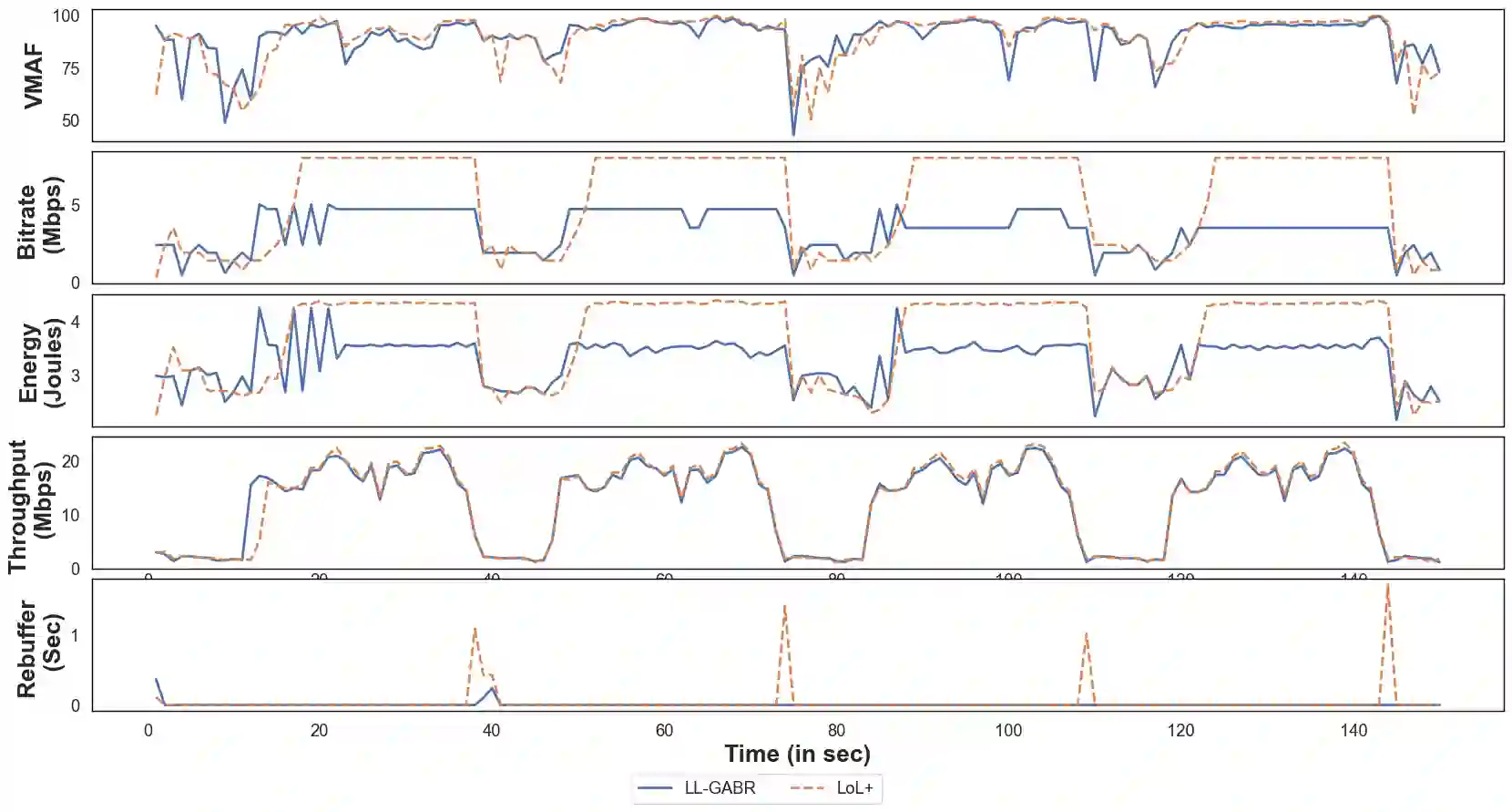
Over the recent years, research and development in adaptive bitrate (ABR) algorithms for live video streaming have been successful in improving users' quality of experience (QoE) by reducing latency to near real-time levels while delivering higher bitrate videos with minimal rebuffering time. However, the QoE models used by these ABR algorithms do not take into account that a large portion of live video streaming clients use mobile devices where a higher bitrate does not necessarily translate into higher perceived quality. Ignoring perceived quality results in playing videos at higher bitrates without a significant increase in perceptual video quality and becomes a burden for battery-constrained mobile devices due to higher energy consumption. In this paper, we propose LL-GABR, a deep reinforcement learning approach that models the QoE using perceived video quality instead of bitrate and uses energy consumption along with other metrics like latency, rebuffering events, and smoothness. LL-GABR makes no assumptions about the underlying video, environment, or network settings and can operate flexibly on different video titles, each having a different bitrate encoding ladder without additional re-training, unlike existing learning-based ABRs. Trace-driven experimental results show that LL-GABR outperforms the state-of-the-art approaches by up to 44% in terms of perceptual QoE and a 73% increase in energy efficiency as a result of reducing net energy consumption by 11%.
翻译:近年来,针对直播视频流的自适应比特率(ABR)算法研发取得了显著进展,通过将延迟降低至接近实时水平,同时以更少缓冲时间传输更优比特率视频,有效提升了用户质量体验(QoE)。然而,现有ABR算法所用的QoE模型并未考虑到大量直播视频流客户端使用移动设备——更高比特率未必转化为更高感知质量。忽视感知质量会导致视频以更高比特率播放而感知画质无显著提升,对受限于电池容量的移动设备造成额外的能耗负担。本文提出LL-GABR深度强化学习方案,该方案采用感知视频质量而非比特率建模QoE,并将能耗与延迟、缓冲事件、流畅度等指标共同纳入考量。与现有基于学习的ABR算法不同,LL-GABR无需对底层视频、环境或网络配置预设假设,可灵活适配不同比特率编码阶梯的视频文件且无需额外重新训练。基于真实网络轨迹的仿真实验结果表明,相较于现有最优方法,LL-GABR在感知QoE上提升达44%,同时通过降低11%的净能耗实现73%的能效提升。




相关内容



 微信扫码咨询专知VIP会员