

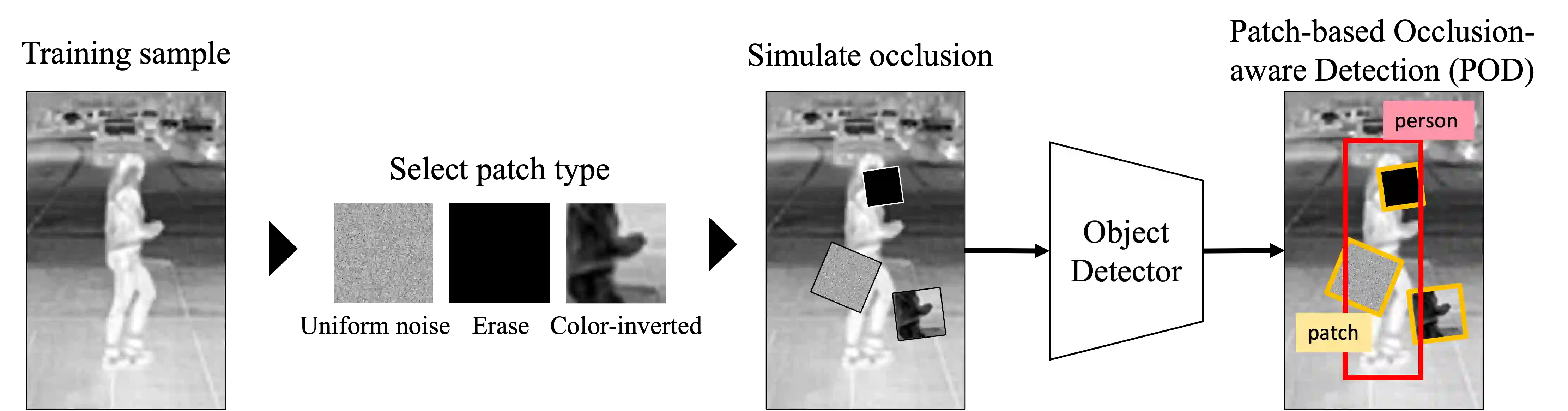
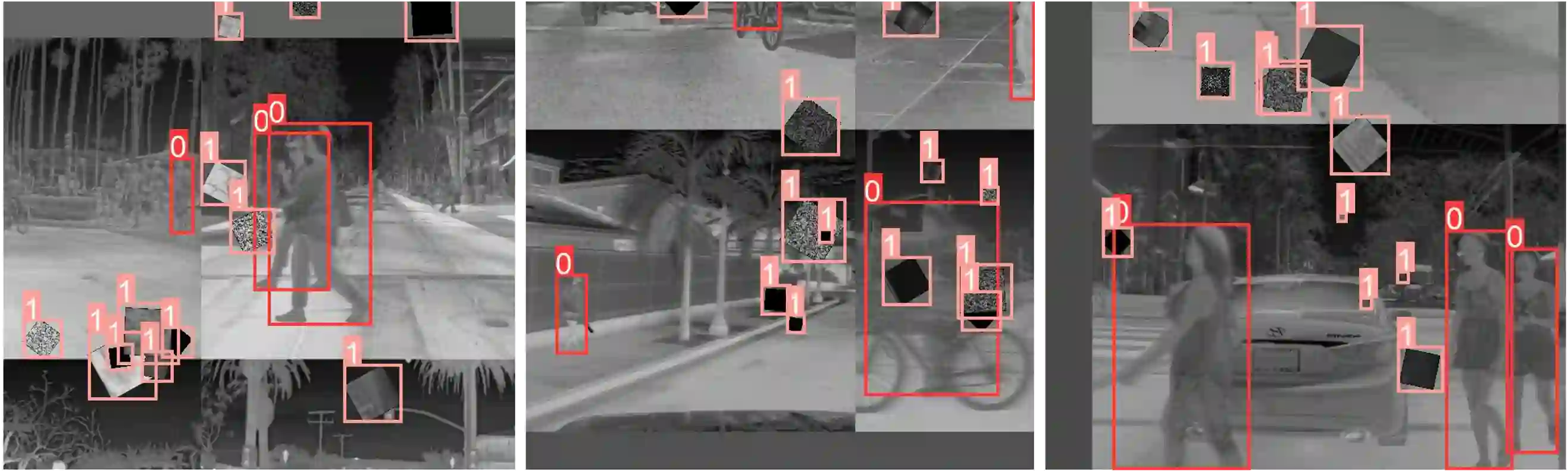
Infrared detection is an emerging technique for safety-critical tasks owing to its remarkable anti-interference capability. However, recent studies have revealed that it is vulnerable to physically-realizable adversarial patches, posing risks in its real-world applications. To address this problem, we are the first to investigate defense strategies against adversarial patch attacks on infrared detection, especially human detection. We have devised a straightforward defense strategy, patch-based occlusion-aware detection (POD), which efficiently augments training samples with random patches and subsequently detects them. POD not only robustly detects people but also identifies adversarial patch locations. Surprisingly, while being extremely computationally efficient, POD easily generalizes to state-of-the-art adversarial patch attacks that are unseen during training. Furthermore, POD improves detection precision even in a clean (i.e., no-attack) situation due to the data augmentation effect. Evaluation demonstrated that POD is robust to adversarial patches of various shapes and sizes. The effectiveness of our baseline approach is shown to be a viable defense mechanism for real-world infrared human detection systems, paving the way for exploring future research directions.
翻译:红外检测因其卓越的抗干扰能力,正成为安全关键任务中的新兴技术。然而,近期研究表明,该技术容易受到物理可实现的对抗性补丁攻击,这给其实际应用带来了风险。为解决此问题,我们首次研究了针对红外检测(尤其是人体检测)中对抗性补丁攻击的防御策略。我们设计了一种简洁的防御策略——基于补丁的遮挡感知检测(POD),该方法能高效地通过随机补丁增强训练样本,并随后对其进行检测。POD不仅能稳健地检测人体,还能识别对抗性补丁的位置。令人惊讶的是,在保持极高计算效率的同时,POD能轻松泛化至训练期间未见的最新对抗性补丁攻击。此外,由于数据增强效果,即使在无攻击的干净场景下,POD也能提升检测精度。评估表明,POD对不同形状和大小的对抗性补丁均具有鲁棒性。我们的基线方法被证明可作为一种可行的防御机制,应用于真实世界的红外人体检测系统,为探索未来研究方向铺平了道路。





相关内容



 微信扫码咨询专知VIP会员