

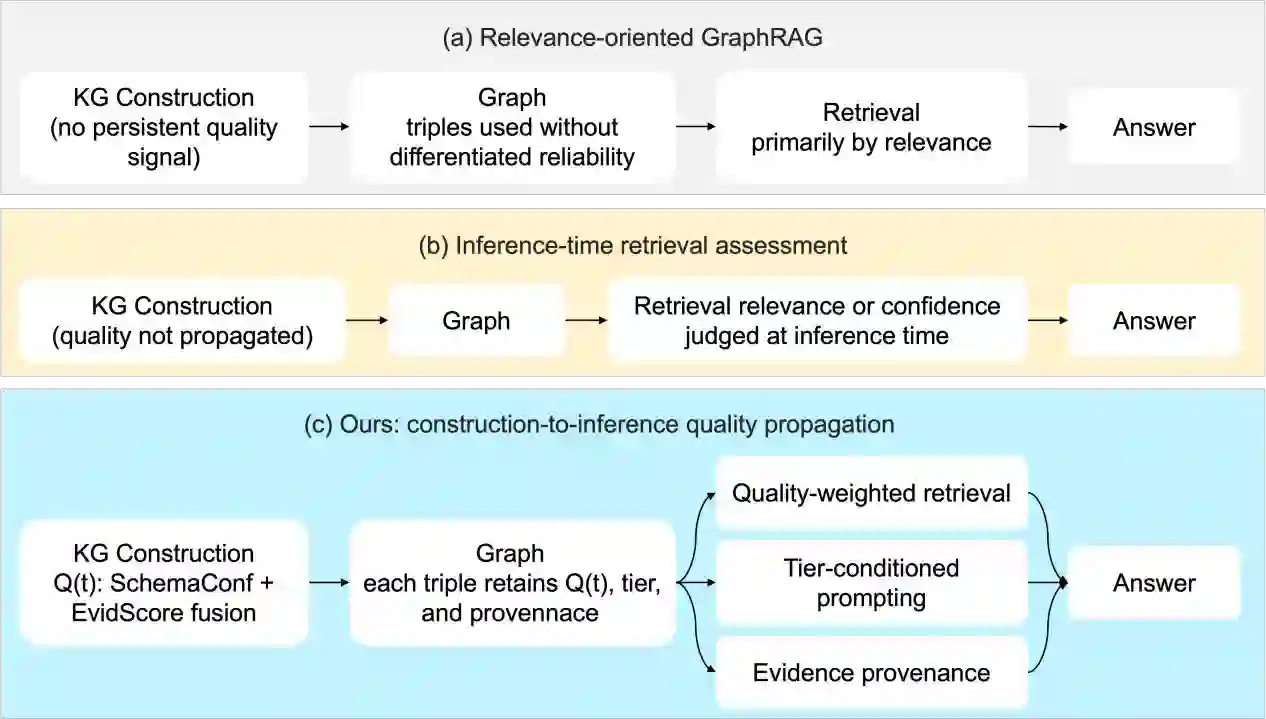
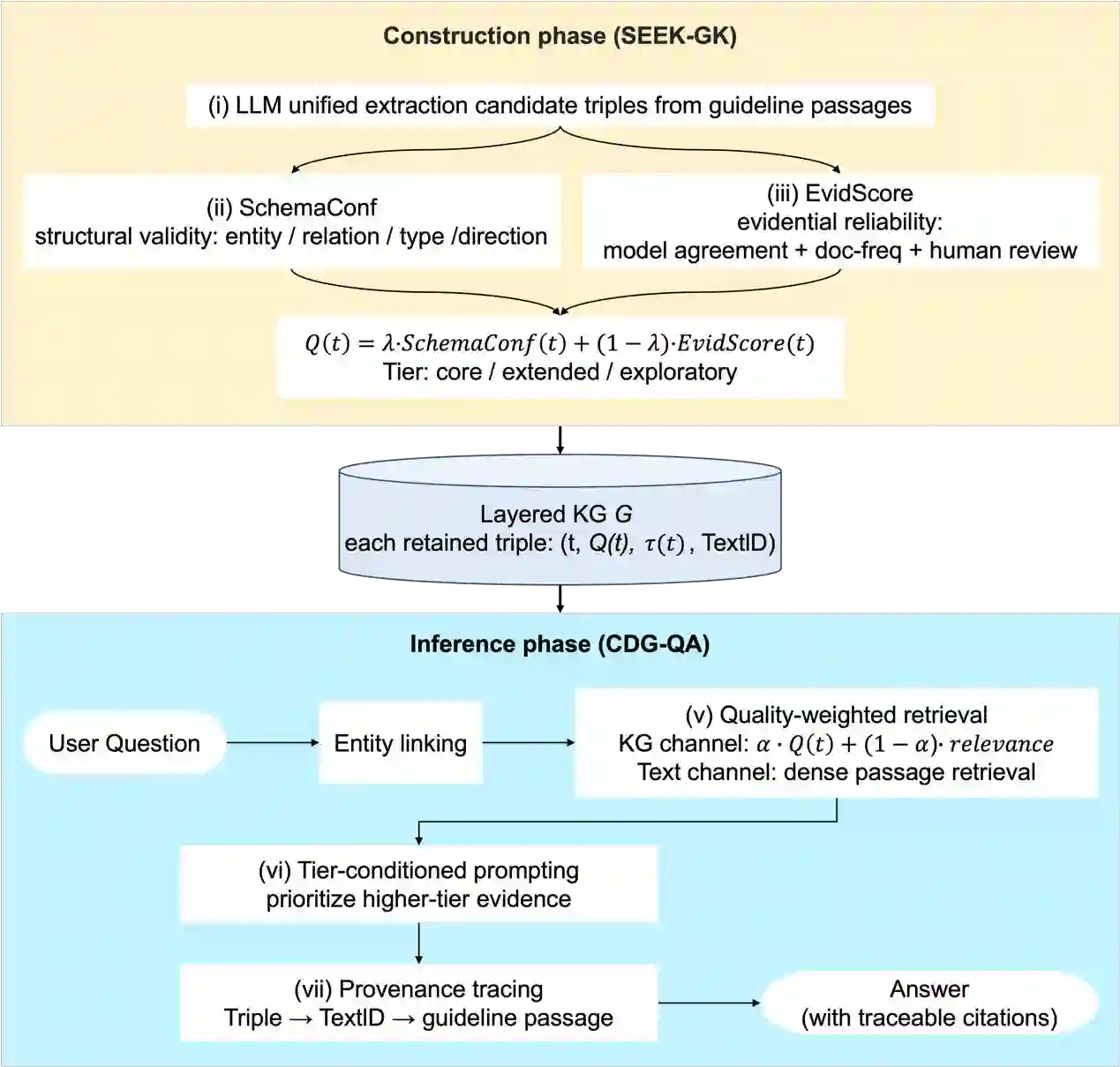
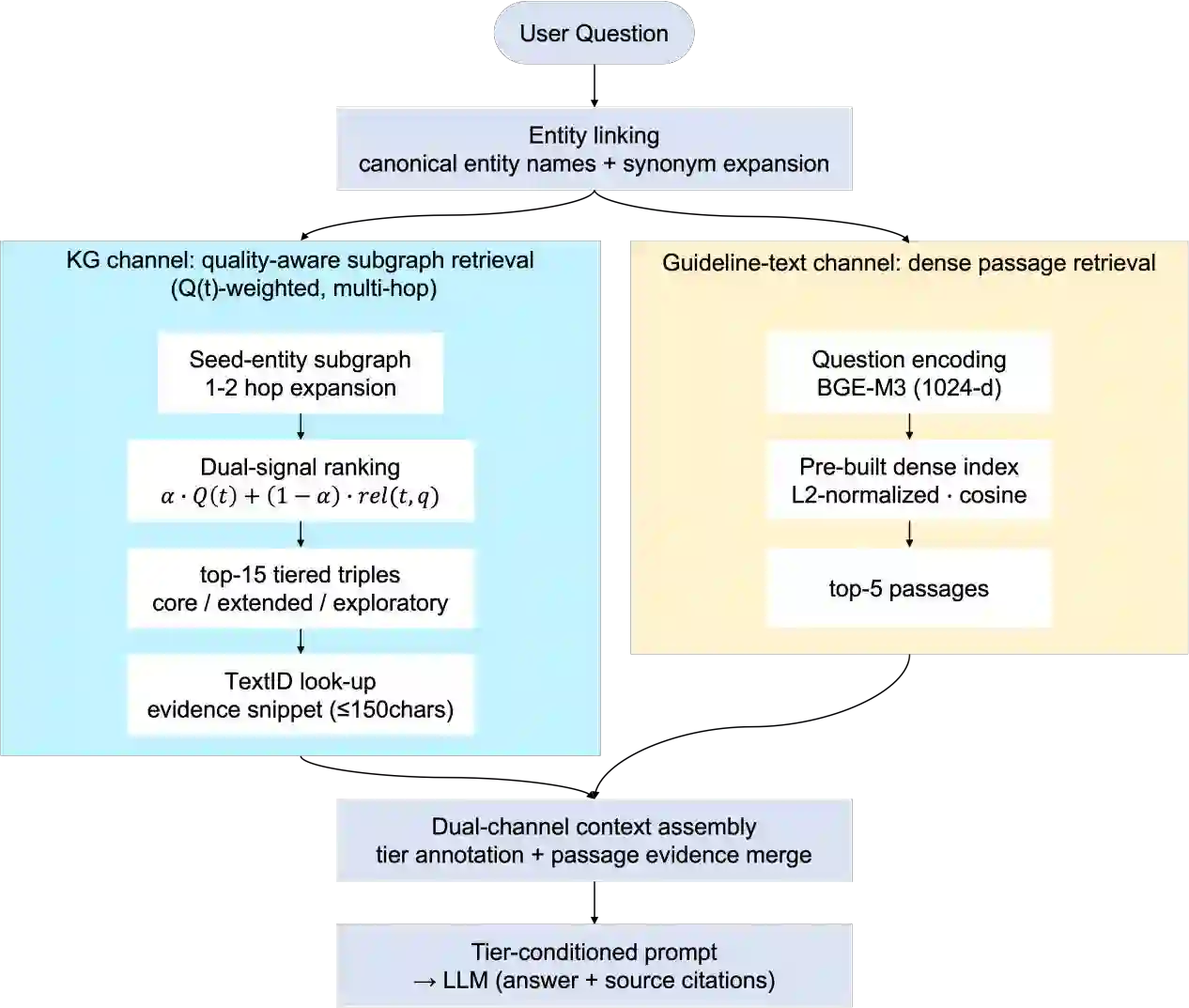
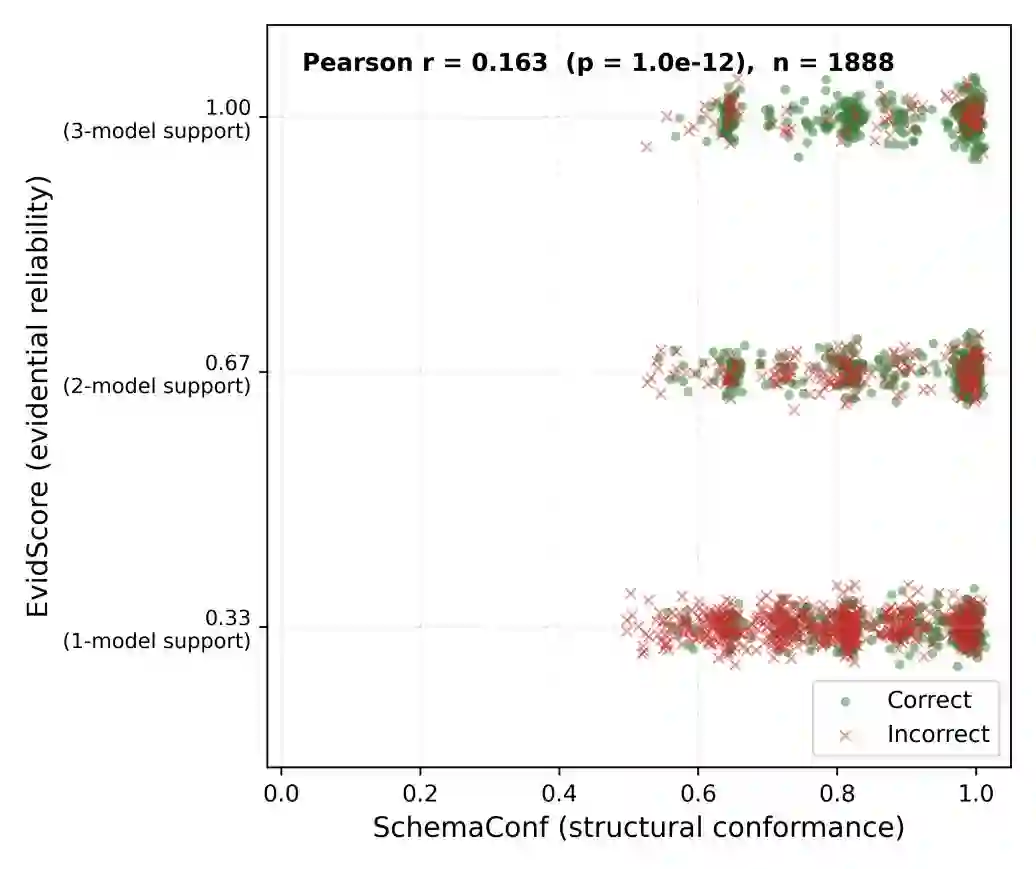
Large language models have facilitated knowledge graph (KG) construction from clinical guidelines, but extracted triples vary in structural validity and evidential support. Meanwhile, graph-augmented question answering (QA) systems typically optimize query relevance during retrieval, with limited reuse of quality information produced during KG construction. This creates a disconnect between construction-time quality control and inference-time evidence use. We investigate whether construction-time triple quality can serve as a persistent signal for downstream evidence selection and presentation. We propose a quality-aware framework that models structural conformance (SchemaConf) and evidential support (EvidScore) as complementary dimensions and fuses them into a per-triple quality signal, Q(t). Rather than using quality solely for filtering, the framework retains Q(t) and derived quality tiers as graph attributes and propagates them into quality-weighted subgraph retrieval and tier-conditioned evidence prompting, while preserving passage-level provenance. Experiments on Chinese diabetes clinical guidelines show that the utility of the quality signal is distribution dependent. Under cross-version and cross-model shift, the fused Q(t) provides stronger triple-quality discrimination than either component alone (AUC 0.748 vs. 0.703 for EvidScore and 0.645 for SchemaConf). In guideline-grounded QA, propagating construction-time quality reduces required-knowledge omission from 16.3% to 5.3% and conflicting outputs from 16.3% to 2.7%, with an evidence-grounded precision of 81.6% and near-zero invalid citations. Blinded clinician ratings favor the full framework over no retrieval (4.68 vs. 4.21 on a five-point scale) and approach the oracle condition (4.80), while cross-generator experiments show consistent trends.
翻译:暂无翻译


相关内容



 微信扫码咨询专知VIP会员