

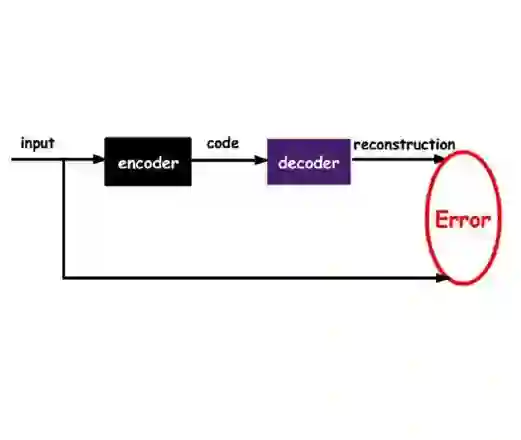
Subjective cognitive decline (SCD) is a preclinical stage of Alzheimer's disease (AD) which occurs even before mild cognitive impairment (MCI). Progressive SCD will convert to MCI with the potential of further evolving to AD. Therefore, early identification of progressive SCD with neuroimaging techniques (e.g., structural MRI) is of great clinical value for early intervention of AD. However, existing MRI-based machine/deep learning methods usually suffer the small-sample-size problem which poses a great challenge to related neuroimaging analysis. The central question we aim to tackle in this paper is how to leverage related domains (e.g., AD/NC) to assist the progression prediction of SCD. Meanwhile, we are concerned about which brain areas are more closely linked to the identification of progressive SCD. To this end, we propose an attention-guided autoencoder model for efficient cross-domain adaptation which facilitates the knowledge transfer from AD to SCD. The proposed model is composed of four key components: 1) a feature encoding module for learning shared subspace representations of different domains, 2) an attention module for automatically locating discriminative brain regions of interest defined in brain atlases, 3) a decoding module for reconstructing the original input, 4) a classification module for identification of brain diseases. Through joint training of these four modules, domain invariant features can be learned. Meanwhile, the brain disease related regions can be highlighted by the attention mechanism. Extensive experiments on the publicly available ADNI dataset and a private CLAS dataset have demonstrated the effectiveness of the proposed method. The proposed model is straightforward to train and test with only 5-10 seconds on CPUs and is suitable for medical tasks with small datasets.
翻译:主观认知衰退(SCD)是阿尔茨海默病(AD)的临床前期阶段,其出现甚至早于轻度认知障碍(MCI)。进展性SCD将转化为MCI,并可能进一步演变为AD。因此,利用神经影像技术(如结构MRI)早期识别进展性SCD对AD的早期干预具有重要临床价值。然而,现有基于MRI的机器学习/深度学习方法通常面临小样本量问题,这给相关神经影像分析带来了巨大挑战。本文旨在解决的核心问题是如何利用相关领域(如AD/NC)辅助SCD的进展预测,同时关注哪些脑区与进展性SCD的识别更密切相关。为此,我们提出一种注意力引导的自编码器模型,用于高效跨域自适应,促进从AD到SCD的知识迁移。该模型由四个关键模块组成:1)特征编码模块,用于学习不同领域的共享子空间表示;2)注意力模块,用于自动定位脑图谱中定义的判别性感兴趣脑区;3)解码模块,用于重建原始输入;4)分类模块,用于识别脑部疾病。通过这四个模块的联合训练,可学习到领域不变特征,同时注意力机制能够突出与脑疾病相关的区域。在公开的ADNI数据集和私有CLAS数据集上进行的广泛实验证明了该方法的有效性。所提模型训练和测试简便,在CPU上仅需5-10秒,适用于小样本医学任务。




相关内容




 微信扫码咨询专知VIP会员