

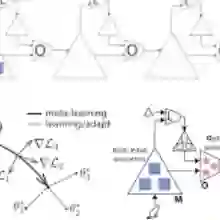
While developments in machine learning led to impressive performance gains on big data, many human subjects data are, in actuality, small and sparsely labeled. Existing methods applied to such data often do not easily generalize to out-of-sample subjects. Instead, models must make predictions on test data that may be drawn from a different distribution, a problem known as \textit{zero-shot learning}. To address this challenge, we develop an end-to-end framework using a meta-learning approach, which enables the model to rapidly adapt to a new prediction task with limited training data for out-of-sample test data. We use three real-world small-scale human subjects datasets (two randomized control studies and one observational study), for which we predict treatment outcomes for held-out treatment groups. Our model learns the latent treatment effects of each intervention and, by design, can naturally handle multi-task predictions. We show that our model performs the best holistically for each held-out group and especially when the test group is distinctly different from the training group. Our model has implications for improved generalization of small-size human studies to the wider population.
翻译:尽管机器学习在大型数据集上取得了显著性能提升,但实际中许多人类受试者数据存在规模小且标注稀疏的问题。现有方法应用于此类数据时,往往难以泛化至样本外的受试者。相反,模型必须对可能来自不同分布的测试数据进行预测,这一挑战被称为“零样本学习”。为解决该问题,我们开发了一种基于元学习方法的端到端框架,使模型能通过少量训练数据快速适应样本外测试数据的新预测任务。我们使用三个真实世界的小规模人类受试者数据集(两项随机对照研究与一项观察性研究),预测保留治疗组的干预效果。该模型能学习每种干预的潜在处理效应,并天然支持多任务预测。实验表明,我们的模型在整体上对每个保留组表现最优,尤其在测试组与训练组存在显著差异时。该模型有望提升小规模人类研究向更广泛人群推广的泛化能力。




相关内容


 微信扫码咨询专知VIP会员