

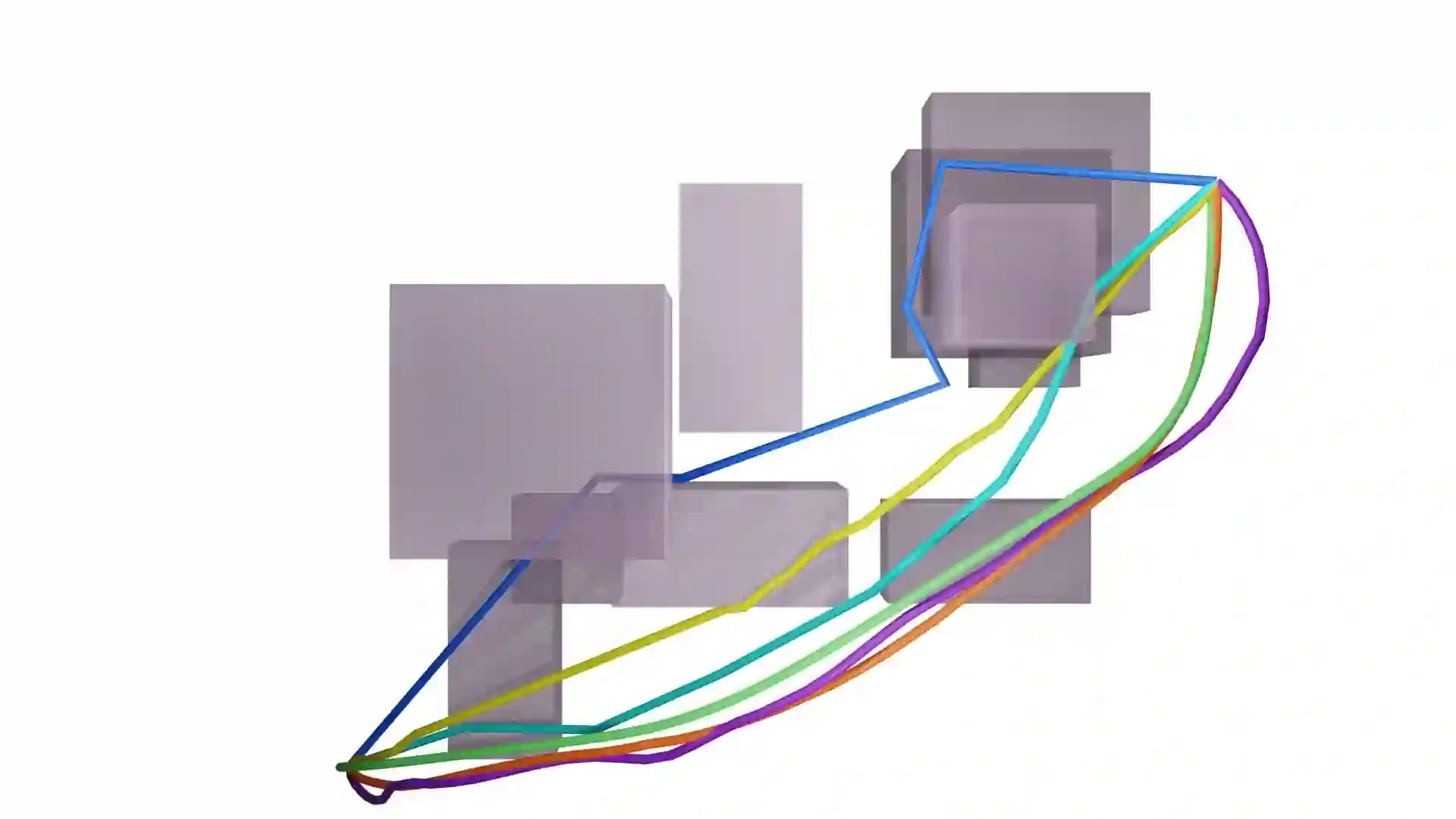
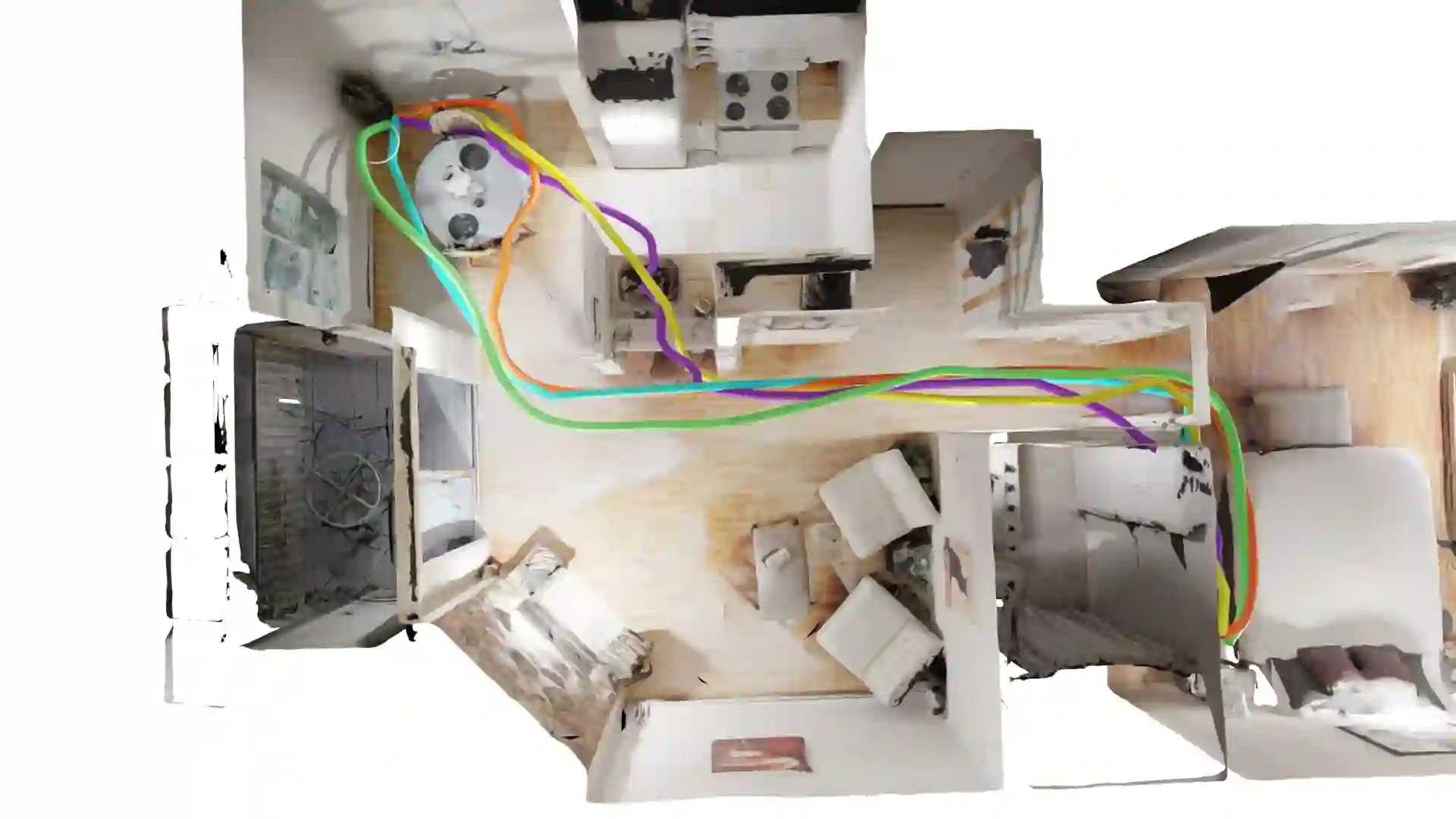
Neural Motion Planners (NMPs) have emerged as a promising tool for solving robot navigation tasks in complex environments. However, these methods often require expert data for learning, which limits their application to scenarios where data generation is time-consuming. Recent developments have also led to physics-informed deep neural models capable of representing complex dynamical Partial Differential Equations (PDEs). Inspired by these developments, we propose Neural Time Fields (NTFields) for robot motion planning in cluttered scenarios. Our framework represents a wave propagation model generating continuous arrival time to find path solutions informed by a nonlinear first-order PDE called Eikonal Equation. We evaluate our method in various cluttered 3D environments, including the Gibson dataset, and demonstrate its ability to solve motion planning problems for 4-DOF and 6-DOF robot manipulators where the traditional grid-based Eikonal planners often face the curse of dimensionality. Furthermore, the results show that our method exhibits high success rates and significantly lower computational times than the state-of-the-art methods, including NMPs that require training data from classical planners.
翻译:神经运动规划器(NMPs)已成为解决复杂环境下机器人导航任务的有前景工具。然而,这类方法通常需要专家数据进行学习,这限制了其在数据生成耗时场景下的应用。近期发展催生了能够表示复杂动态偏微分方程(PDEs)的物理信息深度神经网络模型。受此启发,我们提出用于杂乱场景中机器人运动规划的神经时间场(NTFields)。该框架通过名为程函方程的非线性一阶PDE,构建生成连续到达时间的波传播模型,以寻找路径解。我们在包括Gibson数据集在内的多种杂乱3D环境中评估该方法,验证了其能够解决4自由度及6自由度机器人操作臂的运动规划问题,而传统基于网格的程函规划器常在此类场景中面临维数灾难。此外,结果表明,相较于包括需要传统规划器训练数据的NMPs在内的最新方法,本方法展现出高成功率与显著更低的计算耗时。







相关内容





 微信扫码咨询专知VIP会员