

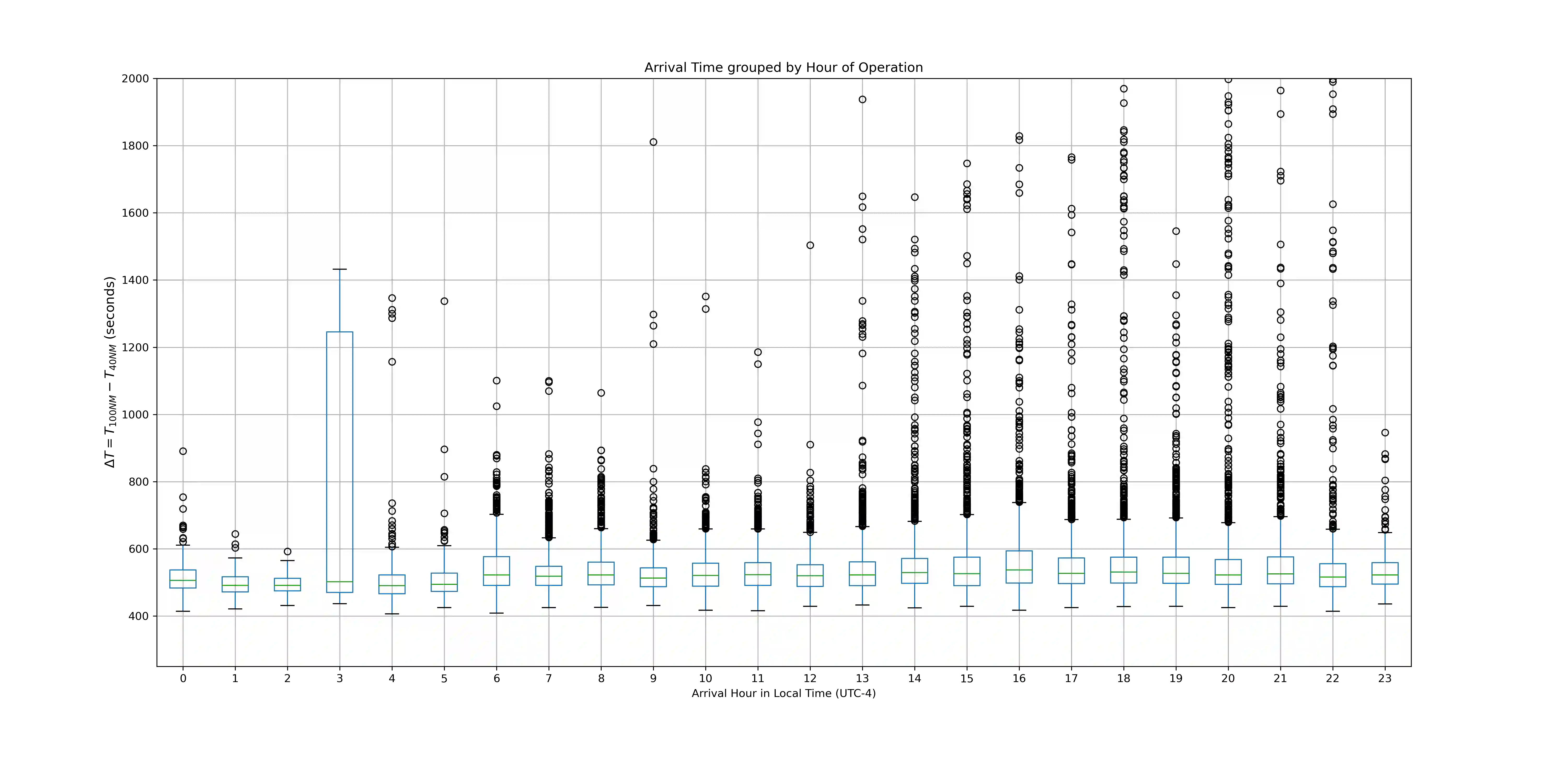
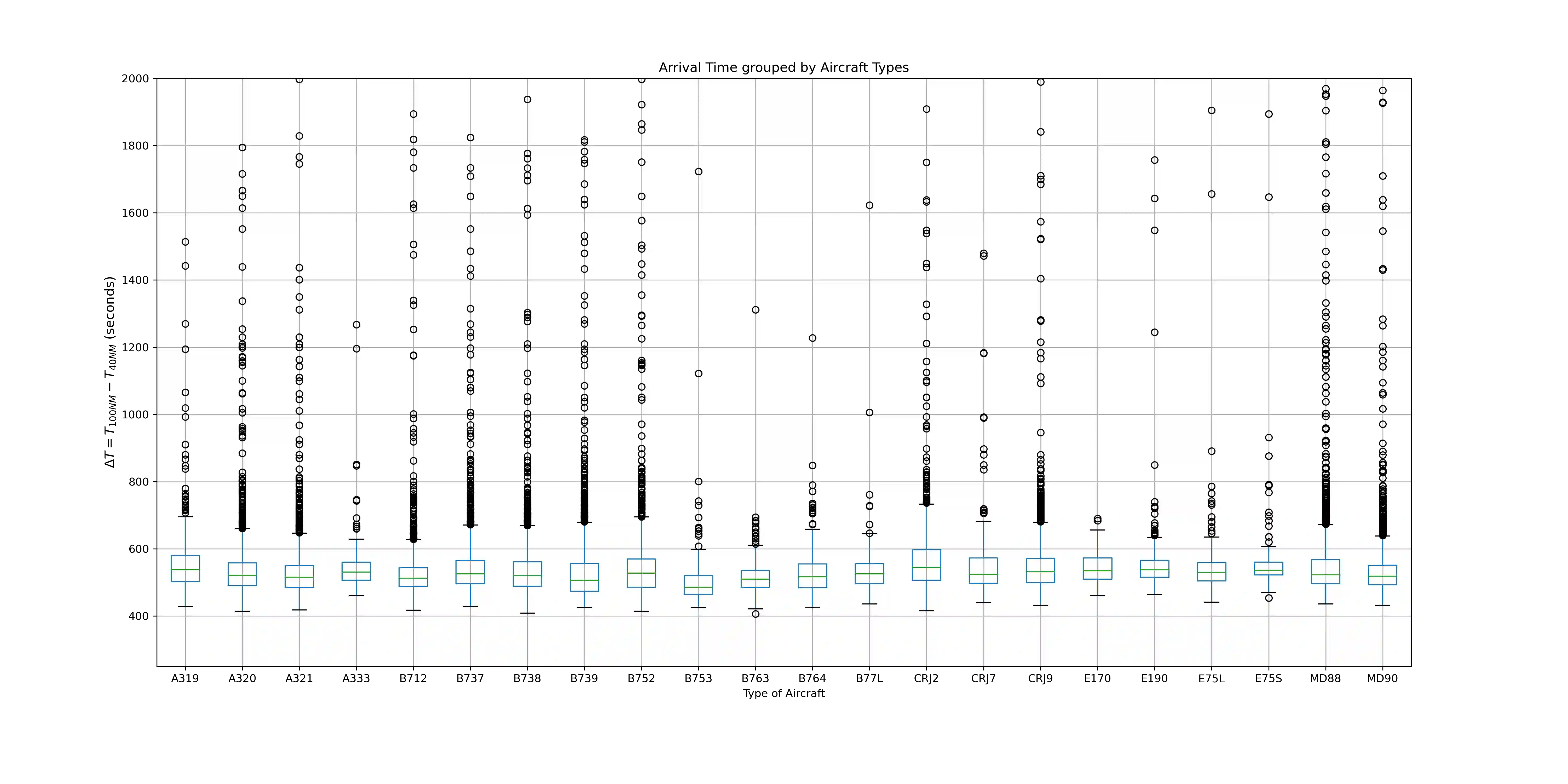
This paper addresses aircraft delays, emphasizing their impact on safety and financial losses. To mitigate these issues, an innovative machine learning (ML)-enhanced landing scheduling methodology is proposed, aiming to improve automation and safety. Analyzing flight arrival delay scenarios reveals strong multimodal distributions and clusters in arrival flight time durations. A multi-stage conditional ML predictor enhances separation time prediction based on flight events. ML predictions are then integrated as safety constraints in a time-constrained traveling salesman problem formulation, solved using mixed-integer linear programming (MILP). Historical flight recordings and model predictions address uncertainties between successive flights, ensuring reliability. The proposed method is validated using real-world data from the Atlanta Air Route Traffic Control Center (ARTCC ZTL). Case studies demonstrate an average 17.2% reduction in total landing time compared to the First-Come-First-Served (FCFS) rule. Unlike FCFS, the proposed methodology considers uncertainties, instilling confidence in scheduling. The study concludes with remarks and outlines future research directions.
翻译:本文针对航班延误问题展开研究,重点分析了延误对安全性和经济损失的影响。为缓解上述问题,提出了一种创新的机器学习增强型着陆调度方法,旨在提升自动化水平与安全性。对航班到达延误场景的分析揭示了到达飞行时间持续时间的强多模态分布与聚类特征。基于飞行事件,多阶段条件式机器学习预测器可增强间隔时间预测。随后,将机器学习预测作为安全约束集成到带时间约束的旅行商问题框架中,并通过混合整数线性规划求解。利用历史航班记录与模型预测处理连续航班间的不确定性,确保调度可靠性。基于亚特兰大航路交通管制中心(ARTCC ZTL)的真实数据验证了所提方法的有效性。案例研究表明,与先到先服务规则相比,该方法使总着陆时间平均减少17.2%。不同于先到先服务规则,所提方法通过考虑不确定性,增强了调度方案的可信度。最后总结研究结论,并展望未来研究方向。







相关内容




 微信扫码咨询专知VIP会员