

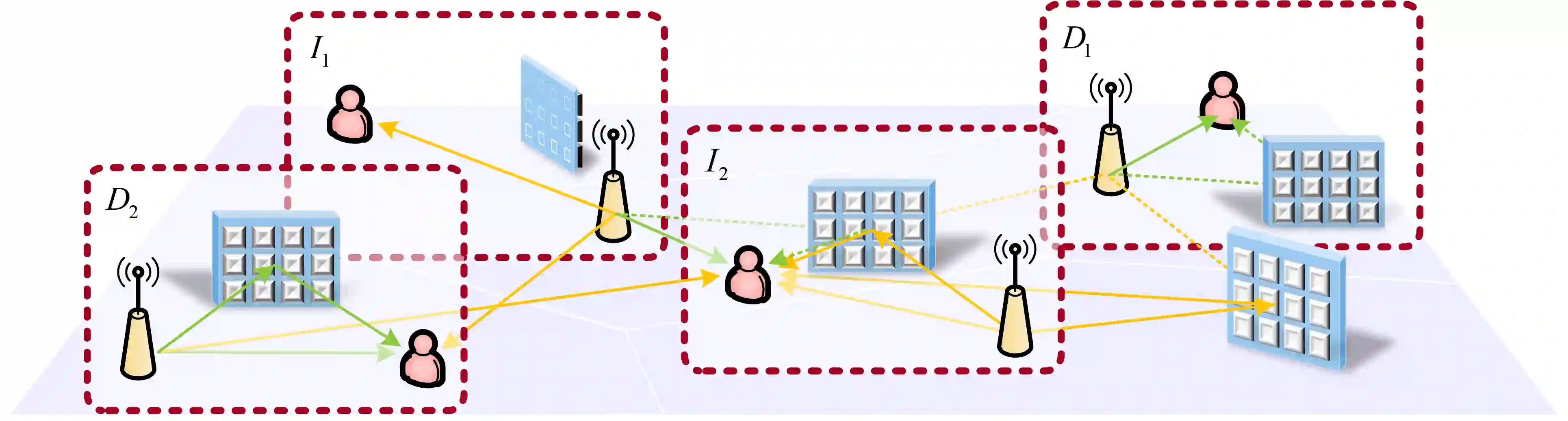
With the fast development of reconfigurable intelligent surface (RIS), the network topology becomes more complex and varied, which makes the network design and analysis extremely challenging. Most of the current works adopt the binary system stochastic geometric, missing the coupling relationships between the direct and reflected paths caused by RISs. In this paper, we first define the typical triangle which consists of a base station (BS), a RIS and a user equipment (UE) as the basic ternary network unit in a RIS-assisted ultra-dense network (UDN). In addition, we extend the Campbell's theorem to the ternary system and present the ternary probability generating functional (PGFL) of the stochastic geometry. Based on the ternary stochastic geometry theory, we derive and analyze the coverage probability, area spectral efficiency (ASE), area energy efficiency (AEE) and energy coverage efficiency (ECE) of the RIS-assisted UDN system. Simulation results show that the RISs can improve the system performances, especially for the UE who has a high signal to interference plus noise ratio (SINR), as if the introduced RIS brings in Matthew effect. This phenomenon of RIS is appealing for guiding the design of complex networks.
翻译:随着可重构智能表面(RIS)的快速发展,网络拓扑结构变得愈发复杂多样,这给网络设计与分析带来了极大挑战。当前多数工作采用二元系统随机几何方法,却忽略了RIS引起的直射路径与反射路径之间的耦合关系。本文首次将典型三角形——由基站(BS)、RIS和用户设备(UE)构成——定义为RIS辅助超密集网络(UDN)中的基本三元网络单元。此外,我们将坎贝尔定理推广至三元系统,提出了随机几何的三元概率生成泛函(PGFL)。基于三元随机几何理论,我们推导并分析了RIS辅助UDN系统的覆盖概率、区域频谱效率(ASE)、区域能量效率(AEE)和能量覆盖效率(ECE)。仿真结果表明,RIS能够提升系统性能,尤其对于具有高信干噪比(SINR)的UE而言,其效果类似于引入的RIS带来了马太效应。这一RIS现象对于指导复杂网络设计具有重要意义。








相关内容



 微信扫码咨询专知VIP会员