

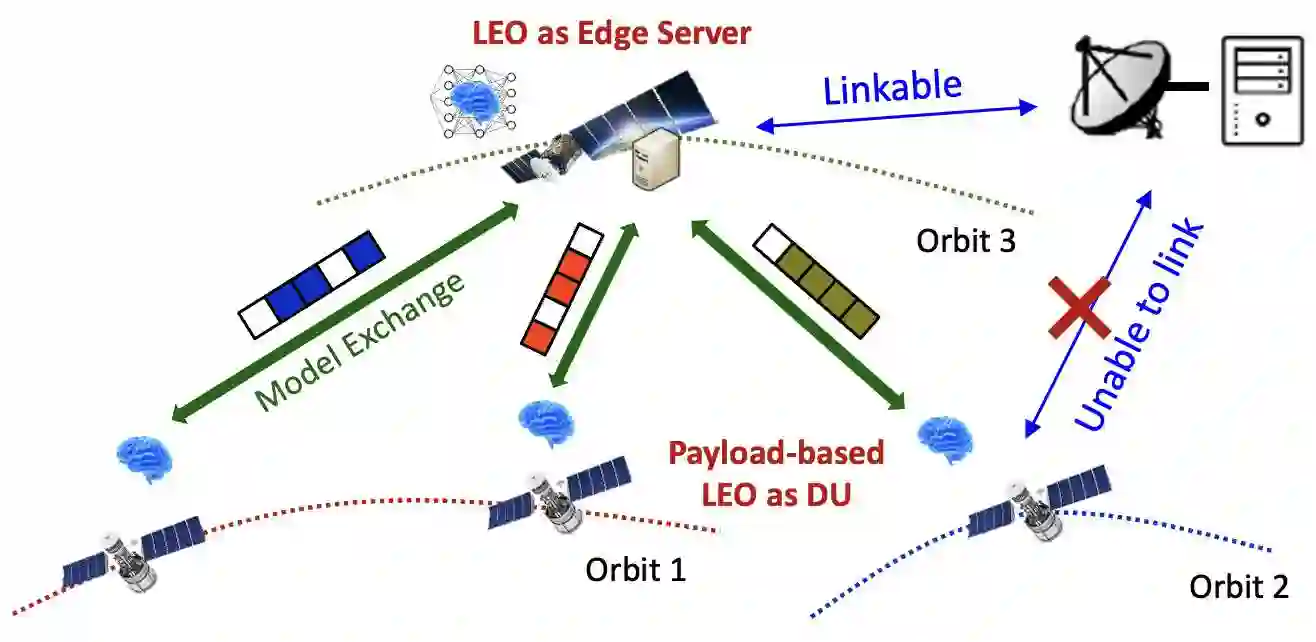
Low-Earth orbit (LEO) satellites have been prosperously deployed for various Earth observation missions due to its capability of collecting a large amount of image or sensor data. However, traditionally, the data training process is performed in the terrestrial cloud server, which leads to a high transmission overhead. With the recent development of LEO, it is more imperative to provide ultra-dense LEO constellation with enhanced on-board computation capability. Benefited from it, we have proposed a collaborative federated learning for low Earth orbit (FELLO). We allocate the entire process on LEOs with low payload inter-satellite transmissions, whilst the low-delay terrestrial gateway server (GS) only takes care for initial signal controlling. The GS initially selects an LEO server, whereas its LEO clients are all determined by clustering mechanism and communication capability through the optical inter-satellite links (ISLs). The re-clustering of changing LEO server will be executed once with low communication quality of FELLO. In the simulations, we have numerically analyzed the proposed FELLO under practical Walker-based LEO constellation configurations along with MNIST training dataset for classification mission. The proposed FELLO outperforms the conventional centralized and distributed architectures with higher classification accuracy as well as comparably lower latency of joint communication and computing.
翻译:低地球轨道(LEO)卫星凭借其收集大量图像或传感器数据的能力,已广泛部署于各类对地观测任务中。然而,传统上数据训练过程在地面云服务器上执行,导致较高的传输开销。随着LEO技术的近期发展,亟需为超密集LEO星座提供增强的星载计算能力。基于此优势,我们提出了一种面向低地球轨道的协作式联邦学习(FELLO)。我们将整个训练过程分配至具有低载荷星间链路的LEO卫星上,而低延迟的地面网关服务器(GS)仅负责初始信号控制。GS初始选择一个LEO服务器,而其LEO客户端则完全通过聚类机制和光学星间链路(ISL)的通信能力确定。当FELLO通信质量较低时,将对动态变化的LEO服务器执行重新聚类。仿真中,我们在基于Walker构型的实际LEO星座配置下,结合MNIST训练数据集对分类任务进行了数值分析。所提出的FELLO算法在分类准确率上优于传统集中式和分布式架构,同时联合通信与计算时延更低。





相关内容



 微信扫码咨询专知VIP会员