

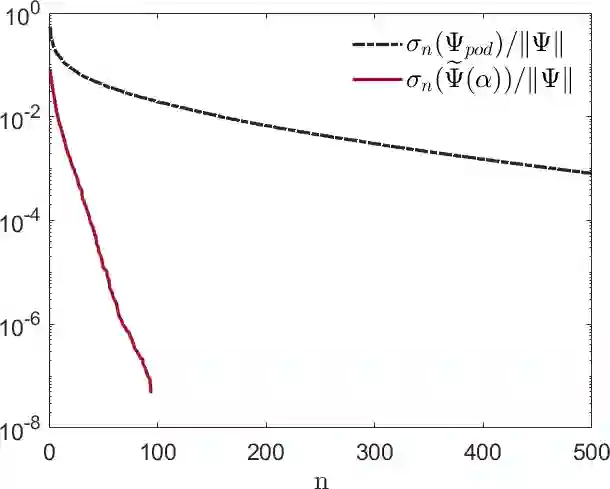
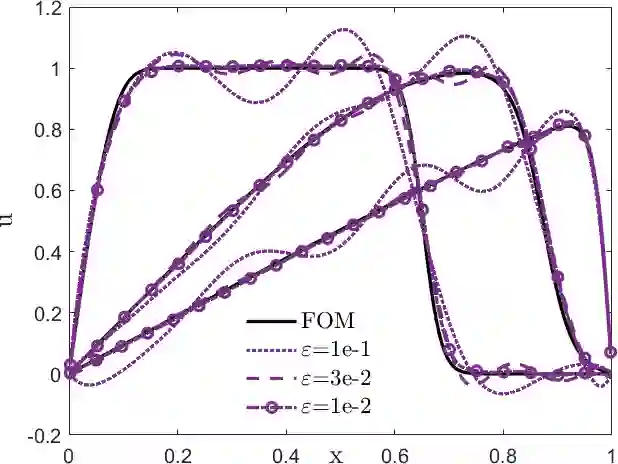
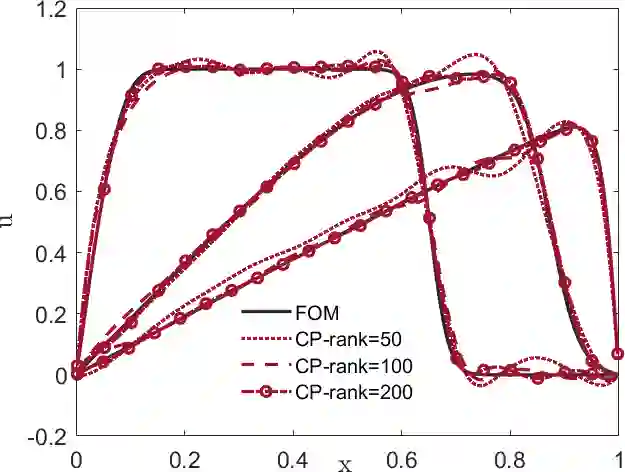
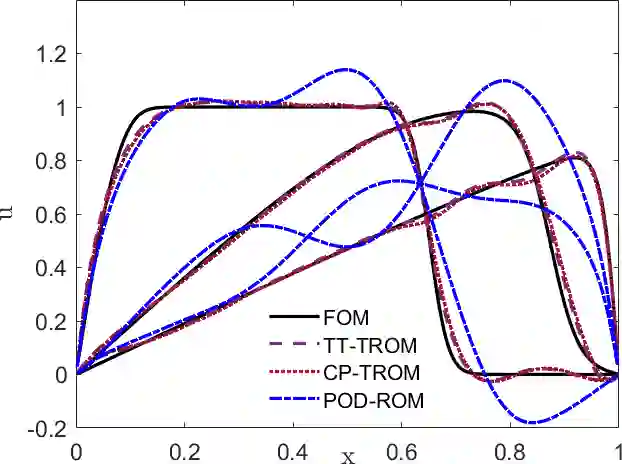
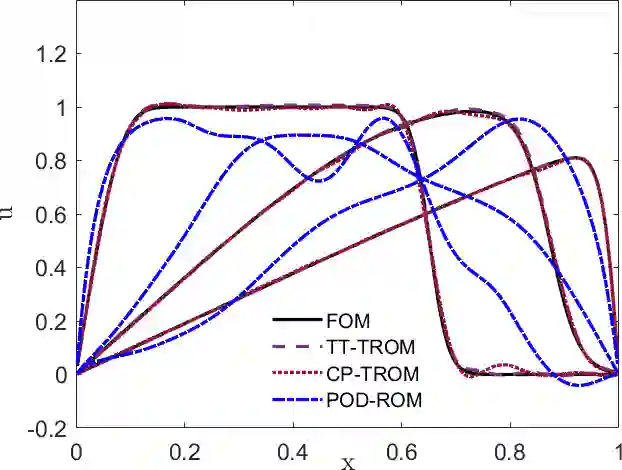
For a nonlinear dynamical system depending on parameters the paper introduces a novel tensorial reduced order model (TROM). The reduced model is projection-based and for systems with no parameters involved it resembles the proper orthogonal decomposition (POD) combined with the discrete empirical interpolation method (DEIM). For parametric systems, the TROM employs low-rank tensor approximations in place of truncated SVD, a key dimension-reduction technique in POD with DEIM. Three popular low-rank tensor compression formats are considered for this purpose: canonical polyadic, Tucker, and tensor train. The use of multi-linear algebra tools allows to incorporate the information about the parameter dependence of the system into the reduced model and leads to a POD--DEIM type ROM which (i) is parameter-specific (localized) and predicts the system dynamics for out-of-training set (unseen) parameter values, (ii) mitigates the adverse effects of high parameter space dimension, (iii) has online computational costs that depend only on tensor compression ranks but not on the full order model size, and (iv) achieves lower reduced space dimensions compared to the conventional POD--DEIM ROM. The paper explains the method, analyzes its prediction power, and assesses its performance for two specific parameter-dependent non-linear dynamical systems.
翻译:对于依赖参数的非线性动力系统,本文提出了一种新颖的张量降阶模型(TROM)。该降阶模型基于投影方法,当系统不涉及参数时,其效果类似于本征正交分解(POD)结合离散经验插值法(DEIM)。对于参数化系统,TROM采用低秩张量近似代替截断奇异值分解(SVD)——后者是POD与DEIM中的关键降维技术。为此,本文考虑了三种主流的低秩张量压缩格式:典型多线性分解、塔克分解和张量列分解。通过利用多重线性代数工具,该方法能够将系统参数依赖性的信息融入降阶模型,从而生成一种POD-DEIM型ROM,其具备以下特性:(i) 参数特异(局部化)且可预测非训练集(未见过)参数值下的系统动态;(ii) 缓解参数空间维度过高带来的负面影响;(iii) 在线计算复杂度仅取决于张量压缩秩,而与全阶模型规模无关;(iv) 相比传统POD-DEIM ROM,可实现更低的降阶空间维度。本文阐述了该方法的原理,分析了其预测能力,并通过两个具体的参数相关非线性动力系统评估了其性能。




相关内容




 微信扫码咨询专知VIP会员