

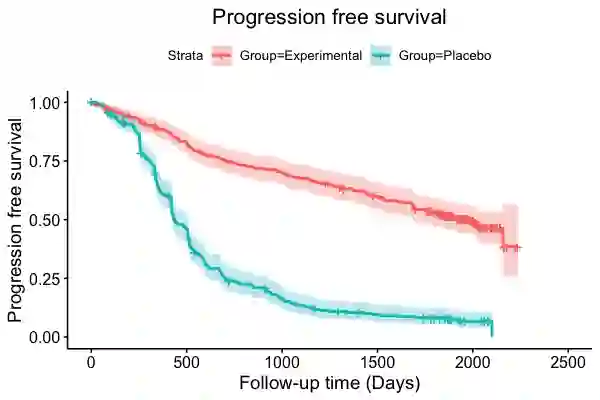
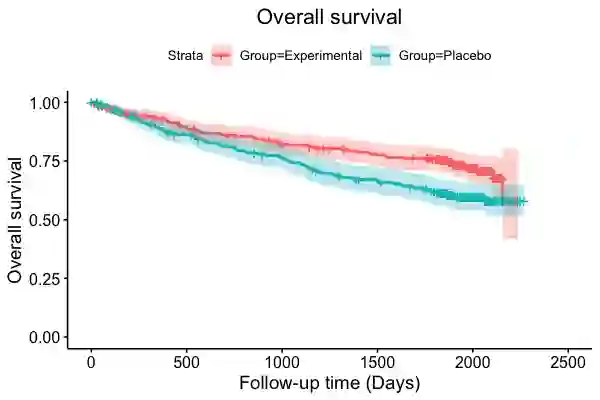
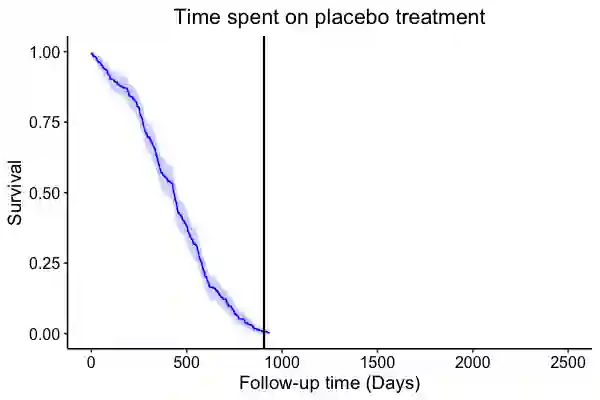
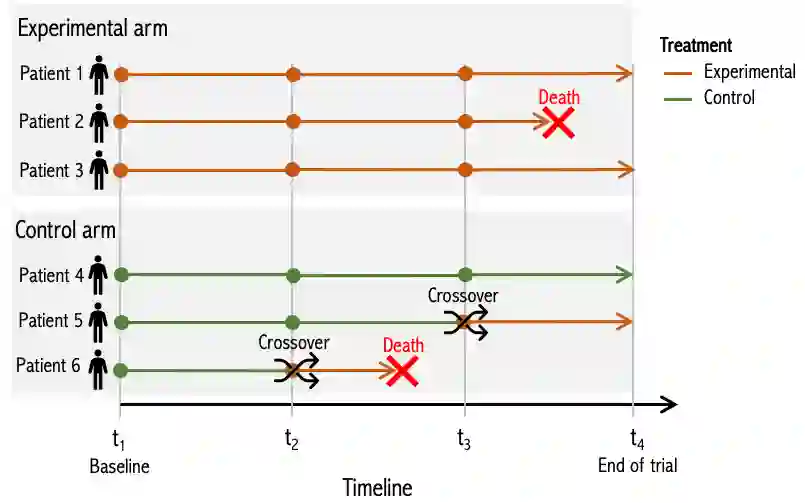
When choosing estimands and estimators in randomized clinical trials, caution is warranted as intercurrent events, such as - due to patients who switch treatment after disease progression, are often extreme. Statistical analyses may then easily lure one into making large implicit extrapolations, which often go unnoticed. We will illustrate this problem of implicit extrapolations using a real oncology case study, with a right-censored time-to-event endpoint, in which patients can cross over from the control to the experimental treatment after disease progression, for ethical reasons. We resolve this by developing an estimator for the survival risk ratio contrasting the survival probabilities at each time t if all patients would take experimental treatment with the survival probabilities at those times t if all patients would take control treatment up to time t, using randomization as an instrumental variable to avoid reliance on no unmeasured confounders assumptions. This doubly robust estimator can handle time-varying treatment switches and right-censored survival times. Insight into the rationale behind the estimator is provided and the approach is demonstrated by re-analyzing the oncology trial.
翻译:在选择随机临床试验的估计目标与估计方法时需谨慎,因为并发事件(例如疾病进展后患者切换治疗)往往具有极端性。此类统计分析极易诱导研究者做出大规模且常被忽视的隐含外推。我们将通过一项真实的肿瘤学案例研究阐述这一隐含外推问题,该案例采用右删失时间-事件结局指标,出于伦理考量,患者可在疾病进展后从对照组交叉至实验组。为解决该问题,我们开发了一种生存风险比估计量,用于对比在每个时间点t所有患者均接受实验治疗时的生存概率与所有患者在时间t前均接受对照治疗时的生存概率。该方法利用随机化作为工具变量以避免依赖无未测量混杂因素的假设。该双稳健估计量可处理时变治疗切换与右删失生存时间。我们阐释了该估计量的设计原理,并通过重新分析该肿瘤学试验验证方法的有效性。




相关内容



 微信扫码咨询专知VIP会员