

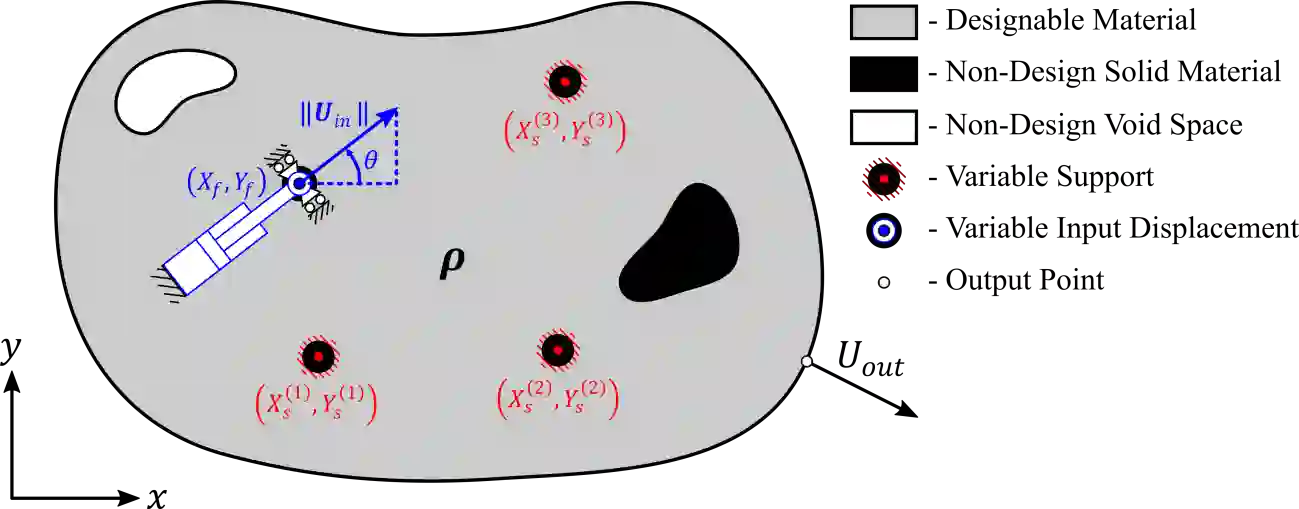
In topology optimization of compliant mechanisms, the specific placement of boundary conditions strongly affects the resulting material distribution and performance of the design. At the same time, the most effective locations of the loads and supports are often difficult to find manually. This substantially limits topology optimization's effectiveness for many mechanism design problems. We remove this limitation by developing a method which automatically determines optimal positioning of a prescribed input displacement and a set of supports simultaneously with an optimal material layout. Using nonlinear elastic physics, we synthesize a variety of compliant mechanisms with large output displacements, snap-through responses, and prescribed output paths, producing designs with significantly improved performance in every case tested. Compared to optimal designs generated using best-guess boundary conditions used in previous studies, the mechanisms presented in this paper see performance increases ranging from 23%-430%. The results show that nonlinear mechanism responses may be particularly sensitive to boundary condition locations and that effective placements can be difficult to find without an automated method.
翻译:在柔顺机构的拓扑优化中,边界条件的具体布置对最终的材料分布和设计性能有显著影响。然而,载荷和支撑的最优位置往往难以通过人工方式确定,这严重限制了拓扑优化在众多机构设计问题中的有效性。为突破这一限制,我们提出了一种新方法,该方法能够自动确定预设输入位移和一组支撑的最优位置,同时获得最优的材料布局。利用非线性弹性物理原理,我们综合了多种具有大输出位移、突跳响应以及预设输出路径的柔顺机构,在每一测试案例中均获得了性能显著提升的设计方案。与以往研究中基于最佳猜测边界条件生成的优化设计相比,本文所提出的机构性能提升幅度达23%至430%。研究结果表明,非线性机构响应可能对边界条件的位置特别敏感,且若无自动化方法,有效位置的确定可能极为困难。




相关内容




 微信扫码咨询专知VIP会员