

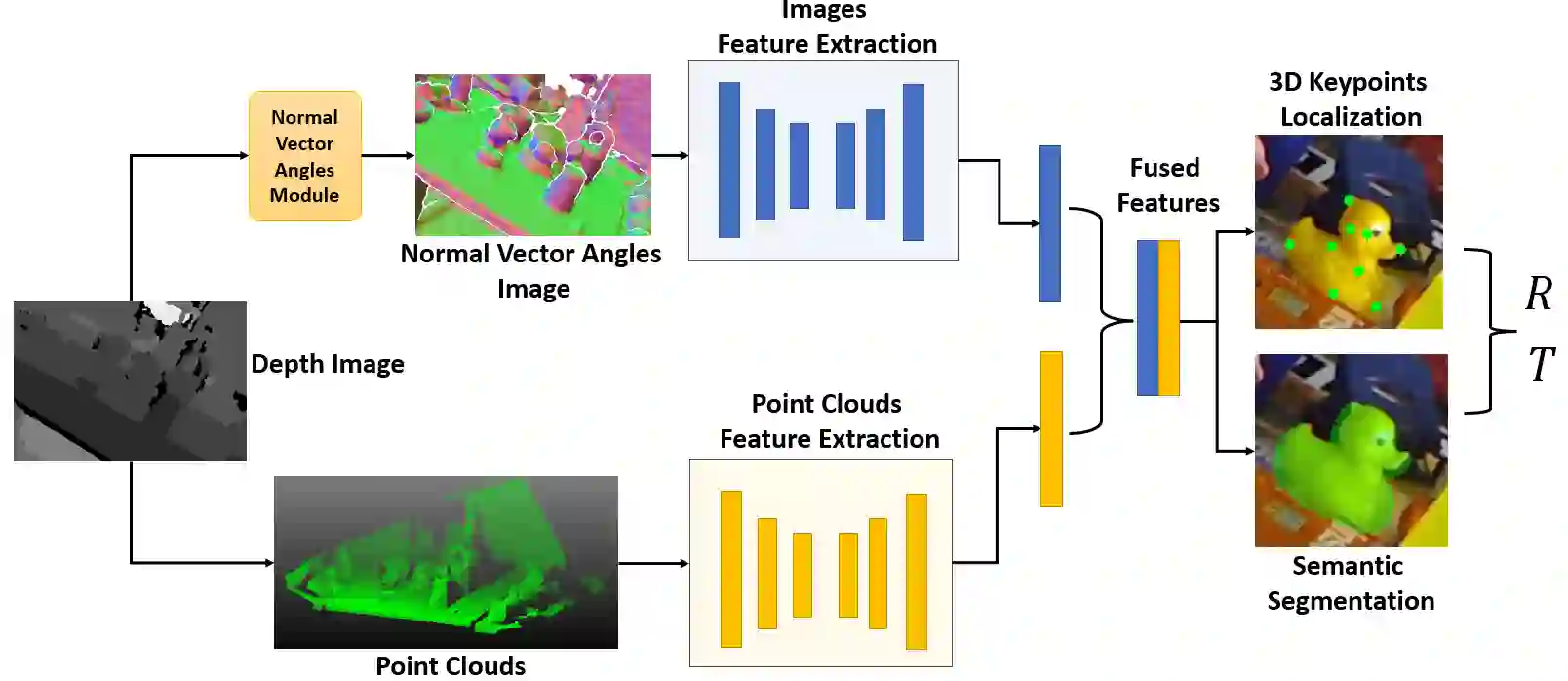
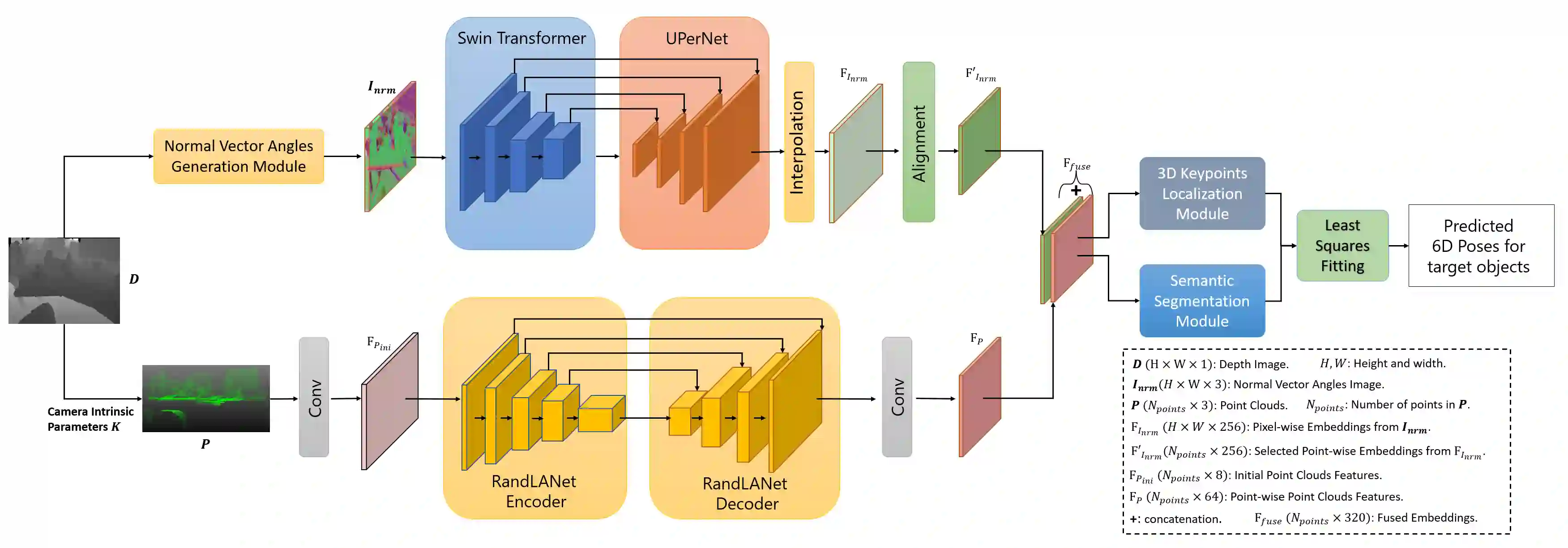
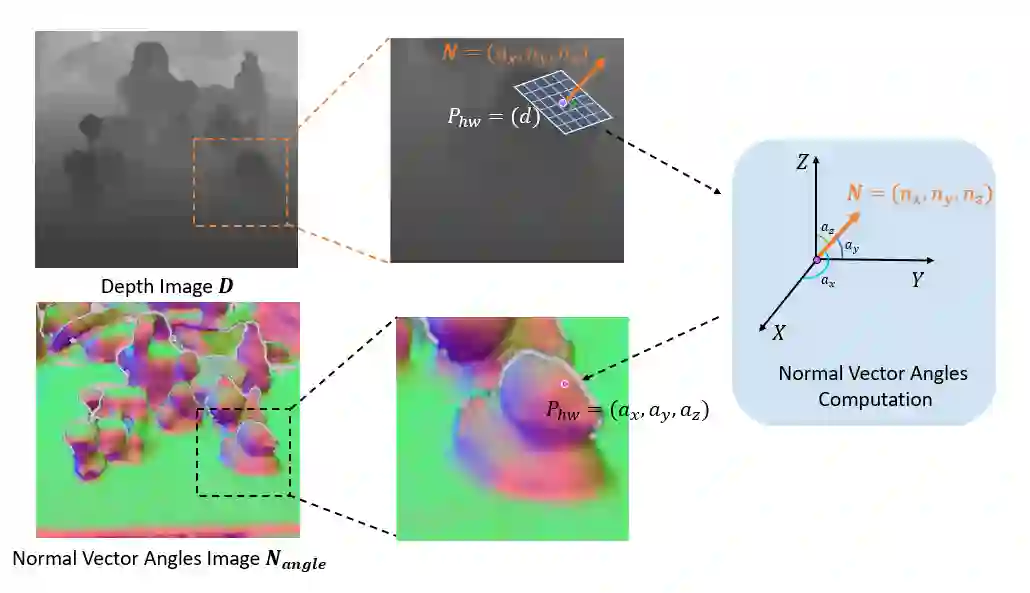
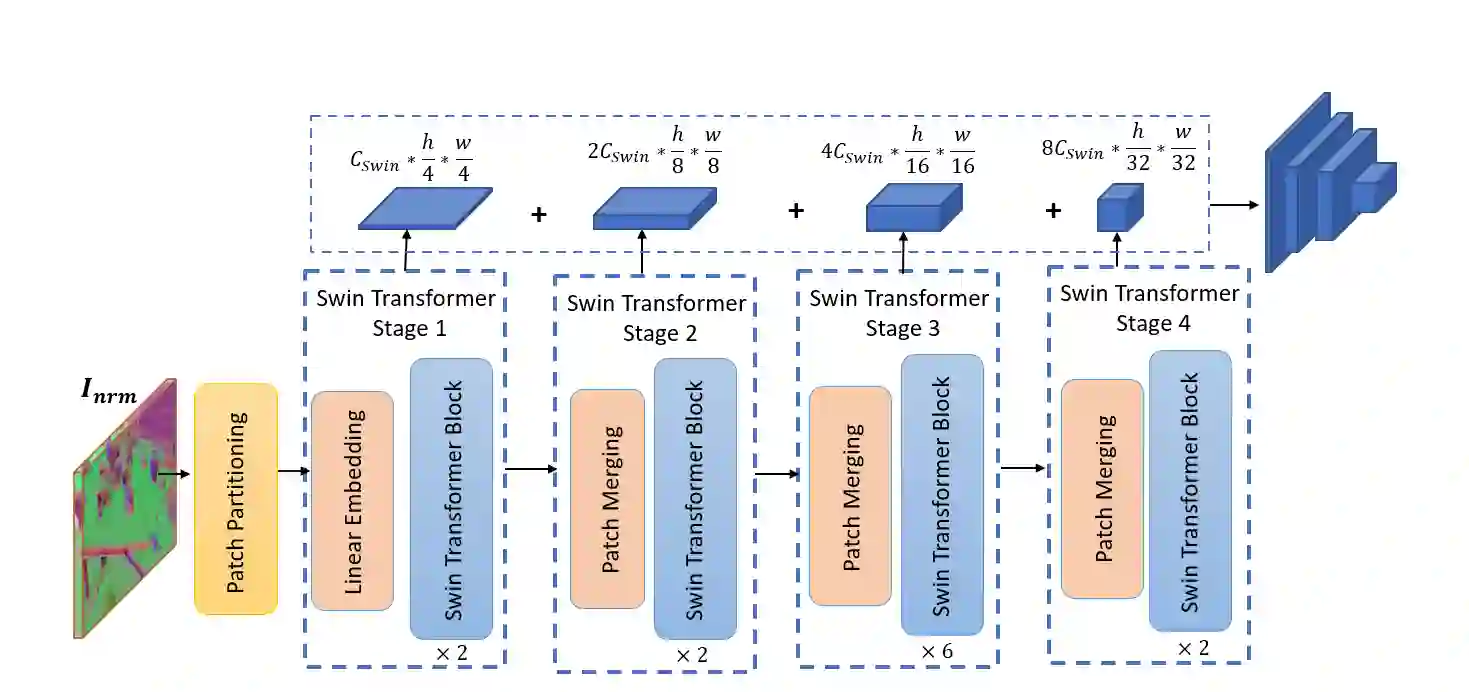
Accurately estimating the 6D pose of objects is crucial for many applications, such as robotic grasping, autonomous driving, and augmented reality. However, this task becomes more challenging in poor lighting conditions or when dealing with textureless objects. To address this issue, depth images are becoming an increasingly popular choice due to their invariance to a scene's appearance and the implicit incorporation of essential geometric characteristics. However, fully leveraging depth information to improve the performance of pose estimation remains a difficult and under-investigated problem. To tackle this challenge, we propose a novel framework called SwinDePose, that uses only geometric information from depth images to achieve accurate 6D pose estimation. SwinDePose first calculates the angles between each normal vector defined in a depth image and the three coordinate axes in the camera coordinate system. The resulting angles are then formed into an image, which is encoded using Swin Transformer. Additionally, we apply RandLA-Net to learn the representations from point clouds. The resulting image and point clouds embeddings are concatenated and fed into a semantic segmentation module and a 3D keypoints localization module. Finally, we estimate 6D poses using a least-square fitting approach based on the target object's predicted semantic mask and 3D keypoints. In experiments on the LineMod and Occlusion LineMod datasets, SwinDePose outperforms existing state-of-the-art methods for 6D object pose estimation using depth images. This demonstrates the effectiveness of our approach and highlights its potential for improving performance in real-world scenarios. Our code is at https://github.com/zhujunli1993/SwinDePose.
翻译:精确估计物体的六自由度(6D)姿态对机器人抓取、自动驾驶和增强现实等众多应用至关重要。然而,在光照条件不佳或处理无纹理物体时,该任务变得更具挑战性。为解决这一问题,深度图像因其对场景外观的不变性以及隐含包含关键几何特征而成为日益流行的选择。然而,充分利用深度信息提升姿态估计性能仍是一个困难且研究不足的问题。为应对这一挑战,我们提出了一种名为SwinDePose的新型框架,该框架仅利用深度图像中的几何信息实现精确的6D姿态估计。SwinDePose首先计算深度图像中每个法向量与相机坐标系三个坐标轴之间的夹角,并将所得的角度值构成一张图像,随后使用Swin Transformer对该图像进行编码。此外,我们采用RandLA-Net从点云中学习表征。将得到的图像和点云嵌入进行拼接,并馈入语义分割模块和三维关键点定位模块。最后,基于目标物体预测的语义掩码和三维关键点,采用最小二乘拟合方法估计6D姿态。在LineMod和Occlusion LineMod数据集上的实验表明,SwinDePose在使用深度图像进行6D物体姿态估计时优于现有最先进方法。这证明了我们方法的有效性,并凸显了其在真实场景中提升性能的潜力。我们的代码位于:https://github.com/zhujunli1993/SwinDePose。




相关内容




 微信扫码咨询专知VIP会员