

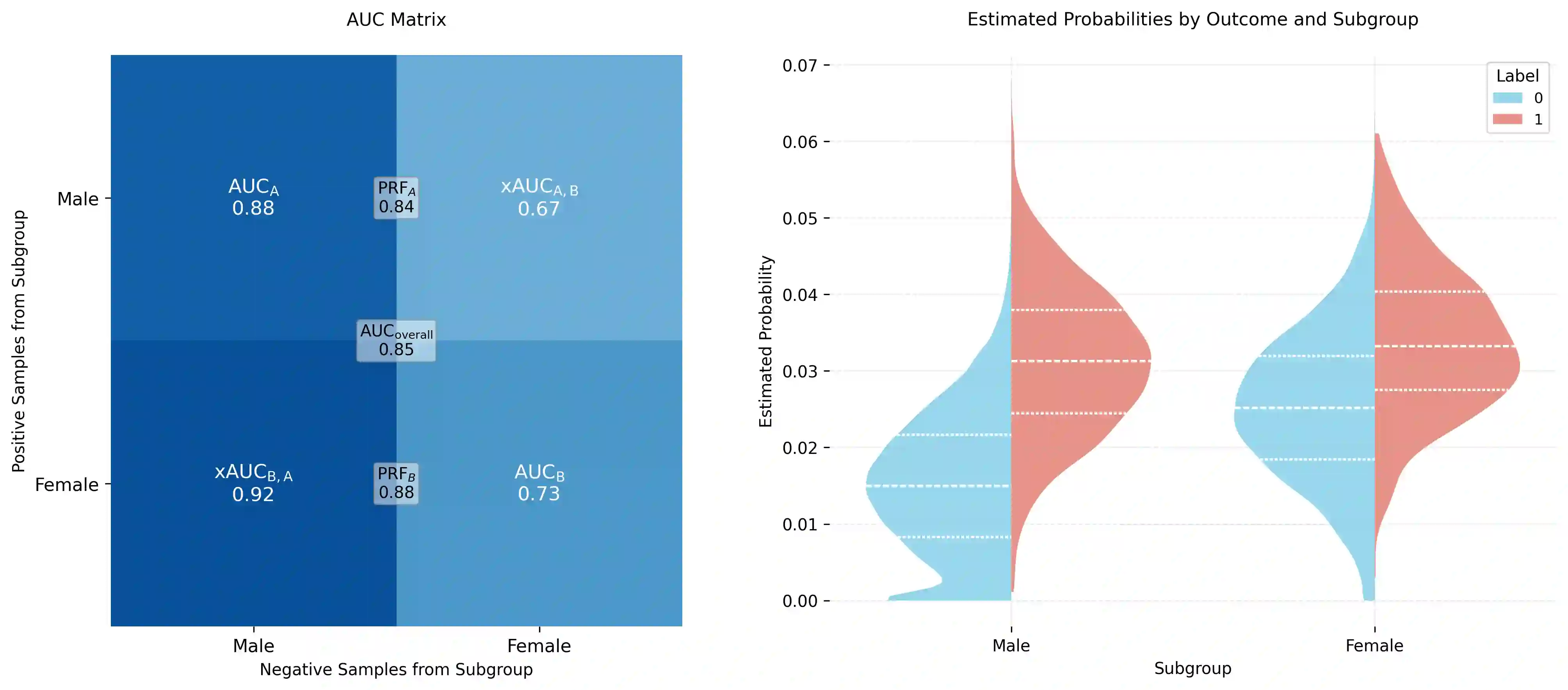
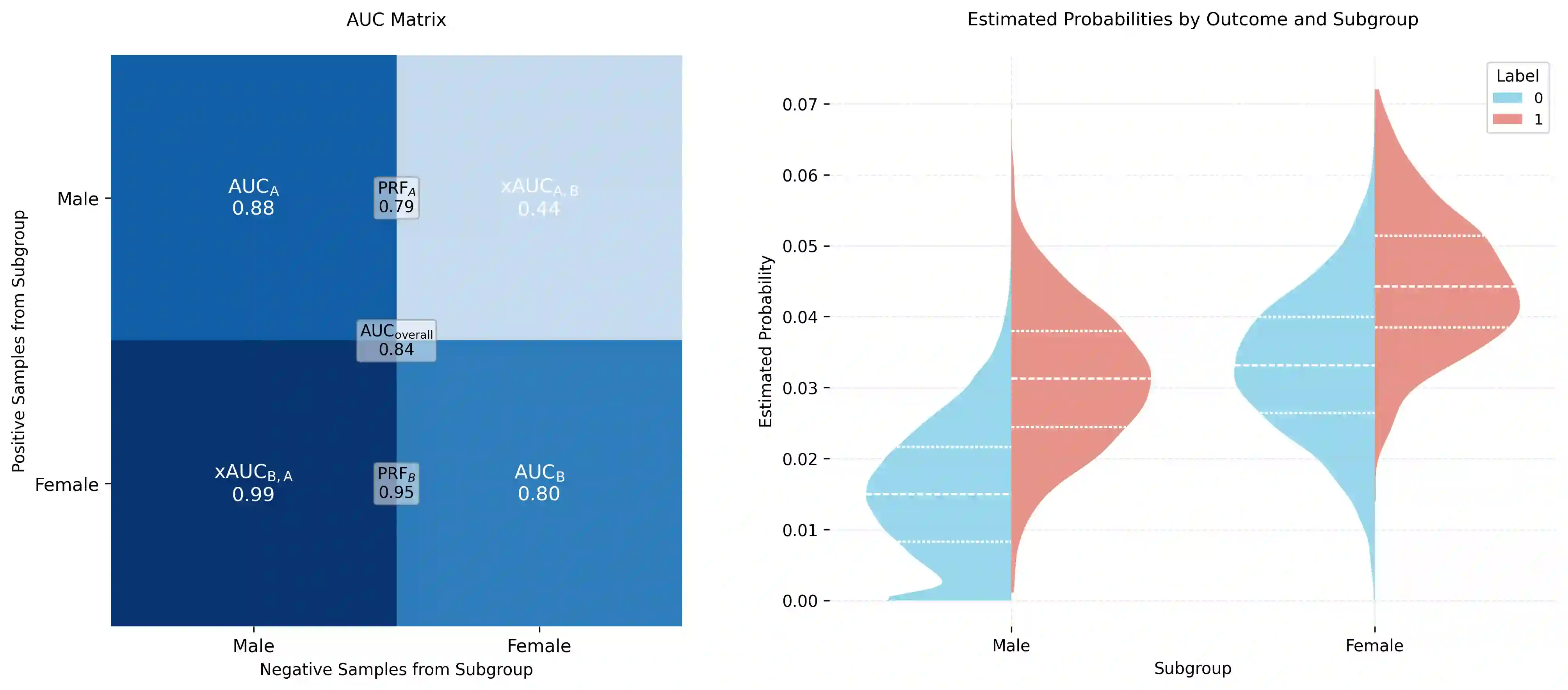
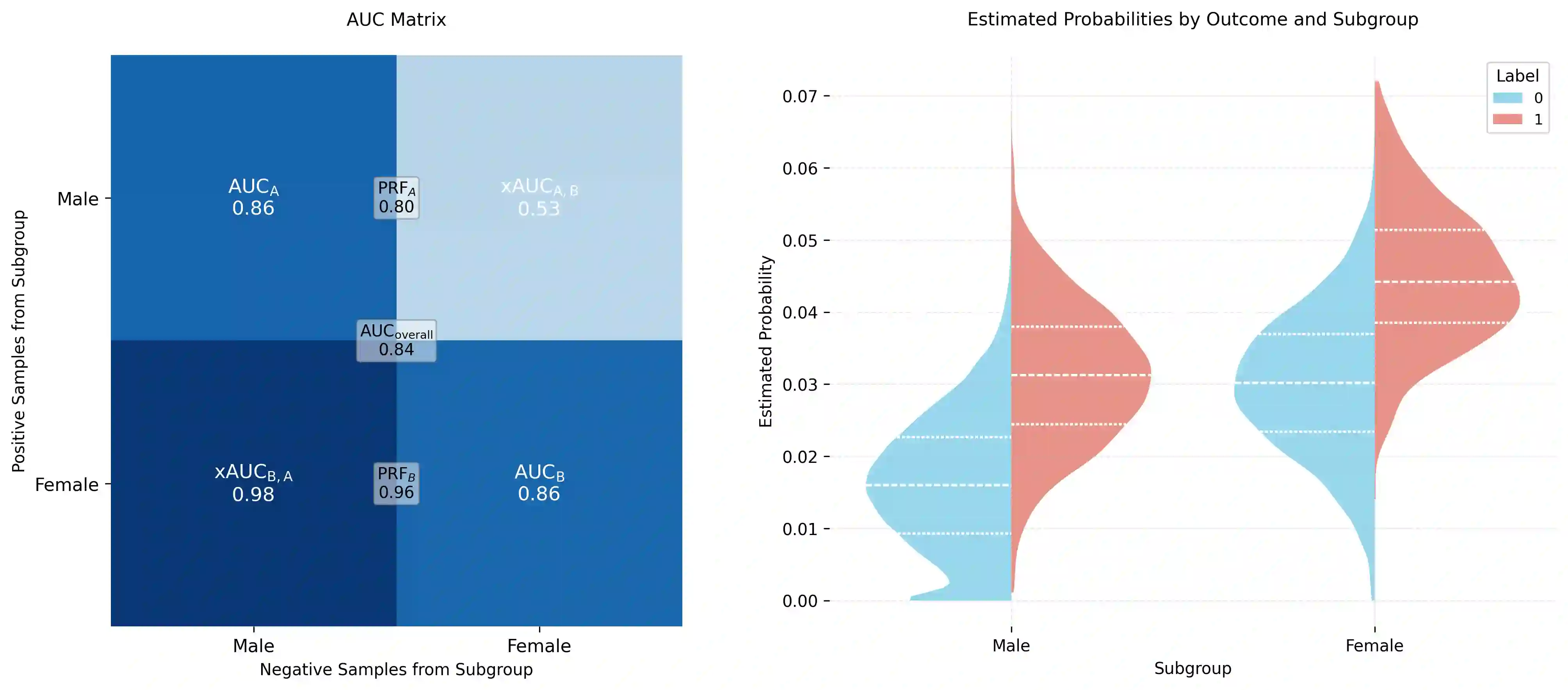
Fairness evaluation of clinical prediction models for binary outcomes often involves fairness metrics that compare the area under the receiver operating characteristic curve (AUC, or c-statistic) across subgroups. However, the AUC has been shown to be a non-collapsible metric, meaning that its subgroup specific and overall values are not directly comparable as often implicitly assumed. This raises important questions about how existing AUC-based fairness metrics should be used and interpreted. We examine eight AUC-based fairness metrics proposed in the literature, including: within-group AUC parity; cross-group AUC (xAUC) parity; gap-to-overall AUC; equity-scaled AUC; minimum-based metrics; $\mathrm{xAUC}^1$; $\mathrm{xAUC}^0$; and $\mathrm{xAUC}^1$ or $\mathrm{xAUC}^0$ parity. We characterise their estimands, relate them to the decomposition of overall AUC (into within- and cross-group components), and critically appraise them. We then illustrate their behaviour using simulations based on the EuroSCORE II, a clinical prediction model for in-hospital mortality. We recommend reporting an AUC matrix, containing the overall AUC and all within- and cross-group AUC components, alongside population characteristics. When fairness metrics are needed, we recommend reporting the within-group AUC parity, with cross-group AUC parity providing supplementary information but requiring caution due to its potential conflict with calibration. Metrics involving $\mathrm{xAUC}^1$ and $\mathrm{xAUC}^0$ have merit, summarising within- and cross-group AUCs into single values, but their interpretation is non-trivial, and they should be used with caution. Gap-to-overall AUC, equity-scaled AUC, and minimum-based metrics compare quantities that should not be compared and it is unclear how to operationalise them, making them not fit for purpose and generally not recommended.
翻译:暂无翻译


相关内容





 微信扫码咨询专知VIP会员