

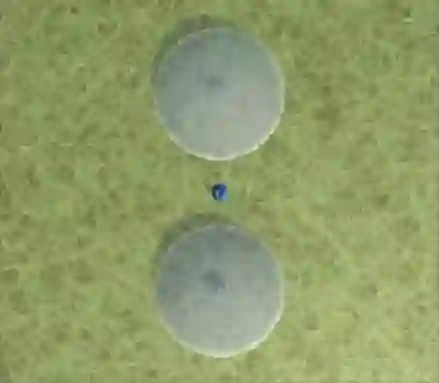
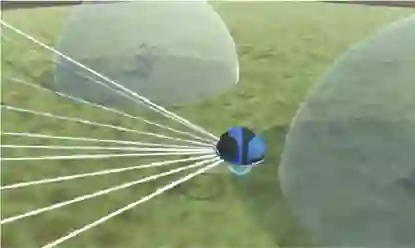
Patch foraging is one of the most heavily studied behavioral optimization challenges in biology. However, despite its importance to biological intelligence, this behavioral optimization problem is understudied in artificial intelligence research. Patch foraging is especially amenable to study given that it has a known optimal solution, which may be difficult to discover given current techniques in deep reinforcement learning. Here, we investigate deep reinforcement learning agents in an ecological patch foraging task. For the first time, we show that machine learning agents can learn to patch forage adaptively in patterns similar to biological foragers, and approach optimal patch foraging behavior when accounting for temporal discounting. Finally, we show emergent internal dynamics in these agents that resemble single-cell recordings from foraging non-human primates, which complements experimental and theoretical work on the neural mechanisms of biological foraging. This work suggests that agents interacting in complex environments with ecologically valid pressures arrive at common solutions, suggesting the emergence of foundational computations behind adaptive, intelligent behavior in both biological and artificial agents.
翻译:补丁觅食是生物学中研究最充分的行为优化挑战之一。然而,尽管其对生物智能至关重要,这一行为优化问题在人工智能研究中尚未得到充分探索。由于补丁觅食具有已知的最优解(当前深度强化学习技术可能难以发现该解),因此尤其适合作为研究课题。在此,我们研究了深度强化学习智能体在生态补丁觅食任务中的表现。我们首次证明,机器学习智能体能够像生物觅食者一样以类似模式学习适应性补丁觅食行为,并在考虑时间贴现时接近最优补丁觅食行为。最后,我们展示了这些智能体中涌现的内部动态特征,这些特征与非人灵长类动物觅食时的单细胞记录相似,补充了关于生物觅食神经机制的实验与理论研究。本研究提出,在具有生态有效压力的复杂环境中交互的智能体会趋同于共同解决方案,这表明生物与人工智能体中自适应、智能行为背后的基础计算机制具有涌现性。







相关内容




 微信扫码咨询专知VIP会员