

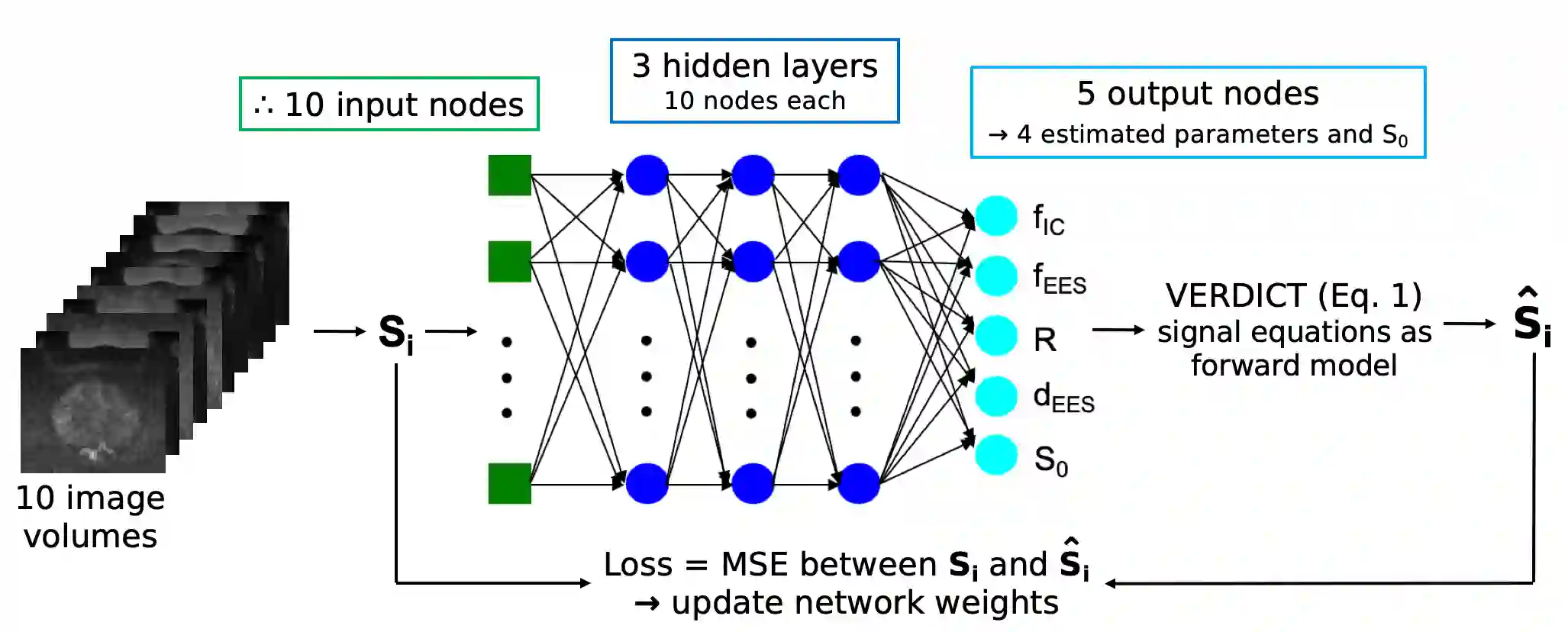
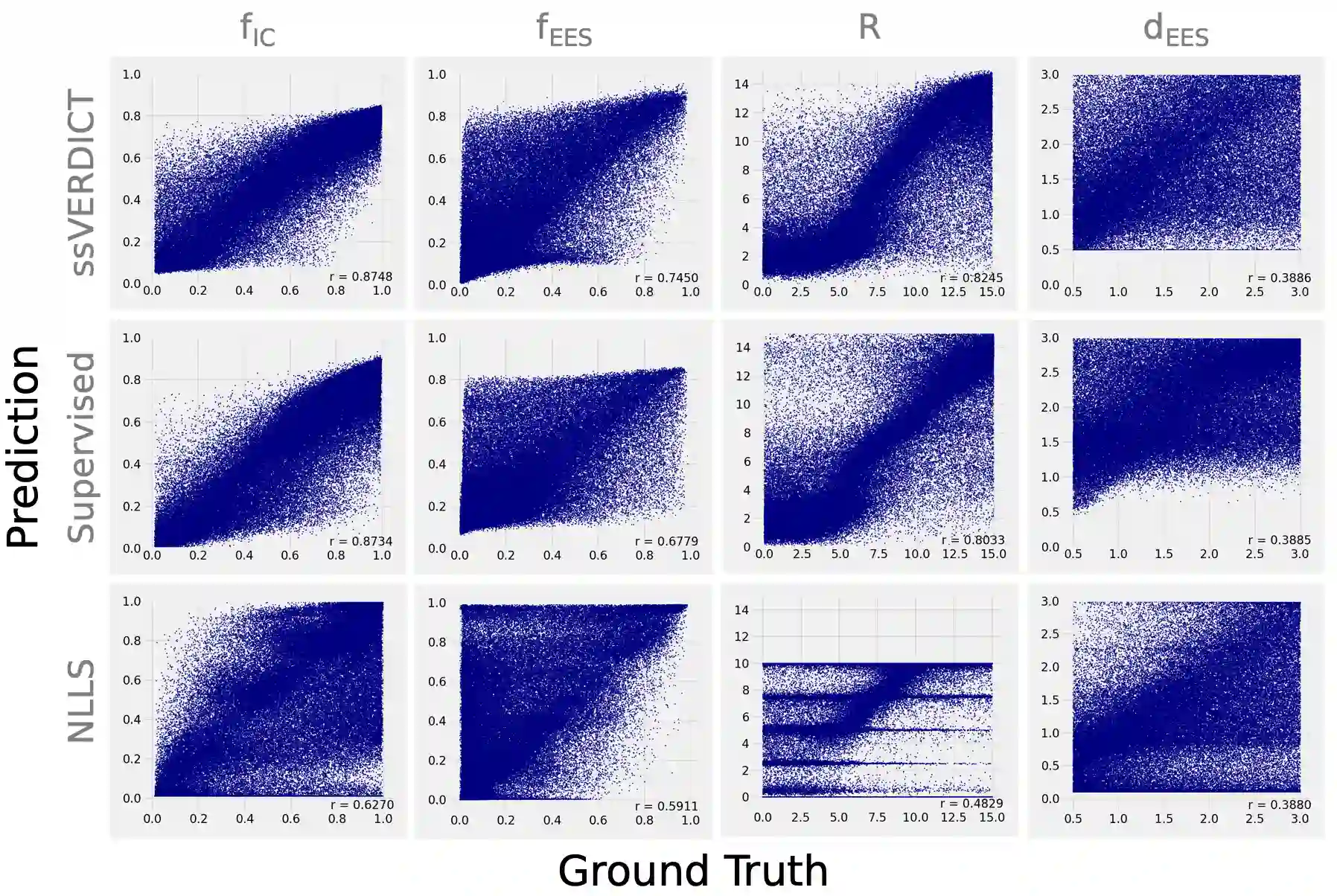
Purpose: Demonstrating and assessing self-supervised machine learning fitting of the VERDICT (Vascular, Extracellular and Restricted DIffusion for Cytometry in Tumours) model for prostate. Methods: We derive a self-supervised neural network for fitting VERDICT (ssVERDICT) that estimates parameter maps without training data. We compare the performance of ssVERDICT to two established baseline methods for fitting diffusion MRI models: conventional nonlinear least squares (NLLS) and supervised deep learning. We do this quantitatively on simulated data, by comparing the Pearson's correlation coefficient, mean-squared error (MSE), bias, and variance with respect to the simulated ground truth. We also calculate in vivo parameter maps on a cohort of 20 prostate cancer patients and compare the methods' performance in discriminating benign from cancerous tissue via Wilcoxon's signed-rank test. Results: In simulations, ssVERDICT outperforms the baseline methods (NLLS and supervised DL) in estimating all the parameters from the VERDICT prostate model in terms of Pearson's correlation coefficient, bias, and MSE. In vivo, ssVERDICT shows stronger lesion conspicuity across all parameter maps, and improves discrimination between benign and cancerous tissue over the baseline methods. Conclusion: ssVERDICT significantly outperforms state-of-the-art methods for VERDICT model fitting, and shows for the first time, fitting of a complex three-compartment biophysical model with machine learning without the requirement of explicit training labels.
翻译:摘要:目的:展示并评估利用自监督机器学习对VERDICT(血管、细胞外及受限扩散用于肿瘤细胞计量学)模型进行前列腺参数拟合的方法。方法:我们推导出一种自监督神经网络用于拟合VERDICT模型(ssVERDICT),该方法无需训练数据即可估计参数图。我们将ssVERDICT的性能与两种扩散MRI模型拟合的经典基线方法(传统非线性最小二乘法和监督深度学习)进行对比。通过模拟数据定量评估,基于皮尔逊相关系数、均方误差、偏倚和方差与模拟真值进行比较。同时,在20例前列腺癌患者的队列中计算体内参数图,并通过威尔科克森符号秩检验比较各方法在区分良性与癌变组织时的性能。结果:在模拟实验中,ssVERDICT在估计VERDICT前列腺模型所有参数时,其皮尔逊相关系数、偏倚和均方误差均优于基线方法(NLLS和监督DL)。体内实验显示,ssVERDICT在所有参数图上呈现出更强的病灶显著性,且相较于基线方法更有效地提升了良性与癌变组织的区分能力。结论:ssVERDICT显著优于现有最优的VERDICT模型拟合方法,并首次实现了无需显式训练标签即可通过机器学习拟合复杂三隔室生物物理模型。







相关内容



 微信扫码咨询专知VIP会员