We show that convex-concave Lipschitz stochastic saddle point problems (also known as stochastic minimax optimization) can be solved under the constraint of $(\epsilon,\delta)$-differential privacy with \emph{strong (primal-dual) gap} rate of $\tilde O\big(\frac{1}{\sqrt{n}} + \frac{\sqrt{d}}{n\epsilon}\big)$, where $n$ is the dataset size and $d$ is the dimension of the problem. This rate is nearly optimal, based on existing lower bounds in differentially private stochastic optimization. Specifically, we prove a tight upper bound on the strong gap via novel implementation and analysis of the recursive regularization technique repurposed for saddle point problems. We show that this rate can be attained with $O\big(\min\big\{\frac{n^2\epsilon^{1.5}}{\sqrt{d}}, n^{3/2}\big\}\big)$ gradient complexity, and $\tilde{O}(n)$ gradient complexity if the loss function is smooth. As a byproduct of our method, we develop a general algorithm that, given a black-box access to a subroutine satisfying a certain $\alpha$ primal-dual accuracy guarantee with respect to the empirical objective, gives a solution to the stochastic saddle point problem with a strong gap of $\tilde{O}(\alpha+\frac{1}{\sqrt{n}})$. We show that this $\alpha$-accuracy condition is satisfied by standard algorithms for the empirical saddle point problem such as the proximal point method and the stochastic gradient descent ascent algorithm. Further, we show that even for simple problems it is possible for an algorithm to have zero weak gap and suffer from $\Omega(1)$ strong gap. We also show that there exists a fundamental tradeoff between stability and accuracy. Specifically, we show that any $\Delta$-stable algorithm has empirical gap $\Omega\big(\frac{1}{\Delta n}\big)$, and that this bound is tight. This result also holds also more specifically for empirical risk minimization problems and may be of independent interest.


翻译:我们证明,在$(\epsilon,\delta)$-差分隐私约束下,凸-凹Lipschitz随机鞍点问题(亦称随机极小极大优化)可实现$\tilde O\big(\frac{1}{\sqrt{n}} + \frac{\sqrt{d}}{n\epsilon}\big)$的*强(原始-对偶)间隙*率,其中$n$为数据集规模,$d$为问题维度。基于差分隐私随机优化的现有下界,该速率接近最优。具体而言,我们通过针对鞍点问题重新设计的递归正则化技术的新颖实现与分析,证明了强间隙的紧上界。我们表明,该速率可通过$O\big(\min\big\{\frac{n^2\epsilon^{1.5}}{\sqrt{d}}, n^{3/2}\big\}\big)$的梯度复杂度实现;若损失函数光滑,则仅需$\tilde{O}(n)$梯度复杂度。作为方法的副产品,我们开发了一种通用算法:给定一个满足关于经验目标函数特定$\alpha$原始-对偶精度保证的黑盒子程序,该算法可为随机鞍点问题提供$\tilde{O}(\alpha+\frac{1}{\sqrt{n}})$的强间隙解。我们证明,这一$\alpha$精度条件可通过经验鞍点问题的标准算法(如邻近点方法和随机梯度下降上升算法)满足。进一步地,我们指出即便对于简单问题,算法可能具有零弱间隙却遭受$\Omega(1)$强间隙。我们还证明稳定性和精度之间存在根本性权衡:具体而言,任何$\Delta$-稳定算法均具有$\Omega\big(\frac{1}{\Delta n}\big)$的经验间隙,且该界是紧的。该结论对经验风险最小化问题也成立,可能具有独立的研究价值。


0
下载
关闭预览

相关内容

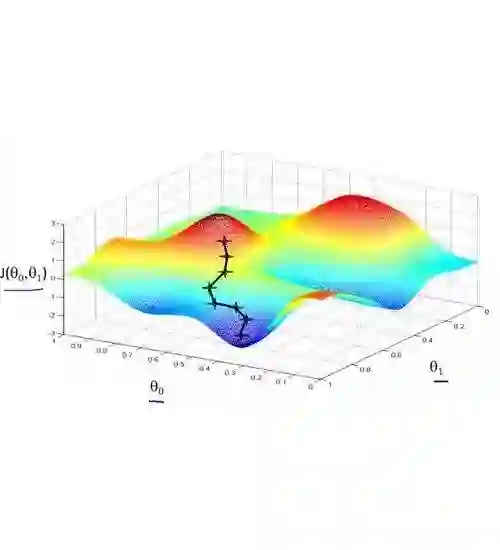
在数学中,鞍点或极大极小点是函数图形表面上的一点,其正交方向上的斜率(导数)都为零,但它不是函数的局部极值。鞍点是在某一轴向(峰值之间)有一个相对最小的临界点,在交叉轴上有一个相对最大的临界点。
FlowQA: Grasping Flow in History for Conversational Machine Comprehension
专知会员服务
34+阅读 · 2019年10月18日
Stabilizing Transformers for Reinforcement Learning
专知会员服务
60+阅读 · 2019年10月17日
《DeepGCNs: Making GCNs Go as Deep as CNNs》
专知会员服务
32+阅读 · 2019年10月17日
Keras François Chollet 《Deep Learning with Python 》, 386页pdf
专知会员服务
164+阅读 · 2019年10月12日
【SIGGRAPH2019】TensorFlow 2.0深度学习计算机图形学应用
专知会员服务
41+阅读 · 2019年10月9日
Hierarchically Structured Meta-learning
CreateAMind
27+阅读 · 2019年5月22日
Transferring Knowledge across Learning Processes
CreateAMind
29+阅读 · 2019年5月18日
强化学习的Unsupervised Meta-Learning
CreateAMind
18+阅读 · 2019年1月7日
Unsupervised Learning via Meta-Learning
CreateAMind
44+阅读 · 2019年1月3日
A Technical Overview of AI & ML in 2018 & Trends for 2019
待字闺中
18+阅读 · 2018年12月24日
disentangled-representation-papers
CreateAMind
26+阅读 · 2018年9月12日
STRCF for Visual Object Tracking
统计学习与视觉计算组
15+阅读 · 2018年5月29日
Focal Loss for Dense Object Detection
统计学习与视觉计算组
12+阅读 · 2018年3月15日
IJCAI | Cascade Dynamics Modeling with Attention-based RNN
KingsGarden
13+阅读 · 2017年7月16日
From Softmax to Sparsemax-ICML16(1)
KingsGarden
74+阅读 · 2016年11月26日
国家自然科学基金
2+阅读 · 2017年12月31日
国家自然科学基金
13+阅读 · 2017年12月31日
国家自然科学基金
2+阅读 · 2015年12月31日
国家自然科学基金
3+阅读 · 2015年12月31日
国家自然科学基金
0+阅读 · 2015年12月31日
国家自然科学基金
1+阅读 · 2015年12月31日
国家自然科学基金
2+阅读 · 2015年12月31日
国家自然科学基金
3+阅读 · 2015年12月31日
国家自然科学基金
0+阅读 · 2014年12月31日
国家自然科学基金
0+阅读 · 2014年12月31日
Arxiv
0+阅读 · 2023年8月18日
VIP会员
最新内容
BES:让语言模型通过双向进化搜索自我改进
专知会员服务
1+阅读 · 5月30日
以色列-美国-伊朗战争中的无人机:关键要点
专知会员服务
3+阅读 · 5月30日
《Palantir任务保障性软件安全标准(MA-S2)》
专知会员服务
8+阅读 · 5月30日
基于声学的无人机检测技术综述
专知会员服务
5+阅读 · 5月30日
《当代混合战争分析框架:俄乌战争经验教训》
战略前沿人工智能的再思考(中文)
专知会员服务
7+阅读 · 5月29日
《量化地基防空系统间接效应的博弈论方法》
专知会员服务
5+阅读 · 5月29日
相关资讯
Hierarchically Structured Meta-learning
CreateAMind
27+阅读 · 2019年5月22日
Transferring Knowledge across Learning Processes
CreateAMind
29+阅读 · 2019年5月18日
强化学习的Unsupervised Meta-Learning
CreateAMind
18+阅读 · 2019年1月7日
Unsupervised Learning via Meta-Learning
CreateAMind
44+阅读 · 2019年1月3日
A Technical Overview of AI & ML in 2018 & Trends for 2019
待字闺中
18+阅读 · 2018年12月24日
disentangled-representation-papers
CreateAMind
26+阅读 · 2018年9月12日
STRCF for Visual Object Tracking
统计学习与视觉计算组
15+阅读 · 2018年5月29日
Focal Loss for Dense Object Detection
统计学习与视觉计算组
12+阅读 · 2018年3月15日
IJCAI | Cascade Dynamics Modeling with Attention-based RNN
KingsGarden
13+阅读 · 2017年7月16日
From Softmax to Sparsemax-ICML16(1)
KingsGarden
74+阅读 · 2016年11月26日
相关基金
国家自然科学基金
2+阅读 · 2017年12月31日
国家自然科学基金
13+阅读 · 2017年12月31日
国家自然科学基金
2+阅读 · 2015年12月31日
国家自然科学基金
3+阅读 · 2015年12月31日
国家自然科学基金
0+阅读 · 2015年12月31日
国家自然科学基金
1+阅读 · 2015年12月31日
国家自然科学基金
2+阅读 · 2015年12月31日
国家自然科学基金
3+阅读 · 2015年12月31日
国家自然科学基金
0+阅读 · 2014年12月31日
国家自然科学基金
0+阅读 · 2014年12月31日
Top
微信扫码咨询专知VIP会员