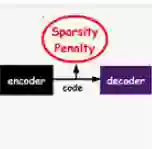
We consider the problem of computing a sparse binary representation of an image. To be precise, given an image and an overcomplete, non-orthonormal basis, we aim to find a sparse binary vector indicating the minimal set of basis vectors that when added together best reconstruct the given input. We formulate this problem with an $L_2$ loss on the reconstruction error, and an $L_0$ (or, equivalently, an $L_1$) loss on the binary vector enforcing sparsity. This yields a so-called Quadratic Unconstrained Binary Optimization (QUBO) problem, whose solution is generally NP-hard to find. The contribution of this work is twofold. First, the method of unsupervised and unnormalized dictionary feature learning for a desired sparsity level to best match the data is presented. Second, the binary sparse coding problem is then solved on the Loihi 1 neuromorphic chip by the use of stochastic networks of neurons to traverse the non-convex energy landscape. The solutions are benchmarked against the classical heuristic simulated annealing. We demonstrate neuromorphic computing is suitable for sampling low energy solutions of binary sparse coding QUBO models, and although Loihi 1 is capable of sampling very sparse solutions of the QUBO models, there needs to be improvement in the implementation in order to be competitive with simulated annealing.


翻译:我们考虑计算图像稀疏二进制表示的问题。具体而言,给定一张图像和一个过完备、非正交基,我们旨在找到一个稀疏二进制向量,指示一组最小基向量,这些基向量相加后能够最好地重建给定输入。我们用重建误差的$L_2$损失和二进制向量上强制稀疏性的$L_0$(或等价地,$L_1$)损失来表述该问题。这产生了一个所谓的二次无约束二进制优化(QUBO)问题,其解通常为NP难求解。本工作的贡献有两点。首先,提出了一种非监督且非归一化的字典特征学习方法,用于在期望的稀疏度水平下最佳匹配数据。其次,利用神经元随机网络遍历非凸能量景观,在Loihi 1神经形态芯片上求解二进制稀疏编码问题。以经典启发式模拟退火为基准对解进行评测。我们证明神经形态计算适用于采样二进制稀疏编码QUBO模型的低能量解,尽管Loihi 1能够采样QUBO模型的极稀疏解,但其实现仍需改进以与模拟退火竞争。


0
下载
关闭预览

相关内容

【ACL2020】多模态信息抽取,365页ppt
专知会员服务
151+阅读 · 2020年7月6日
FlowQA: Grasping Flow in History for Conversational Machine Comprehension
专知会员服务
34+阅读 · 2019年10月18日
Keras François Chollet 《Deep Learning with Python 》, 386页pdf
专知会员服务
164+阅读 · 2019年10月12日
强化学习最新教程,17页pdf
专知会员服务
182+阅读 · 2019年10月11日
【SIGGRAPH2019】TensorFlow 2.0深度学习计算机图形学应用
专知会员服务
41+阅读 · 2019年10月9日
RL解决'BipedalWalkerHardcore-v2' (SOTA)
CreateAMind
31+阅读 · 2019年7月17日
强化学习的Unsupervised Meta-Learning
CreateAMind
18+阅读 · 2019年1月7日
Unsupervised Learning via Meta-Learning
CreateAMind
44+阅读 · 2019年1月3日
disentangled-representation-papers
CreateAMind
26+阅读 · 2018年9月12日
STRCF for Visual Object Tracking
统计学习与视觉计算组
15+阅读 · 2018年5月29日
Focal Loss for Dense Object Detection
统计学习与视觉计算组
12+阅读 · 2018年3月15日
IJCAI | Cascade Dynamics Modeling with Attention-based RNN
KingsGarden
13+阅读 · 2017年7月16日
国家自然科学基金
2+阅读 · 2015年12月31日
国家自然科学基金
1+阅读 · 2015年12月31日
国家自然科学基金
0+阅读 · 2015年12月31日
国家自然科学基金
0+阅读 · 2015年12月31日
国家自然科学基金
2+阅读 · 2015年12月31日
国家自然科学基金
0+阅读 · 2015年12月31日
国家自然科学基金
3+阅读 · 2015年12月31日
国家自然科学基金
0+阅读 · 2014年12月31日
国家自然科学基金
0+阅读 · 2014年12月31日
国家自然科学基金
1+阅读 · 2014年12月31日
Arxiv
0+阅读 · 2023年9月20日
Augmentation for small object detection
Arxiv
13+阅读 · 2019年2月19日
VIP会员
最新内容
ICML 2026 | SARDI:扩散语言模型的自增强检索
专知会员服务
4+阅读 · 6月6日
《国防领域安全采用大语言模型的战略蓝图》
专知会员服务
7+阅读 · 6月6日
ICML 2026 | 演化选择的因果建模
专知会员服务
7+阅读 · 6月5日
综述|学习式3D表征最新进展与趋势
专知会员服务
7+阅读 · 6月5日
人工智能重塑威慑:算法优势的兴起
专知会员服务
8+阅读 · 6月5日
AgentOps综述:智能体系统运维框架
专知会员服务
17+阅读 · 6月4日
《美陆军最新条令:兵力防护》
专知会员服务
14+阅读 · 6月4日
相关资讯
RL解决'BipedalWalkerHardcore-v2' (SOTA)
CreateAMind
31+阅读 · 2019年7月17日
强化学习的Unsupervised Meta-Learning
CreateAMind
18+阅读 · 2019年1月7日
Unsupervised Learning via Meta-Learning
CreateAMind
44+阅读 · 2019年1月3日
disentangled-representation-papers
CreateAMind
26+阅读 · 2018年9月12日
STRCF for Visual Object Tracking
统计学习与视觉计算组
15+阅读 · 2018年5月29日
Focal Loss for Dense Object Detection
统计学习与视觉计算组
12+阅读 · 2018年3月15日
IJCAI | Cascade Dynamics Modeling with Attention-based RNN
KingsGarden
13+阅读 · 2017年7月16日
相关基金
国家自然科学基金
2+阅读 · 2015年12月31日
国家自然科学基金
1+阅读 · 2015年12月31日
国家自然科学基金
0+阅读 · 2015年12月31日
国家自然科学基金
0+阅读 · 2015年12月31日
国家自然科学基金
2+阅读 · 2015年12月31日
国家自然科学基金
0+阅读 · 2015年12月31日
国家自然科学基金
3+阅读 · 2015年12月31日
国家自然科学基金
0+阅读 · 2014年12月31日
国家自然科学基金
0+阅读 · 2014年12月31日
国家自然科学基金
1+阅读 · 2014年12月31日
Top
微信扫码咨询专知VIP会员