

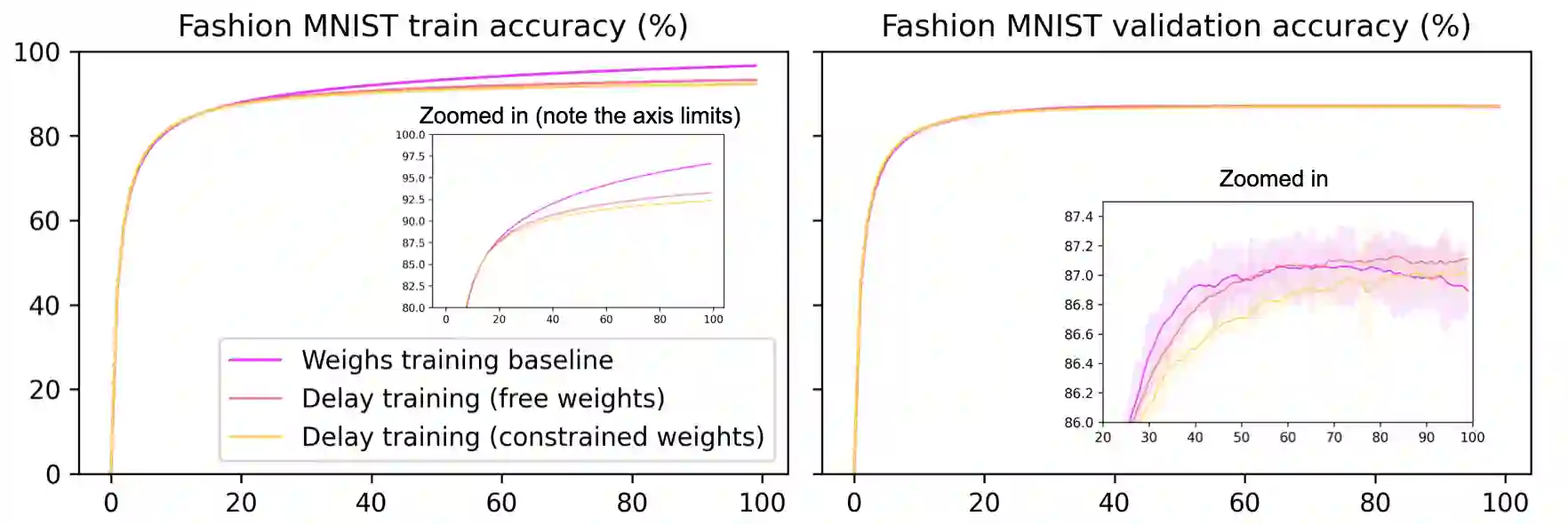
Biological evidence suggests that adaptation of synaptic delays on short to medium timescales plays an important role in learning in the brain. Inspired by biology, we explore the feasibility and power of using synaptic delays to solve challenging tasks even when the synaptic weights are not trained but kept at randomly chosen fixed values. We show that training ONLY the delays in feed-forward spiking networks using backpropagation can achieve performance comparable to the more conventional weight training. Moreover, further constraining the weights to ternary values does not significantly affect the networks' ability to solve the tasks using only the synaptic delays. We demonstrate the task performance of delay-only training on MNIST and Fashion-MNIST datasets in preliminary experiments. This demonstrates a new paradigm for training spiking neural networks and sets the stage for models that can be more efficient than the ones that use weights for computation.
翻译:生物学证据表明,短至中等时间尺度上的突触延迟适应在大脑学习中扮演重要角色。受生物学启发,我们探索了在突触权重保持随机固定值而不进行训练的情况下,利用突触延迟解决具有挑战性任务的可行性与能力。研究表明,仅通过反向传播训练前馈脉冲网络中的延迟参数,即可达到与传统权重训练相当的性能。此外,即使将权重进一步约束为三值,也不会显著影响网络仅依赖突触延迟解决问题的能力。我们在MNIST和Fashion-MNIST数据集上的初步实验中展示了纯延迟训练的任务性能。这为脉冲神经网络训练开辟了新范式,并为构建比基于权重的计算模型更高效的模型奠定了基础。







相关内容



 微信扫码咨询专知VIP会员