

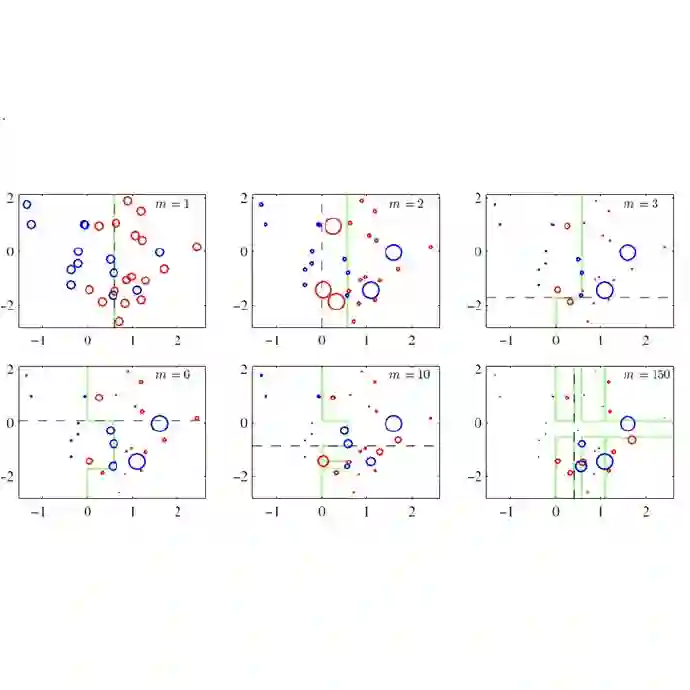
A new extremely simple ensemble-based model with the uniformly generated axis-parallel hyper-rectangles as base models (HRBM) is proposed. Two types of HRBMs are studied: closed rectangles and corners. The main idea behind HRBM is to consider and count training examples inside and outside each rectangle. It is proposed to incorporate HRBMs into the gradient boosting machine (GBM). Despite simplicity of HRBMs, it turns out that these simple base models allow us to construct effective ensemble-based models and avoid overfitting. A simple method for calculating optimal regularization parameters of the ensemble-based model, which can be modified in the explicit way at each iteration of GBM, is considered. Moreover, a new regularization called the "step height penalty" is studied in addition to the standard L1 and L2 regularizations. An extremely simple approach to the proposed ensemble-based model prediction interpretation by using the well-known method SHAP is proposed. It is shown that GBM with HRBM can be regarded as a model extending a set of interpretable models for explaining black-box models. Numerical experiments with real datasets illustrate the proposed GBM with HRBMs for regression and classification problems. Experiments also illustrate computational efficiency of the proposed SHAP modifications. The code of proposed algorithms implementing GBM with HRBM is publicly available.
翻译:提出了一种以均匀生成的轴平行超矩形为基模型(HRBM)的极简集成方法。研究了两种类型的HRBM:闭合矩形与角点矩形。HRBM的核心思想是统计各矩形内部及外部的训练样本数量。本文将HRBM集成至梯度提升机(GBM)框架中。尽管HRBM结构简单,但实验表明这些基模型可构建有效的集成模型并避免过拟合。本文提出一种可显式方式在GBM每轮迭代中修正的集成模型最优正则化参数计算方法。此外,在标准L1与L2正则化基础上,研究了名为"步高惩罚"的新型正则化策略。针对所提集成模型的预测解释问题,本文提出了一种基于知名SHAP方法的极简解决方案。研究表明,融合HRBM的GBM可视为扩展黑箱模型可解释模型集合的新框架。基于真实数据集的数值实验展示了所提GBM+HRBM在回归与分类问题上的性能,同时验证了所提SHAP改进方案的计算效率。本文提出的GBM+HRBM算法代码已公开。




相关内容




 微信扫码咨询专知VIP会员