

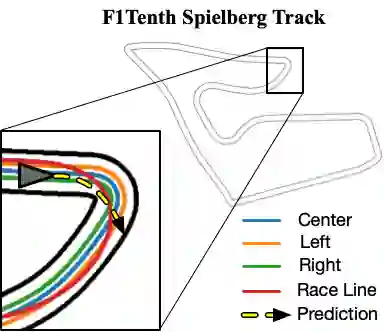
Uncertainty quantification and robustness to distribution shifts are important goals in machine learning and artificial intelligence. Although Bayesian Neural Networks (BNNs) allow for uncertainty in the predictions to be assessed, different sources of uncertainty are indistinguishable. We present Imprecise Bayesian Neural Networks (IBNNs); they generalize and overcome some of the drawbacks of standard BNNs. These latter are trained using a single prior and likelihood distributions, whereas IBNNs are trained using credal prior and likelihood sets. They allow to distinguish between aleatoric and epistemic uncertainties, and to quantify them. In addition, IBNNs are more robust than BNNs to prior and likelihood misspecification, and to distribution shift. They can also be used to compute sets of outcomes that enjoy probabilistic guarantees. We apply IBNNs to two case studies. One, for motion prediction in autonomous driving scenarios, and two, to model blood glucose and insulin dynamics for artificial pancreas control. We show that IBNNs performs better when compared to an ensemble of BNNs benchmark.
翻译:不确定性量化及对分布偏移的鲁棒性是机器学习与人工智能领域的重要目标。尽管贝叶斯神经网络(BNNs)能够评估预测中的不确定性,但不同来源的不确定性难以区分。我们提出不精确贝叶斯神经网络(IBNNs);该方法对标准BNN进行泛化并克服了其部分缺陷。标准BNN使用单一先验和似然分布训练,而IBNN则采用信度先验与似然集进行训练。这使得IBNN能够区分偶然不确定性与认知不确定性并对其进行量化。此外,IBNN对先验和似然的误设及分布偏移具有比BNN更强的鲁棒性,还可用于计算具有概率保证的结果集。我们将IBNN应用于两个案例研究:其一为自动驾驶场景中的运动预测,其二为人工胰腺控制中的血糖与胰岛素动力学建模。实验表明,与BNN集成基准相比,IBNN性能更优。




相关内容




 微信扫码咨询专知VIP会员