

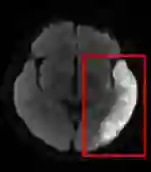
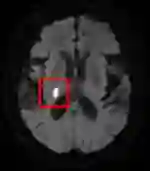
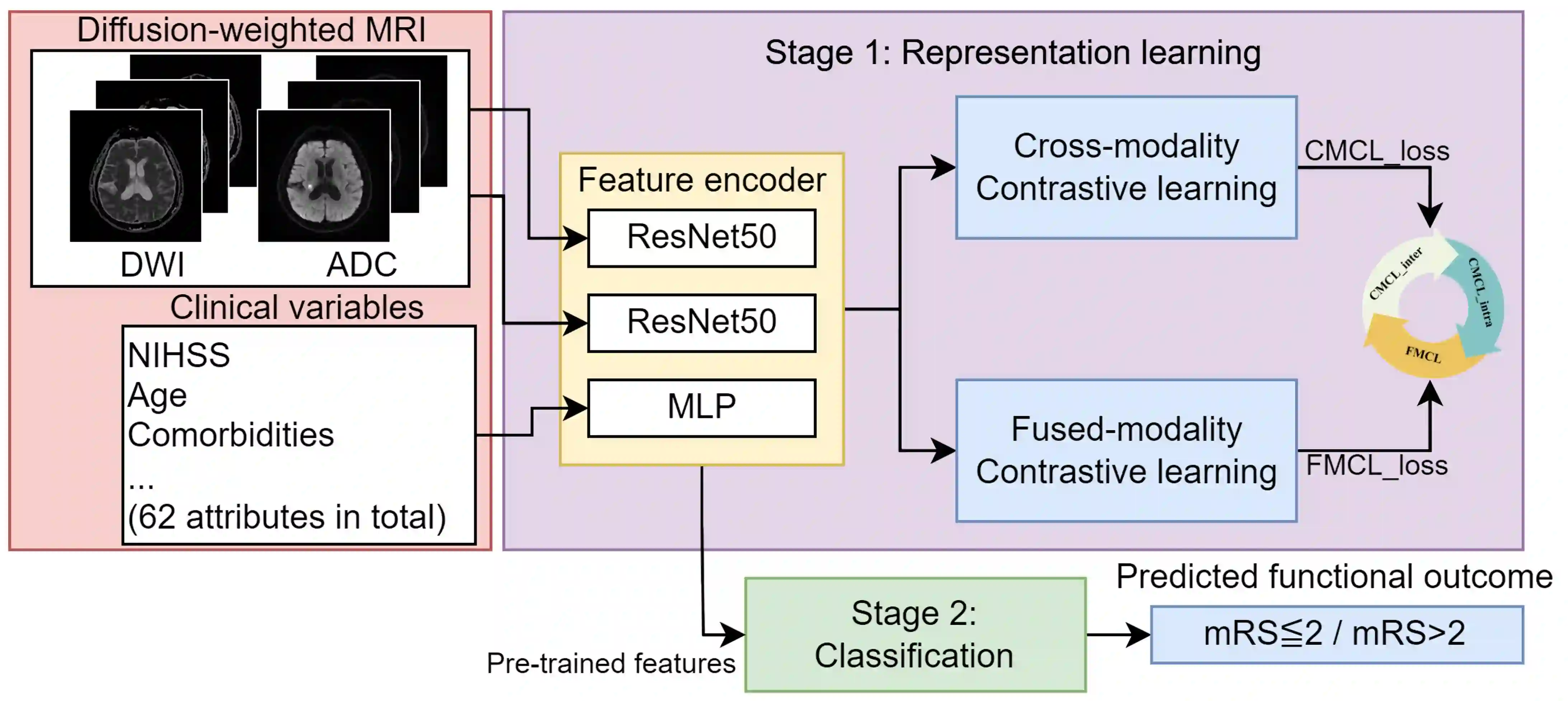
Stroke is a common disabling neurological condition that affects about one-quarter of the adult population over age 25; more than half of patients still have poor outcomes, such as permanent functional dependence or even death, after the onset of acute stroke. The aim of this study is to investigate the efficacy of diffusion-weighted MRI modalities combining with structured health profile on predicting the functional outcome to facilitate early intervention. A deep fusion learning network is proposed with two-stage training: the first stage focuses on cross-modality representation learning and the second stage on classification. Supervised contrastive learning is exploited to learn discriminative features that separate the two classes of patients from embeddings of individual modalities and from the fused multimodal embedding. The network takes as the input DWI and ADC images, and structured health profile data. The outcome is the prediction of the patient needing long-term care at 3 months after the onset of stroke. Trained and evaluated with a dataset of 3297 patients, our proposed fusion model achieves 0.87, 0.80 and 80.45% for AUC, F1-score and accuracy, respectively, outperforming existing models that consolidate both imaging and structured data in the medical domain. If trained with comprehensive clinical variables, including NIHSS and comorbidities, the gain from images on making accurate prediction is not considered substantial, but significant. However, diffusion-weighted MRI can replace NIHSS to achieve comparable level of accuracy combining with other readily available clinical variables for better generalization.
翻译:脑卒中是常见的致残性神经系统疾病,影响约四分之一25岁以上成年人群;超过半数患者在急性卒中发作后仍预后不良,表现为永久性功能依赖甚至死亡。本研究旨在探究弥散加权MRI模态与结构化健康档案联合应用对预测功能结局的有效性,以促进早期干预。本文提出一种两阶段训练的深度融合学习网络:第一阶段聚焦跨模态表征学习,第二阶段聚焦分类任务。通过监督对比学习,从各模态嵌入及融合多模态嵌入中学习区分两类患者的判别性特征。该网络输入包括DWI和ADC图像以及结构化健康档案数据,输出为卒中发作后3个月需长期护理的预测结果。基于3297例患者数据集的训练与评估显示,所提出的融合模型在AUC、F1分数和准确率上分别达到0.87、0.80和80.45%,优于医学领域整合影像与结构化数据的现有模型。若采用包含NIHSS评分及合并症在内的全面临床变量进行训练,影像对准确预测的增益虽不显著但仍具意义。然而,弥散加权MRI可替代NIHSS,与其他易获取临床变量联合使用时能达到相当的预测精度,从而提升模型泛化能力。




相关内容



 微信扫码咨询专知VIP会员